TWiT+ Club Shows 753 Transcript - Mikah's Crafting Corner #22
Please be advised that this transcript is AI-generated and may not be word-for-word. Time codes refer to the approximate times in the ad-free version of the show.
Mikah Sargent [00:00:00]:
This is twit. Welcome, welcome, welcome back. Yeah, there was something going on with the Discord event situation. I noticed that it wasn't on the calendar for today, so I think it will be back. I know that it's on the calendar for July, so I don't know what happens to today's. But it was gone. But worry not, because we are here now and we're here together. Yeah.
Mikah Sargent [00:00:35]:
I wonder if it's something I'm doing, to be honest. Hello, Joe. Welcome. Welcome to crafting. So here we are. It's time to craft. We are currently. There's my zoom one.
Mikah Sargent [00:00:59]:
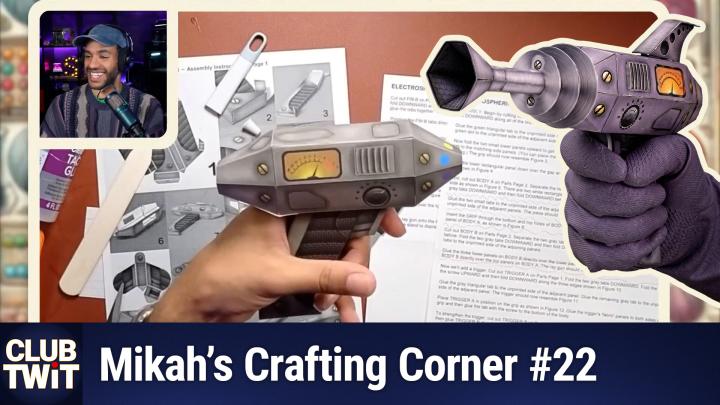
Ta da. So we have been trying to create this blaster and we've got the bag here that has the pieces, plus what we've done before today. If I give my little rings here. Put this over here. Yes. We will be doing our first Media club on Friday and I'm attempting to iterate in public a little bit. I'm thinking about giving folks the opportunity to participate sort of in the same way that book club is, in the sense of if it's sort of a. It's a vibe situation, is it not? And so, yes, Honestly, Joe, I did always see you participating in Media Club, so if you weren't there, I'd be a little sad.
Mikah Sargent [00:02:29]:
But yeah, we will. We'll sort of feel things out and see as we're going. And I think that's part of the fun is, you know, taking the opportunity to make it together with you all. Let's see. Timothy says I'm trying to craft places to store everything that I need to unpack. Moving is super annoying. Even more so when it's from a larger place to a smaller place. Yeah.
Mikah Sargent [00:02:58]:
I do not envy you the fact that you have to downsize. I can't imagine that being. Well, moving here already felt like downsizing a bit and has been a bit of downsizing and, you know, I sort of went into it kicking and screaming. So I feel for you. 2 foot wide n scale train model module based on the Transformers. Oh, my word. Is that paper mache? What are we working with there? Is that clay? Is that a special material? Oh, now I can see closer. Wow.
Mikah Sargent [00:03:47]:
It's a lot of mountain. Excuse me, plaster over insulation foam. It's very true, Timothy. A good time to figure out what you have that you really don't need. The thing that I found out I had that I really didn't need was an overactive Amazon subscribe and save because we would get, you know, detergent and whatever else and there was just a place to put the extra ones. And so I just kept getting, you know, we weren't using all of it. And I just kept putting the ones that would arrive into this closet and then walk to the closet when I needed a new one and pull from that. But the ones that were coming would go into the back.
Mikah Sargent [00:04:42]:
So basically, when it came time to move, there was this closet that was just filled with detergent pods and laundry detergent and, I don't know, cloth, cleaning spray, all sorts of stuff. Oh, okay. So you kind of bulk it up, Patrick, with. With newspaper. That makes sense. You know, I've seen people doing a lot with spray foam lately. They'll sort of spray in a general direction, put on gloves, wet their gloves, and then kind of sort of squirk it down and shape it, form it, zip it. Okay, now, Joe, is that a two part signature that you're working with there? Do you have to write twice or is it one pen that has two different colors, A color over black? And you do them piece by piece? It's not sort of taped together.
Mikah Sargent [00:06:07]:
Got it. I would do green on top. And I can see, you know, you're making choices about how the light is, in theory, hitting it. And that's where I don't trust myself. I don't trust my perception of. I don't trust my ability to translate my visual perception of light into a physical representation of light, if that makes sense. And so I find myself doubting my ability. And then I look at it and I go, why did I put that stroke underneath? That doesn't make any sense.
Mikah Sargent [00:06:52]:
The light's coming from this way, and I just spent way too long overthinking it. You know, Patrick says, I considered doing spray foam until a model railroading expert told me it's messy and it would be more round. But I wanted a rocky mountain and plaster sheets would work better. All right, let's see. Where were we? Yeah. When you're having a stroke, don't think too long about it. You're absolutely right. Time is essential in those situations.
Mikah Sargent [00:07:40]:
Joe, did you develop your signature over. Actually, I'll ask everyone here. How. How did your signature come about? Has it just sort of arrived naturally? Did you develop it over time? Has your signature changed over time, regardless of your desire to develop it? Also, forgive me for all of the handography that's going on here. Got lazy and just went with a big J. For me, the M in my signature was something that came about naturally. And then the rest of it I developed based off of The M being the way that I do my M, which is this little note card here. Oh, I don't have a good marker pen.
Mikah Sargent [00:08:43]:
Let's see. What else are people saying? Just my natural handwriting of my name. I got tired of cursive and just wrote my name very fast. My older signatures were every letter, and that was just tiring. Patrick says when I was about 10 or 12, I started trying to imitate my father's signature, which is a mess except for the T and the D. Now, mine is similar with P and T being the only legible characters. Lots of angles. So, yeah, mine, I guess starts.
Mikah Sargent [00:09:32]:
I think it's a little bit Patrick in the sense of the letters that matter. Let's see. You know, now I'm doing it on the spot so you could see the M. And that was how I would write if I was writing. You can see how I do my M's. So that I carried over. There's the I that's kind of there, and then it disappears. And the S sort of looks like a J if we're honest.
Mikah Sargent [00:10:07]:
But that's the S all the way into the final letters. All right, let's see. We gotta go back to our. Our paper craft, don't we? I suppose that is a form of crafting on paper. You know, same thing. All right, where are. Craft that corner. Cut body A on parts, page 2.
Mikah Sargent [00:10:58]:
Separate the two small tabs from the adjacent panels by cutting along one side as shown in Figure 5. There are two white rectangles with a red X. Remove both of these rectangles, fold all six gray tabs downward, and then fold downward between all 12 panels is what we did last time. Glue the two small tabs to the unprinted side of the adjacent panels and then glue the four remaining gray tabs to the unprinted side of the adjacent and panels. The piece should now resemble six. Did that last time. Insert the grip through the bottom and top holes of body A as shown in Figure 7. Glue the four blue tabs.
Mikah Sargent [00:12:04]:
Where are we glue? Now I've lost it. Where are the blue tabs? Yes. Okay, so here we go. Now, hang on. Because we haven't done that part. Ah, I see. So it needs to go through here. Now, when I first was doing this, I didn't realize that if this was a thing from the side, I thought this was on top.
Mikah Sargent [00:12:49]:
So that's pretty cool. So these pieces will go through here, And then they will glue down like this. Oh, I love. That's the best kind. Timothy. I don't the only cork. The only way to open a bottle of wine. Okay.
Mikah Sargent [00:13:24]:
No, I'm not gonna say that. There are people for whom it is very difficult to dexterity wise to open a bottle of wine. The way I like to open a bottle of wine is using a wine key. All right, so now what we'll do is we'll glue these pieces down with some tacky glue. But first, I must respond to this message. And so I will continue to communicate with you all while you tell me about the crafts you're working on. I'm sort of doing a little bit of a queen thing, but it's not very good, is it? Oh, nice. Thank you, Patrick.
Mikah Sargent [00:14:19]:
Oh, no, that's Paul. I thought that Patrick was sharing. Yes. And so where were we? All right, Do these piece by piece. Oh, my. Some here, this is what I get for now. Turning my tacky glue upside down. And we'll place that along the blue tabs, Like show.
Mikah Sargent [00:15:40]:
Oops. These tabs don't want to unfold. That's all right. I started watching this survival show on Netflix. It's a little silly. They mostly seem to be kind of survival influencers or other people who can spend multiple days away and it not affect their job. Is basically the category you need to be on the show because it's, you know, 30, 40 days. Anyway, it's not people that are technically qualified for survival and they are competing to win some portion of $1 million.
Mikah Sargent [00:16:41]:
The only rule is that you have to finish on a team, and that can be a team of two, but it still needs to be a team. So you will never make more than half a million. In any case, it was surprisingly more interesting than I was expecting. And some of the characters. Characters, yes. Certainly surprise you. I don't recall where I was going with that, but that is the show I'm watching right now. All right.
Mikah Sargent [00:17:19]:
Patrick says the plaster cloth has holes, so I'm going to coat it with a layer of spackle. Then I'll paint it in the same brown tan as the rocks. What painting for this? Will you be using an airbrush or is this large enough that you can use sort of a really moppy roller? After that, I'll add some grass trees around the base and glue down a tiny Optimus prime truck cab. Then I can attach the tracks and bring it to a train show to be displayed connected to other people's modules, which are usually boring things like a town or a farm or a train station and not the Autobots crashed spaceship from the 1984 cartoon series. I love that. Patrick, my next question for you is, how do you know that it will fit with other people's models? Is there a certain sort of template that you follow where as long as you have an input here and an output here, you can be next to this person and you all have like, special, I don't know, shirts that you wear? Everybody with a green shirt has an input here and an output there. Everybody in an orange shirt has an input in the northeast quadrant. I'm so curious about this.
Mikah Sargent [00:18:33]:
And Patrick is typing and we will get a follow up on that as we go. Patrick did say just acrylic paint from. For painting. It brushed on large brush for the base color and then details with the smaller brush. I can't remember if I showed you all some of the progress I made on the minis, although while I was working on this mini, it fell over. And you can see that the sword is now, Whoops, the sword has broken. She's holding a sword. Well, what I should say, she was holding a sword.
Mikah Sargent [00:19:20]:
Now she's holding a hilt. So that was a little frustrating. And then there's this one, which did not fall. So the fire has not broken because this one. Oh, and there's a little rat. Look at the little rat. It is not really in focus, but I don't think I can get that close. Yeah, but it does have a magnet on the.
Mikah Sargent [00:19:49]:
Well, you can't see it on here. It's a. The magnets in here. The metal plate is on the actual pad that I put these on, so it stays up and I need to get one for this 3D printed holder that I made. Okay, let's see what Patrick has said back. The base of the module is a uniform size. Anyone who makes a T track module follows the standard and has modules that are multiples of a certain size. Tracks are set a specific distance back from the front of the module.
Mikah Sargent [00:20:31]:
Those are my own prints. I've been looking at resin, but it's so, so much waste and like, mess and ventilation requirements. And if you, if you leave something behind, then you really have a huge mess left. By that, I mean, if I was in the middle of a 3D print and let's say the print failed, it'd be okay if I just was going, oh, some new ADHD thing has pulled my attention for a couple of days that I could come back to it. I could pull it apart. I could at the most need to sort of use the little poker to clear out the. The tip. Right.
Mikah Sargent [00:21:24]:
But with resin, you leave something and you just have a huge mess to clean up. So, yeah, I'm kind of. I want to get into it for the sake of the detail that can be captured. It's end up. It has ended up being that most of the things I'm interested in in this space do have that level of detail. But I. I'm not sure that I'm quite ready to tackle all of it yet. So it's on the list as a possibility.
Mikah Sargent [00:21:58]:
All right, back to our blaster here. That's doing quite well. Cut out body B on parts, page two. That's not the body. This is the body. The allergies have been really something lately and I ended up bringing out the big guns, Benadryl. And I forgot. I've forgotten just how much Benadryl is, how powerful Benadryl is.
Mikah Sargent [00:23:06]:
Anywho, so energy, energy, energy, energy. Let's go. All right, so cut out the body B. Exactly, Ben. A drowsy. Have you been a drowsy? Have been a drowsy. All right, cut out body B on parts, page 2. Separate the two gray tabs from the adjoining panels in the same manner as we did before.
Mikah Sargent [00:23:26]:
Fold the two gray tabs downward and then fold downward between all 12 panels. Glue the two gray tabs to the unprinted side of the adjoining panels. All right, So you may recall that I used the Cricut, which is the little cutting machine, to cut out all of these pieces, but decided to do. All of the scoring by hand. Just like John Williams. For anyone who's pointing or for anyone who's not watching. I was just pointing at the screen in sort of a if you get it, you get it way. All right, let's go ahead and start to.
Mikah Sargent [00:24:47]:
This shows a bunch of T track modules connected together. Okay, so that's more than one. Those are all different T track modules that were brought. And then tell me about the little bridge in the middle, because that doesn't look as secure. Well, I did try to bring up the image, but ecamm string does not want to accept it for some reason. Let me see. Did that work? There we go. Those trucks.
Mikah Sargent [00:25:49]:
I like the RV park sort of situation going on. That's cool. Patrick says some small ones with straight tracks. Then there's a 180 degree curve. They're supposed to connect right up next to each other, but I suspect they had trouble with something and used the short bridges to fix it. Understood. So sometimes you've just got to quickly correct it. Now, does that mean that those vehicles that are running along the bridge Are magnetic.
Mikah Sargent [00:26:19]:
Like, do they move or are those stationary? And it's just the train that has to move? Now, Paul is making API jokes in the chat. Those are crafted by hand, not by a large language model. I mean, the jokes, I can't speak for the API calls. All right, we're folding down. Have any of you ever considered getting into stand up? And just how quickly did you back away from that concept after thinking, you know, maybe that's something I could do because I had a moment and then I said, and this moment has passed? Timothy says, yes, I even bought a desk. Okay. I don't know if it's the Benadryl or my love of a good, good, good pun friend, but that was great. You know, but that.
Mikah Sargent [00:28:06]:
I think there's also just a little bit of truth in that, because, look, this is a stand up desk, but how often do I hit that button to make it stand up? Far less than my doctor would wish. Am I right? I see in the audience it's silent, and that's how I know that's not what I should be doing. I think you have to be an incredibly brave person to be willing to be that vulnerable on stage. I think. Let's see if mine has height memory. Oh, man. This could be. This could be nightmarish.
Mikah Sargent [00:29:21]:
Oh. Or. Oh, Yep. Okay. Nope, nope, nope, nope. Let's put that back down. Oh, okay. No cracking sounds.
Mikah Sargent [00:29:31]:
But something that I had put. I'll just show you. Oh, something I put over on the side of the bed on the side of the desk, which the reason I said bed is because it is a bed. That started to lift against the wall and because it has these anti slip dots on the back, it was kind of going up the wall. So. Yeah, none of that. None of that, please. It is a dog bed.
Mikah Sargent [00:30:18]:
I once I started doing the number of crafts that I do in here. In here, the dogs don't get to be inside of here because I've got thick shag carpeting underneath me for the echo. Well, to make less of an echo. And stuff gets in there. And then they all. They did they both just want to eat off of the floor and it's just nightmarish. So the dog bed, which was once down on the floor, is now to the side of the desk so that they don't feel like it's a good idea to come in here and sit down and start sniffing on the floor. Breaks my heart every time.
Mikah Sargent [00:31:02]:
All right, Just the side left it. What happened to Joe? Two different neighbors that I frequently see out on My nightly walks each have a female Bernese and I am trying so hard to get them to trust me enough to get some pets. But they seem very loyal to their masters and won't really trust me enough even after years. But I get most of my dog love from my neighbor's dogs. All right. It would be nice to pet one of those beautiful dogs. Should have a straight edge over here. It's about the only thing in this house that is.
Mikah Sargent [00:33:47]:
All right, there we go. Anyone working or has anyone. Because I know some of you are 3D printing folks curious if you've worked on any or printed out any kind of difficult or longer term prints, Sort of things that, you know, you get past a certain stage and you go, oh, please don't mess up at this point. Please don't mess up at this point. So close. We're almost there. Also, happy Pride month to those of you for whom that is of note. Patrick says my longest print was that spaceship in the train module.
Mikah Sargent [00:34:56]:
Took 24 hours. And it's only the back of it. Wow. Yeah. There was. I. I put something in the other day just curious and you know, sliced said 18 hours and I said, never mind. So I just finished printing.
Mikah Sargent [00:35:20]:
I just. Just a little display shelf that. Well, let me find it. So it printed in two beds here, two plates. I meant these two brackets printed on the plate and then these three shelves printed. I did not make this. It was a model that was available and it has the little locking joints here. But whoops.
Mikah Sargent [00:35:59]:
It is because I do have quite a few things in these shelves that would benefit from having some raised viewing. So this, this one is going to be used immediately for the Lego succulents and other plants. And then I'm going to see about using one here perhaps and maybe doing a little bit of rearranging. Unstable unicorn T shirt that has a unicorn barfing a rainbow. Whoa. Let's see. Paul, what was this? What is it? Okay, here we go. I had one project that I needed to know how to orient correctly.
Mikah Sargent [00:36:51]:
I made a lot of spaghetti until I got it, but it's only a three hour print. Got it. So it just kept messing up, Making it difficult. Ah. Attaches to the blender to hold a smoothie attachment. Is this that smoothie? That's. Is this that smoothie machine that I'm jealous of that makes like sorbets? Also, has anyone noticed the green PR40? Anodized green PR40. I need to get.
Mikah Sargent [00:37:37]:
I need to put the frame back in or the pop filter back in. But Aside from that, Patrick says I need to print two trains that are compatible with wooden train tracks. It's a tradition for my son to give them to his teachers at the end of the school year. They're personalized with his name and the years on one side and the teacher's name and room number on the other side. Cool. That's neat. All right, so we're back to our prints here. This one's a little bit more complicated.
Mikah Sargent [00:38:52]:
Okay. I might use glue dots on this. Actually, no, never mind. Worried if I use glue dots, it won't stay in the long run. Also, I apologize for the vocal fry there at the end. I had dropped. Well, there I go again. I had dropped register.
Mikah Sargent [00:39:25]:
It's the allergies. They do not leave for much dynamics in the voice. Also, it's apparent, apparently, my inclination to when my voice is tired, drop down into these lower registers. As you can hear, I keep doing it without thinking. That's the funny thing about when people misunderstand vocal fry. They think it's. It's. It's sort of.
Mikah Sargent [00:40:14]:
It's. It's the lack of dynamics in the voice. It's not. Dynamics. A high PR 22. I'm not sure I know that model, Patrick. But to be fair, I really only know the 40. Yay.
Mikah Sargent [00:41:15]:
I love it when the tacky glue is actually participating by being slightly tacky instead of being far too liquid. Glue. The three lower panels on body B directly over the lower panels on body A. Probably like that. Well, it did say lower. Yeah. Okay, so first we do lower, and then we do upper. Oh, that's a cool one.
Mikah Sargent [00:42:06]:
Oh, thank you, Paul, for showing me. I remember that microphone. We used to have those in theater class. Whoops. I'm sorry. I was gluing off screen, And the stage directions in this script did not call for that. So I do apologize. I would totally make that blue band green.
Mikah Sargent [00:42:50]:
Have I told you my favorite color? Leave it to Portland to have artisan anodizing solutions. Is. Is that like a livestrong band? I'm no enjoying how that's gluing. If I'm being perfectly frank, That's upsetting. O. Oh, that's really disappointing. An zine. Wow.
Mikah Sargent [00:44:17]:
I wouldn't even know the first thing about how that's pronounced. Oh, is this who you tried to show me? Who you were telling me about last time? Because. And I'm not saying that in a. In a shady way either. I'm saying shady, by the way, sensors shady. I'm not saying that in a shady way either. I'm saying that in a genuine. Is this the band that you tried to get me to listen to last time and I completely forgot, and so this time I'll actually do it.
Mikah Sargent [00:45:03]:
That's how I mean it. Yeah. This is very upsetting. I blame it on that tab not being precise. Folded tab, Y'. All. Part of the reason I like Papercraft is because it's very precise. And you know when you've done something correct because everything just lines up.
Mikah Sargent [00:45:46]:
So when it's not lining up. It's a little difficult here, a little hard to deal with. But remember, we've been trying to work on Good enough is Good enough. Oh, now, audio. Audibly unique. Sounds interesting to me. Something new, something different. I do think it just got to be about 200 degrees down here.
Mikah Sargent [00:46:52]:
Could also be the sweater I am wearing. All right, I'm feeling better about that. Good. And bump this music in the background where you can't hear it, but I can. 27 minutes and 53 seconds. All right, we shall continue. Oh, my goodness. Long nose.
Mikah Sargent [00:47:38]:
Okay. Is that. Were they saying their name? Here they go. How does I like that? The nose moves independently. Base. Do they? Okay, I know. I'm just gonna have to wait and find out. I am kind of living for the drummer.
Mikah Sargent [00:48:34]:
Yes. No's. Oh, painted foot. Is that why you wanted me to see this? You knew I'd hate that. Okay. Whiny electric moment. Squeak, squeak, squeak. Yes.
Mikah Sargent [00:49:08]:
I can only imagine if people are tuning into this having no idea what's going on. Micah Live reacts to On Jean Day something, but you can't hear the music. And that's what makes this a unique form of media. You just know that everyone who's tuning in on the other platforms besides Discord are going, is this what Twit has become? It's a crafting show now where he's weirdly dancing the music you can't hear. Okay, Speed it up. Honestly, there's a lot of footage in this. I'm not gonna lie. There's a lot of foot in this.
Mikah Sargent [00:50:14]:
Maybe like 20. 20 to 40% more than is needed for me to feel comfortable. That's not bad. It's not great, but it's not bad. Next, we're going to add the trigger. Thank you, Paul. I was. I was certainly being dramatic, so I appreciate the very kind response, but it is not bothering me that much.
Mikah Sargent [00:51:37]:
But it means a lot that you heard that and apologized. All right, I'm looking for the trigger. Found. Says to cut out the trigger on parts page One, fold the two gray tabs downward, Fold the tab with the screw upward, and then fold downward along the three edges shown in figure 10. So I know we can do these two grays downward. Oh, it's kind of fun. As they change songs, they're talking to each other in a different language, Shaking it out, doing their little triangle thing. Oh, I can see they didn't paint their elbows.
Mikah Sargent [00:53:21]:
As someone who paints their arms, face, arms, face, neck, etc, once a year for the DND campaign that I do for St. Jude, I could say I would also not paint up that far. Well, no, actually I can't say that because I would. But I understand why they didn't. It's annoying body paint and it gets all over everything. No matter what you do, no matter how much spray paint you put. I mean, excuse me, hairspray you put all over yourself to try to form a barrier. Now it says, it says to fold the tab with or.
Mikah Sargent [00:54:19]:
Here we go. Fold downward along the three edges shown in Figure 10. The problem is that Figure 10 in black and white here. So I've got to go back to the PDF to find it. And then we find the assembly instructions. There we go. So the three lines are left, right, and sort of at this diagonal. Okay, This one.
Mikah Sargent [00:55:48]:
Then we'll do this one. And then we'll do this one. I was just watching something that said that they're having to rethink the concept of major and minor scales in music because people are no longer inherently associating major scales with positivity and upbringing, you know, up, uplifting and minor scales with the opposite due to some modern music with minor scales included having sort of dancey vibes. And that, that, that club, like, nature of it makes what would otherwise be for. For others, I guess, sort of downward. It makes them feel more uplifted, it makes them feel positive. And so there's an argument that it is not an inherent thing, that you can play any chord and, you know, it's either up or it's down. Which is fascinating because I always thought, you know, it's just built in.
Mikah Sargent [00:58:00]:
Exactly. Timothy. Oh, no. Artists are being too experimental and causing a change of classic Western music theory feelings. It's absolutely true, I think. Yeah. The fact that it's. I always wanted to believe that it was one more thing that everyone just had in common where it's kind of like, despite our differences, music is a common language that we speak.
Mikah Sargent [00:58:27]:
And here are some examples. And I used to always consider that to be an example of a way to go across Cultures across different generations, we all share this common language of an understanding of the mood in music. But it turns out, no, it was just one of those things that there was enough of, there was enough training involved due to the way that our music was published that we built that into ourselves, as opposed to it being something that we came programmed with. All right, Fold the two tips downward. Fold the tab with the screw upward. And then. Okay, so we did that. Glue the gray triangular tab to the unprinted side of the adjacent panel.
Mikah Sargent [00:59:30]:
Okay. It. And that. Oh, let go. We'll go in there. A lot of glue. I think that'll be good, though. There we go.
Mikah Sargent [01:00:57]:
Aha. There we go. Now it resembles figure 11. Place the trigger in position on the grip as shown in Figure 12. Glue the trigger's fabric panels to both sides of the grip, and then glue the tab with the screw to the bottom of the body. So it should go like. And then. Here, like, so it.
Mikah Sargent [01:03:24]:
Wow. This actually comes with two of the trigger pieces. Yeah, we're starting to actually get a. A gun now. A ray gun. Pew, pew, pew, pew, pew, pew, pew, pew. All right, folks, I just noticed the time, which means that it is time for me to make dinner, which means that it also is time for me to say goodbye to all of you for one more month until we join each other once again for crafting time here on Micah's Crafting Corner. I hope you'll join me tomorrow for Tech News Weekly.
Mikah Sargent [01:04:04]:
I hope you'll join me Friday for the first Media Club, where we will be talking about the fifth Element. And then I hope you will join us again on Sunday for another recording session of Hands On Tech. All of that and more. And thank you so much to you wonderful supporters who are here with us and who are members of Club Twit. And if you aren't a member of Club Twit, check it out. Twitter, tv. Club Twit. Goodbye, good night, and I'll see you all tomorrow.
Mikah Sargent [01:04:49]:
Bye. Bye.