TWiT+ Club Shows 754 Transcript - Photo Time With Chris Marquardt #19
Please be advised that this transcript is AI-generated and may not be word-for-word. Time codes refer to the approximate times in the ad-free version of the show.
Leo Laporte [00:00:00]:
This is Twit. Hey, everybody. Time once again. And we took a month off, so it's definitely time once again for photo time with Chris Markquart joining us from the Viewfinder Villa in beautiful downtown Germany. Hello, Chris Markquart.
Chris Marquardt [00:00:19]:
Hello. Good to be back. I missed you.
Leo Laporte [00:00:22]:
We missed you. We missed you. But it gave us an extra month to be playful, so that wasn't so bad. Yep, that's good. Chris is a very, very talented photographer. Joins us usually every month in the club to do two things. One, to give you a photo assignment. Well, actually three things.
Leo Laporte [00:00:40]:
So one, to review the previous month's photo assignments. Two, to give you a new photo assignment. And three, we look at the news of the month and. Oh, four things. Because then we answer your questions, although you've none of you have any questions. So. But it's not too late. If you go to tftf.com ptq and you can see that on the screen right now, you can ask questions before the end of the show.
Leo Laporte [00:01:09]:
There's still an hour to do that. We only have an hour because in exactly one hour, it's Micah's Media Corner. What are we calling it? Micah's Media Club, because we have a book club. So it's Media Club and we're going to Micah's Media Club. This month is, by your vote, the Fifth Element. So if you've seen that movie or you want to talk about that movie, stay tuned. But right now, let's talk photography. First of all, condolences on the loss of your papa.
Leo Laporte [00:01:38]:
That's what kept us off the air for a month. Yeah, but I know that was a tough time for you, so we're glad you're.
Chris Marquardt [00:01:45]:
Yeah, it's. It's getting better. Yeah, on the way up again, for sure.
Leo Laporte [00:01:50]:
But now we have some exciting, playful pictures. And, you know, it's a perfect time of year to be playful. This is the waning days of spring, and this is 12 pictures. People submitted playful pictures. So you have picked three of them.
Chris Marquardt [00:02:10]:
No, no, I picked 1, 2, 3, 4, 5, 6 of them. Because we have a bit of catching up to do. And because it was months and so many good submission, I thought we'll do just a few more.
Leo Laporte [00:02:23]:
Yeah, there are some cute ones here I'm really enjoying.
Chris Marquardt [00:02:25]:
There's some really good stuff this time. So playful was the assignment, and I've picked six. And the first one is by. Let me check by Mitch xx. Mitch xx. Let me see if there's any information. We're at the beach where there's A tent. There's surfboards and someone's waving at the camera.
Leo Laporte [00:03:00]:
Maybe that's Mitch. Xx I don't know.
Chris Marquardt [00:03:03]:
Possibly. No, I guess Mitch probably took the
Leo Laporte [00:03:05]:
picture behind the camera. Yeah.
Chris Marquardt [00:03:07]:
But what I really love about this picture, not just that it's playful, is the repetition of colors. I mean, look at the, look at the orange in the tent. The orange in the surfboards. The orange in the, in the. What's one of those life vests on the left? Yeah. And then you have the gray in the surfboards that is mirrored in the, in the water and in the sky. And then there's this outlier, this pink bag on the, on the ground which kind of sticks out. And a friendly person and the whole.
Chris Marquardt [00:03:39]:
I, I love it when, when it, when it feels like there is something coordinated in this picture. And in this case there is color coordination. Maybe on accident, maybe on purpose. I mean, these are the kind of things I look out for when I'm. When I'm taking pictures.
Leo Laporte [00:03:55]:
These are. I could tell because it says it on the tent. Stand up paddle boards.
Chris Marquardt [00:04:00]:
Yes.
Leo Laporte [00:04:01]:
So this is. I'm always a great admirer of people who can balance on top of a surfboard and paddle along. And that's what these people are about to do. And obviously that guy's got a scooter, so he knows how to balance. I don't understand what step stools are for. Maybe to get up on the surfboards. I don't know.
Chris Marquardt [00:04:22]:
Or maybe to sit down and put your, I don't know, your neoprene clothes.
Leo Laporte [00:04:27]:
Oh, that's probably it.
Chris Marquardt [00:04:28]:
Yeah.
Leo Laporte [00:04:28]:
To put on the.
Chris Marquardt [00:04:28]:
Possibly.
Leo Laporte [00:04:29]:
Sure.
Chris Marquardt [00:04:30]:
Anyway, playful. For sure. Okay, next one is by Ron Hikes 816 titled Central Park.
Leo Laporte [00:04:40]:
Well, there's always playful things going on in Central Park.
Chris Marquardt [00:04:43]:
That's not just that, but again, again, the, There's a, there's a color, color coordination thing going on because we see cherry blossoms or are those magnolia blossoms or Magnolia. Oh, magnolia, you're right, those are magnolia. They are. They are pinkish. And then there's someone underneath who's also pink.
Leo Laporte [00:05:07]:
Pink shirt, very pretty.
Chris Marquardt [00:05:10]:
So color coordination. And I love the shapes the branches make. It has something like a fairy tale kind of thing going on there. So cool. Lovely. Very playful. Love it.
Leo Laporte [00:05:25]:
Wonderful Werner Herzog movie called Perfect Days. And the protagonist in the movie, it seems his one and only hobby is taking pictures of tree branches.
Chris Marquardt [00:05:36]:
Yeah.
Leo Laporte [00:05:37]:
And he has boxes and boxes of tree branch pictures. They are beautiful. And everyone's unique and different. So. Yep, it's fun.
Chris Marquardt [00:05:43]:
Absolutely.
Leo Laporte [00:05:44]:
Yeah.
Chris Marquardt [00:05:45]:
So third picture is by Jane McFarland jumping from the boat in Turks and. What's that?
Leo Laporte [00:05:58]:
Oh, that is. That is great. It looks like she's walking on water.
Chris Marquardt [00:06:01]:
It's. It's a forced perspective thing going on. Of course she's jumping and she's right in the air, but at the same time, it looks like she's a giant walking on the horizon. I mean, that's, that's just optical illusion.
Leo Laporte [00:06:15]:
What a lovely photo.
Chris Marquardt [00:06:17]:
Absolutely.
Leo Laporte [00:06:18]:
Yeah.
Chris Marquardt [00:06:19]:
So, yeah, she's.
Leo Laporte [00:06:21]:
She's timing is everything, isn't it?
Chris Marquardt [00:06:23]:
Absolutely.
Leo Laporte [00:06:24]:
Yeah. I know photographers who will wait all day knowing within their mind's eye that at some point there's going to be something.
Chris Marquardt [00:06:33]:
I mean, you can plan these things with like a celestial body, the sun or the moon. There's apps that can tell you when.
Leo Laporte [00:06:39]:
Ephemeris.
Chris Marquardt [00:06:40]:
It's going to be somewhere. Photographers, Ephemeris or photo. Photo pills or something. But this you can't plan. You have to just. Well done, spray and pray.
Leo Laporte [00:06:50]:
Now I'm. Now I'm curious. I'm gonna look at The EXIF, Apple iPhone 17 Pro. Max. Look at that. Yeah, look at that. That's pretty amazing.
Chris Marquardt [00:07:03]:
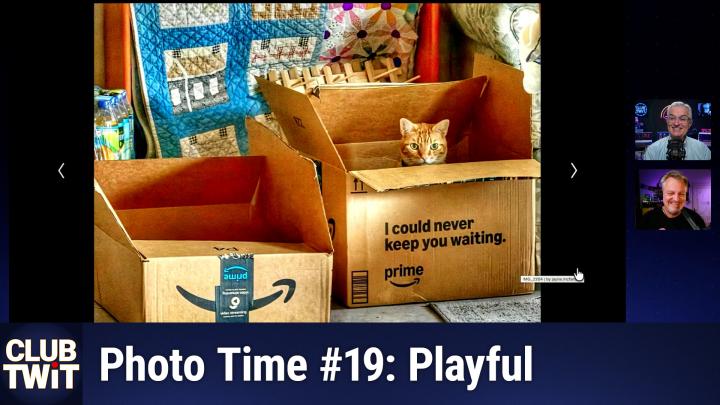
It is. It is pretty amazing. It is pretty amazing. So, and then RB19 has a delivery from Amazon.
Leo Laporte [00:07:14]:
That's fun. Oh, and look what he got.
Chris Marquardt [00:07:19]:
A new cat delivered.
Leo Laporte [00:07:21]:
This is another one where the climbers harmonize.
Chris Marquardt [00:07:24]:
There's color coordination. What I again, even, even like the, the, the. The prime sticker and the, the quilt in the back. Yeah, they, they have a match, the cat and the boxes, of course.
Leo Laporte [00:07:36]:
So that's a great shot.
Chris Marquardt [00:07:38]:
I love this. And then, of course, hey, cats and boxes. I mean, that's what she gets.
Leo Laporte [00:07:42]:
Who doesn't love cats and boxes?
Chris Marquardt [00:07:44]:
Exactly.
Leo Laporte [00:07:45]:
So Chris and I are both cat lovers.
Chris Marquardt [00:07:50]:
Yeah, cats. Cats are awesome. Yeah, cats are absolutely awesome. So. Yeah, well done. Well, well done.
Leo Laporte [00:07:56]:
That's pretty funny.
Chris Marquardt [00:07:58]:
So the next one is by someone on this side of the screen.
Leo Laporte [00:08:04]:
Oh, it's a Marquardt. Marquardt original.
Chris Marquardt [00:08:08]:
Absolutely. Because. Because I was near the Baltic Sea on a vacation and there's these rental scooters. You definitely have them too. And someone parked it there and hung a dandelion chain off of the. Love it off of the handlebar. So it was one of these unexpected little finds. And when I, when I saw this, I thought to myself, hey, that's a playful picture.
Chris Marquardt [00:08:40]:
I'll have to submit that.
Leo Laporte [00:08:42]:
You know, sometimes the picture submits itself.
Chris Marquardt [00:08:47]:
In that case. Absolutely has a bit of a bit of the charm of old European roads, you know. That's an iPhone shot.
Leo Laporte [00:08:54]:
Yeah, another iPhone shot. It's the camera.
Chris Marquardt [00:08:57]:
You have the color. The bright yellow from the dandelions are. Again, there's a bit of repetition in the. In the bar.
Leo Laporte [00:09:05]:
Very playful on that. Yeah.
Chris Marquardt [00:09:07]:
Of the scooter. So. Yeah, that's it. And then I came across another shot which I chose without seeing who submitted that.
Leo Laporte [00:09:16]:
See who submitted it. I want to insist that you never knew who submitted this.
Chris Marquardt [00:09:22]:
It's this other guy here on the show. And that play, you're actually playing a game. Someone in play. They're playing a game with. What's that? Softball? No, it's not baseball.
Leo Laporte [00:09:38]:
It's called the stickball in the stick ball. So it's a very. One of the little bat and a what my dad used to call a pensy pinky ball. It's just a little rubber ball. And actually the backstory of this is that's the Petaluma fire department. Those are firemen in the field there. And it was a little. Little pickup game in the street front of the fire department.
Leo Laporte [00:10:00]:
So that was kind of fun.
Chris Marquardt [00:10:02]:
Very cool. Very. And. And. And I mean, focus is where it needs to be. So even though the background is kind of busy, it's out of focus, so it just fits nicely. I love the light coming from behind. You can see this at the.
Chris Marquardt [00:10:17]:
At the edge of the. Of the head of the. Of the shirt of the arm of the bat. Gives you nice little. A good and nice separation, you know.
Leo Laporte [00:10:29]:
Supposed to tear me apart, Chris.
Chris Marquardt [00:10:32]:
No, it's a good photo. It's a good photo. Even the ball is where. Where. Where. It's. Where it's nicely distinguished from the background. It could.
Chris Marquardt [00:10:39]:
Could as well have been in front of that black door, and then you wouldn't see it, you know?
Leo Laporte [00:10:43]:
So I'll tell you, this was not easy because this was a shot with my very, very fast nocturnal.
Chris Marquardt [00:10:50]:
Oh, yeah, they are super fast.
Leo Laporte [00:10:52]:
And in order to get this, man, I mean, focus is so shallow.
Chris Marquardt [00:10:58]:
Did you get a bit of a burst there, or is it a single shot?
Leo Laporte [00:11:00]:
No, no, because it's a range finder with no bursting.
Chris Marquardt [00:11:06]:
That's an E. That's. That's. That's. That's photo economy. That is very economic, what you did there. One shot, and you nailed it.
Leo Laporte [00:11:14]:
1 4,000th. Although I do have a. Because it is so fast, and I like to shoot when I have a F. 0.95. Yeah, I like to shoot it at 0.95 because why else? So that, of course, has to have a neutral density filter on it. And I have a variable one, so I can turn it up and down. But this is bright sunlight. So even though I have it turned all the way up, I still had to shoot it at 1 4,000th.
Leo Laporte [00:11:39]:
But that's good because it froze the ball.
Chris Marquardt [00:11:41]:
That's what you get.
Leo Laporte [00:11:43]:
Yep.
Chris Marquardt [00:11:44]:
No, awesome, awesome job.
Leo Laporte [00:11:46]:
So. No, no, I'm very proud of that.
Chris Marquardt [00:11:48]:
Shred this to bits.
Leo Laporte [00:11:49]:
It's good. It's good. I have to practice with this Noctilux because it is not. First of all, it's rangefinder camera with super fast lens
Chris Marquardt [00:11:59]:
deluxe there. It's kind of in the name. That's not necessarily a daytime lens.
Leo Laporte [00:12:04]:
I know.
Chris Marquardt [00:12:05]:
It's more a nocturnal lens, you know, but I.
Leo Laporte [00:12:08]:
What I like is a super shallow depth of field that you get with 0.9.
Chris Marquardt [00:12:13]:
Oh, yes, right, yes. And. And, and the Leica bokeh is very pretty. As creamy as it gets.
Leo Laporte [00:12:21]:
Yeah.
Chris Marquardt [00:12:21]:
So that's one. That's one of the things you pay for with Leica lenses is that legendary bokeh, that legendary creamy, out of focus background. Yeah.
Leo Laporte [00:12:35]:
Yes, I agree. Somebody likes the shadows on the kid. That was kind of. Those came out very crisp too. It's kind of nice. Pretty fortuitous. This was actually at a fair in Petaluma and I walked all over, actually, a parade. It was our butter and eggs day.
Chris Marquardt [00:12:52]:
Oh, that one. Okay. I remember you talking about this earlier.
Leo Laporte [00:12:56]:
Once a year, it's a big deal. Lots of people. And I walked all over trying to get the perfect picture. And I have to say, the first 20 I shot were I had to throw out because I was still trying to figure out how to get that Noctilux to actually work. They were either highly blurry or they were.
Chris Marquardt [00:13:13]:
I mean, the thing with photography is there's several kinds of friction. And the creative friction that comes from the equipment is often a good thing because it forces you to try out, to experiment, to think outside the box.
Leo Laporte [00:13:31]:
And normally I'm not looking for something for the assignment because I don't want to compete with people, but when I took that, I said, well, I think that's playful.
Chris Marquardt [00:13:42]:
It's not completely one of us.
Leo Laporte [00:13:47]:
Anyway, thank you, all of you for submitting. Yes. Great fun. Really. I can see why you had to pick six.
Chris Marquardt [00:13:53]:
Yeah, that's really, really good stuff. So maybe, maybe we should do it every other month from now on just because of the.
Leo Laporte [00:14:00]:
Give us some time.
Chris Marquardt [00:14:01]:
No, we don't. No, we don't.
Leo Laporte [00:14:03]:
Well, you know, what's next? We go to the bowl of fish. Actually, it's the bowl of adjectives.
Chris Marquardt [00:14:10]:
The bowl of adjectives. And I will draw one from the depths of the bowl and it. Oh, yeah, it is.
Leo Laporte [00:14:21]:
Yes, Coastal. Now, this is gonna pose a problem for people who live inland.
Chris Marquardt [00:14:28]:
No, this does not pose a problem. This is a creative challenge. This will get everyone who's not near a coast to either take a short vacation or to. To become. To get thinking about how to do this. How could we. As opposed to. Oh, no, that's too hard.
Chris Marquardt [00:14:50]:
That's the question. How could I make a coastal picture work without being near a coast?
Leo Laporte [00:14:58]:
Coastal or Costco.
Chris Marquardt [00:15:02]:
It could be Costco if you shuffle. If you make some permutations, there might be a Costco in there.
Leo Laporte [00:15:11]:
That's. Wait.
Chris Marquardt [00:15:12]:
Oh, hey, I'm pretty sure there's fish markets. There's, you know.
Leo Laporte [00:15:16]:
Yeah, coastal could be. You could be coasting. There's all sorts of things. That's the point is this is just a word. It's up to you.
Chris Marquardt [00:15:23]:
That's where you start to work that noodle a bit.
Leo Laporte [00:15:27]:
And now here's how this is going to work. You will have four weeks to take pictures illustrating the idea, the concept, coastal, whatever that means to you. If you find one, as Chris and I did, that shouts coastal to you. Here's what you do. And by the way, we want you to take new pictures. This is the whole point of. This is not fame, fortune, it's not the glory that you're going to get. It is to get you out there taking pictures.
Leo Laporte [00:15:54]:
So take some new ones. You can submit up to one per week. So you have a chance to submit up to four photos. What does that mean, to submit it? Well, you upload it to flickr.com it's a free photo sharing site that we very much love. And you'll have to create an account, but it is free, as I said. And then once you upload it, you can add tags to it. In this case, we want you to tag it with the assignment. So we know that you're submitting it for the assignment.
Leo Laporte [00:16:22]:
And the way that works is you tag it TG for tech guy, because that's the name of the group we're going to be in. And Coastal. So take your picture, tag it tg, Coastal. And then there's one remaining step. You got to go to the tech guy group. Now you'll know you're in the right place when you go to the tech guy group because there's a picture of me. And there are 9,000 people in the group. Many, many images they used to show.
Leo Laporte [00:16:53]:
How many images? That's interesting that they don't. Oh, I see. I'm. I, I see. That's. This is it. That. There you go.
Chris Marquardt [00:16:59]:
This. Yeah. There's more than 9,000 followers.
Leo Laporte [00:17:02]:
14,000 members. That's how many followers I have. I'm sorry. Seven. Almost 8,000 photos. Let's make it 8,000 by the next show. 385 discussions. You will also see Nabui, who is somebody named Chris Marquardt.
Chris Marquardt [00:17:18]:
I think it's me.
Leo Laporte [00:17:20]:
N U B U I. That's Chris's Flickr handle. We'll put the information about the next show there. And our moderator, the wonderful Renee Zimmerman, will. So what is her. I just gave her the wrong name.
Chris Marquardt [00:17:34]:
Silverman.
Leo Laporte [00:17:34]:
Silverman. Renee Silverman, not Zimmerman. It's been too much Dylan last week. And that's.
Chris Marquardt [00:17:40]:
You guys use that.
Leo Laporte [00:17:41]:
Yeah. Renee Silverman will welcome you into the group and she will accept your photo. You see all these great pictures. We have so many good images here. I love these. And by the way, you're all winners. They're all great. Submit those photos with TG Playful.
Leo Laporte [00:17:57]:
So once you upload it to Flickr, you can submit it to a group. You want to submit it to the tech guy group? You have to be a member, I think. So join the group as well. And we will take a look at all of the submissions next month.
Chris Marquardt [00:18:11]:
And you can submit one per week.
Leo Laporte [00:18:13]:
Yeah. So four up to four brand new photos. They must be taken from this date forward. All right. Okay. Now the news.
Chris Marquardt [00:18:29]:
The news.
Leo Laporte [00:18:30]:
Yeah.
Chris Marquardt [00:18:31]:
It was tough to look through the last two months and find new. Well, it wasn't tough to find new things. It was just tough to decide what is important. Let's start with something that I think is the most important one of all of them. Canon has finally fixed their dust caps. Finally.
Leo Laporte [00:18:52]:
I didn't know there was something wrong with them.
Chris Marquardt [00:18:55]:
Anyone who owns a Canon mirrorless camera with an RF mount, the dust cap that goes on the back of the lens used to only go on in one specific position. You remember the old EF lenses where you could put that thing on in three different spots? Like, you just had to wiggle it a bit. And it was on with the RF mount. You had to turn it. Exactly. There was a marker. Just super annoying, really. One of the most annoying things I've ever seen because they had that solved before.
Chris Marquardt [00:19:30]:
They had a good solution before and someone didn't get the memo. And so they have now changed the design of their desk caps. You can buy new ones. I think they're eight or nine bucks.
Leo Laporte [00:19:45]:
So this is not the lens cap. This is the thing in the back.
Chris Marquardt [00:19:47]:
It's the dust cap. It's the back of. In the back of the lens.
Leo Laporte [00:19:50]:
So when you take off the lens.
Chris Marquardt [00:19:52]:
Yes. And again, this is. This was one of the most annoying things of that new system. And now it's fixed.
Leo Laporte [00:19:59]:
I mean, that's so funny.
Chris Marquardt [00:20:01]:
That's good news. That's very good news. That is.
Leo Laporte [00:20:04]:
And if you're gonna buy it, you know, go to Petapixel because they probably get a little bit of money off of it if you buy it there. Probably. Yeah, probably. Affiliate link. Yeah, because we love.
Chris Marquardt [00:20:15]:
This was really the biggest head shaker ever. Why on earth did they make this worse?
Leo Laporte [00:20:22]:
That's hysterical.
Chris Marquardt [00:20:24]:
That's probably the new guy or something. But hey, a new guy.
Leo Laporte [00:20:27]:
A new guy. He thought, I just always want the Canon logo to be upright.
Chris Marquardt [00:20:33]:
I guess that might have been.
Leo Laporte [00:20:35]:
Sure.
Chris Marquardt [00:20:35]:
A reason we might never find out. Maybe in a documentary in 10 years. All right, first, first piece of real news. Apple has made announcements around Mac OS 27, iOS 27 and so on on their WWDC. And I just picked three things or four things actually from the. The photography related lineup. And the first is. Well, the first is new tools in the Photos app have been announced.
Chris Marquardt [00:21:13]:
I have not installed any of the betas. You might have probably. I guess not.
Leo Laporte [00:21:19]:
I. No, we do have.
Chris Marquardt [00:21:20]:
You haven't. Okay.
Leo Laporte [00:21:22]:
No, I did. I stay away from developer betas, especially the first one because they're often. Yeah, first one crashy. I will almost. Because I really want to try the new Siri. So I will almost undoubtedly install the first public beta in July.
Chris Marquardt [00:21:36]:
Yeah, me just not wrong. Anyway, so the Photos app is getting three new tools or. Well, first of all, the cleanup tool gets an improvement. You know the cleanup tool where you can take smudges off the picture or
Leo Laporte [00:21:53]:
take people out of the picture?
Chris Marquardt [00:21:54]:
Well, it used to be more like a smudge replacement removal thing because it needs to fill in what was behind the smudge. And it was. It was okay. It was decent, but not perfect. That gets a big upgrade. Apparently you can now take entire people out and the background gets just filled in and kind of like the demos
Leo Laporte [00:22:17]:
been doing for the last few years.
Chris Marquardt [00:22:19]:
Yeah, it's nothing new, but it's good that they are also getting that into the Photos app, making it better. So. Yeah. Cool. Nice. Second tool player, they're adding an extend tool which Means you can just extend the picture on all sides up to 25% as like if you framed it weird. Or you need to make a different crop and we don't have enough stuff on the picture.
Leo Laporte [00:22:52]:
The other tools call outfill.
Chris Marquardt [00:22:56]:
AI has been like stable diffusion. And all the, all the tools have done this for, yeah, three, four years now. So it's again, nothing new. But hey, good that it's there. It's like, you know, like if you rotate a picture and then you lose too much from the sky and you can just fill it in. I, I would expect that to work decently well. The third feature had a very interesting demo. It looked good and they called it spatial reframing.
Chris Marquardt [00:23:32]:
Imagine you take a picture and you come home and you realize, oh, there is a branch, a tree branch growing out of someone's head and it looks weird. I wish I would have stood more to the left. This tool, they claim, can do that. So they do an analysis of the depth analysis of the picture. Pretty much what they do with making a picture spatial. So they make that picture into like a 3D representation and then they let you rotate things so that you could, after the fact, change your own position from where you took the picture. And the demo looked decent.
Leo Laporte [00:24:22]:
It's interesting for sure.
Chris Marquardt [00:24:23]:
It is a technology demo. That's very interesting. I just have a few questions. The first one is I've heard people who tried it that it looks very synthetic.
Leo Laporte [00:24:38]:
Yeah.
Chris Marquardt [00:24:39]:
So not the quality, at least in this early version, doesn't seem to be there. And the second one, and I think that's a valid argument. How many people, how many non photographers do you know who don't care about
Leo Laporte [00:24:58]:
these kind of things?
Chris Marquardt [00:25:00]:
I mean, people. Do people crop their photos, non photographers. No, they don't.
Leo Laporte [00:25:05]:
The person smack dab in the middle and that's that.
Chris Marquardt [00:25:08]:
Do they wipe, do they wipe their smartphone lenses before they take them?
Leo Laporte [00:25:13]:
Never.
Chris Marquardt [00:25:13]:
No, they don't.
Leo Laporte [00:25:15]:
Which is why Google at least, and I think Apple started doing this from time to time, will say, your lens is smooched.
Chris Marquardt [00:25:21]:
You need to clean it. So. So it's it. I have my doubts that this is gonna get a lot of use. It's a cool tech demo for sure, and may. And maybe the availability of the tool will also teach people that that is something they might want to look into. I just don't think they will.
Leo Laporte [00:25:44]:
Yeah, I.
Chris Marquardt [00:25:46]:
Most people won't. And if it doesn't look that good, then most photographers will also. Maybe it's a teaching tool. As in, you see how Bad it looks. And that makes you compose your pictures better from then on so you don't have to use it. Maybe, I don't know.
Leo Laporte [00:26:07]:
It really works best if you have been. If you're using the burst mode because it doesn't have information about what's behind that thing or if you change perspective, you know what's going on back there. So if you have a photo, use the other photos in your burst mode. Will it? Okay. Yeah. Or actually Christina Warren showed us and she said she was doing the live photo, which also takes multiple photos.
Chris Marquardt [00:26:32]:
Okay.
Leo Laporte [00:26:33]:
And so because I asked her, I said, well, that's interesting. You reframed the photo and there's stuff that was hidden that is now visible. How does it, how do it know? And she said, well, it's a live photo and it captured the stuff behind the railing.
Chris Marquardt [00:26:51]:
It's good to know that it takes that additional information into account.
Leo Laporte [00:26:54]:
And it did make up some things.
Chris Marquardt [00:26:58]:
That is exactly what happens with just filling things in. And that's what the diffusion models do anyway. It's interesting.
Leo Laporte [00:27:10]:
Yeah.
Chris Marquardt [00:27:11]:
Find the hidden person behind your subject. Make that into a game of sorts.
Leo Laporte [00:27:19]:
My general reaction to this was A, Google's been doing it better in all these cases for a while. I don't know about the new perspective reframing thing. I've never seen that before. But Google and Adobe and others are doing all those other things. And B, as is often the case, Samsung always is announcing weird new photo capabilities in their phones. You use it at least. My experience was you use it a few times. Oh, that's interesting.
Leo Laporte [00:27:44]:
And then you never use it again.
Chris Marquardt [00:27:46]:
How much, what do you think? How much Nano Banana is in there?
Leo Laporte [00:27:50]:
Ah, that's a good question because they did really upgrade the Playground. Yeah, they're definitely. They say they're not. It's not Nano Banana, it's not Gemini. Of course, it's our models with a little help from Google. It's really unclear what they're doing, but I have to say looking at Image Playground, which is up to now been terrible, I mean, just stuff you would never want to use. The new Image Playground looks just like Nano Banana. It's very good in creating images.
Leo Laporte [00:28:23]:
So I have to think, yeah, there's
Chris Marquardt [00:28:25]:
some, it must be some of that
Leo Laporte [00:28:27]:
Nano Banana in there. You can't train a model with Nano Banana and get that kind of quality. You have to actually use Nano Banana. So I think it's unclear, but I think Google, some of the Google models have been white labeled for Apple's use. So that Apple can say it's ours. That's just my guess. Apple's not saying.
Chris Marquardt [00:28:49]:
And the one thing that came out a bit later is an under the hood change, which is Apple raw 9.
Leo Laporte [00:28:59]:
I didn't know there were 8 others.
Chris Marquardt [00:29:03]:
So this was the first time I saw a chart of the timelines from when to when it was apple raw 1, 2, 3.
Leo Laporte [00:29:11]:
This is a RAW format from Apple.
Chris Marquardt [00:29:14]:
It's not. It's their processing, it's. They do what the system does. So if a RAW photo comes in to the whole pipeline, there are lots of steps it has to go, you
Leo Laporte [00:29:26]:
have to process it.
Chris Marquardt [00:29:27]:
There's denoising, there's denoising, mosaicing, there's a whole lot of massaging going on to make that into a photo. And that pipeline has been updated every now and then. And the last time it was updated to RAW 8 was about 10 years ago. And since then they haven't really touched it, so. Which means also they have fallen behind in quality. RAW processing, Apple's RAW processing. Others have become better in terms of image quality and they have now updated or they will update with, with the 27 versions to RAW 9. Which makes it better, which makes the processing better.
Chris Marquardt [00:30:13]:
There's one, it's one better, it goes to 11. So they have more, better noise reduction, more detail, restructure, recreation. There's a lot of AI and stuff in there for sure. So they will. I'm not sure. I mean the examples they've shot they showed in, in one of their sessions looked very impressive. Like very noisy pictures for a long time, detail recovered there.
Leo Laporte [00:30:39]:
People would have an opinion whether Apple Camera RAW or Adobe Camera RAW was the best. Yeah, There are other RAW processors, but Adobe is probably the best known. It's the one I, Camera RAW probably hasn't been updated since they killed Aperture because that's.
Chris Marquardt [00:30:57]:
Well, for 10 years. It hasn't been updated for about 10 years. That's what they said.
Leo Laporte [00:31:01]:
And then I guess there's other RAW processors we've talked about last week, last time we talked about Photo Mechanic. I think it has its own RAW processor. The thing people need to understand is that a RAW image straight out of the camera doesn't look like the picture at all.
Chris Marquardt [00:31:22]:
No, no.
Leo Laporte [00:31:23]:
In fact, I don't even think it has color.
Chris Marquardt [00:31:27]:
Not really. It's weird looking. So the sensor. Well, let's start with this. Let's do this. Let's start with the sensor. The sensor is a grid of photosensitive pixels, right. And there is what's called a Bayer array on top of it, some Mr.
Chris Marquardt [00:31:43]:
Bayer from Kodak, I think invented that. And what they do is it's a red, green, blue grid. So some of the pixels see the light that comes into the blue filter. Some of the pixels see light that comes in through the yellow, through the red filters and through the green filters. So you have three black and white photos pretty much. And then that needs to be processed into the full picture. And that's part of what the pipeline does. But then all these color channels have different noise levels that needs to be processed separately and different cameras have different geometries in those pixels.
Chris Marquardt [00:32:25]:
So the Bayer array and then there's other configurations. So there's a lot of know how that goes into that. And the whole processing chains have become better with almost all RAW processors just Apple was kind of standing still there.
Leo Laporte [00:32:45]:
When you shoot with a camera that does raw actually I guess all cameras start with raw.
Chris Marquardt [00:32:52]:
Most of them do, yeah.
Leo Laporte [00:32:53]:
But many of them will make a JPEG for the thumbnail anyway so that there's something you can see. Because if you do pixel peeping on the back, you have, you wouldn't want to see the RAW picture. You want to see something like a picture.
Chris Marquardt [00:33:07]:
You want something that's developed, that's what they call it.
Leo Laporte [00:33:09]:
So all cameras have that capability to create JPEGs. And frequently when you upload your photos from your fancy camera to Apple Photos or somewhere else, Apple will just display the JPEG because that everyone sidecar because it's faster, it's fast what comes along with it. But generally it's not as good and it's not as editable as the original raw. So what you kind of want to do, the problem is it requires post processing and every, every time is take that image, run it through something like Photo Mechanic or Adobe's Bridge or Apple,
Chris Marquardt [00:33:44]:
or have it automatically taken care of by whatever you chose as a filter in Apple Photo. So, but, but, but the promise is with Apple RAW 9 coming in, the 27OSS noise will be better, detail will be better.
Leo Laporte [00:34:00]:
And does this mean the JPEGs will be better?
Chris Marquardt [00:34:02]:
Yes, yes. And it works for old pictures. It works like for your entire catalog. It also works for third party pictures. So if you have your Canon RAWS or your Nikon raws, those will be also processed through Apple RAW and be better. I had this experience years ago, you remember when panorama stitching became a thing and you could throw in four or five pictures and I would, would combine them into panorama. I had a picture of a room that never stitched in the early days. But I didn't throw away the RAW picture, the source pictures.
Chris Marquardt [00:34:36]:
And then 10 years later I threw them in the then modern, more modern panorama stitcher and it did it without. It just went through. So I was so glad I didn't throw away my old pictures. That might be a similar situation where you have old pictures that are like very noisy and don't look good and you throw them in there and they come out nicely polished.
Leo Laporte [00:34:57]:
So on my, on my Leica with two memory cards, and this is probably true of a lot of cameras, I store the JPEGs on one and the RAWs on the other. And the reason is I don't want Apple Photos or some other program to. Without letting me know, just take the JPEGs. I want to make sure that when I and I use Apple Photos to copy my photos, I want to make sure it's getting just the raws. If it wants to make a JPEG sidecar, that's fine. And in fact, this would argue for that because it's going to do a better job probably than the camera, right?
Chris Marquardt [00:35:31]:
It will probably do a better job, yes.
Leo Laporte [00:35:33]:
Maybe not. Leicas are probably pretty good, but they don't have the processors, they don't have
Chris Marquardt [00:35:36]:
the, you know, maybe the Leica JPEGs are better because Leica did the processing on them and they know their raws very well. Possibly you're possibly going, not the.
Leo Laporte [00:35:49]:
Well, you know what I actually do most of the time, so sometimes I can just pop the SD card copy from there. Now I'm just getting the raw. But when, when the Leica Photos app asks me, because that's the other time I do it is wirelessly with the Photos app. I will always say RAW+JPEG so that I have two images. It's kind of annoying, but I have two images in Apple and Apple Photos has gotten pretty smart about combining them and saying, oh, here's an image. But you have both a raw. And so that sounds like that was the smart thing to do is as long as you can keep the raw, as long as you have the storage, because it'll get better. Software always gets better.
Chris Marquardt [00:36:24]:
Yeah, that might be one of those cases. So I'm looking forward to looking at a few old pictures and go, ooh, didn't see that.
Leo Laporte [00:36:31]:
I hope I have the, like the old, you know, when I was shooting Canon and was shooting Sony, I hope I saved all those raws. I think I did. You know, it's funny, Flickr doesn't keep the raw. I don't think. I don't think SmugMug does. You can pay them to, but they don't give you storage for raws because they're so big. And so most online services I think just keep the JPEGs. So find out it's worth.
Chris Marquardt [00:36:57]:
We will find out. Yeah, we will find out. All right, next item is a tool that I ran across that I haven't really tried it yet, but I've seen people use it. Have you ever had an old scanner that fell out of support? Like you have that usb plug it in, but there's no driver anymore because your operating system is too modern. Scanner makers are notorious for not updating their drivers after a while. So what do you do? Well, you could get an app like View Scan which supports.
Leo Laporte [00:37:31]:
Yeah, that's been around forever.
Chris Marquardt [00:37:32]:
I don't know, 800 scanners, but that's tough to use. This kind of.
Leo Laporte [00:37:37]:
That's what I used to recommend on the radio show because it's awesome.
Chris Marquardt [00:37:40]:
But it requires you to know a lot about scanning or you do you go to yesweescan app. Yes, we scan app. So what does that do?
Leo Laporte [00:37:52]:
Oh, it's a web app.
Chris Marquardt [00:37:54]:
Well, it's more than that. It's really interesting. You need to run this in a Chromium based browser.
Leo Laporte [00:38:01]:
There's a technology called Web usb. I've used it to update my pixel. You can actually connect to devices from the browser.
Chris Marquardt [00:38:09]:
You can connect those old scanners. But what it does in the browser now comes the crazy thing. It runs a virtual machine in the browser that runs a Linux operating system and that runs sane. That's an open source scanner access software. So it runs an entire computer inside the browser on your computer. That runs sane, short for Scanner Access now easy. And that supports a ton of scanners. Old stuff.
Chris Marquardt [00:38:45]:
It's open source, but you don't have the hassle. You don't have to install a Linux. You don't have to install and fiddle with ports and drivers and stuff. No, you run this in your browser and it does all that for you inside of the browser. Is that wild?
Leo Laporte [00:39:01]:
This is brilliant. This is a reason to keep Chrome around, by the way. Works on Mac, Windows, Chromebook and on Linux everywhere. But if you. Linux is funny because if you have SANE already installed, you have to stop it and then. Exactly, it'll conflict. This is great.
Chris Marquardt [00:39:19]:
I don't know what functionality will exactly be surfaced by sane. I guess it depends on what the support is in SANE for that specific browser scanner. But hey, it's worth a shot. It doesn't cost you anything. It's open source and it. I do. I have three scanners that I can't use anymore. Yeah, I need to run those through.
Leo Laporte [00:39:44]:
I'm going to steal this from you for Mac Break Weekly. This is really.
Chris Marquardt [00:39:47]:
Go ahead and do that.
Leo Laporte [00:39:48]:
I'll give you credit. But this is a really good tool.
Chris Marquardt [00:39:51]:
But try it first. Maybe, maybe it's crap. I haven't really tried it myself. I only heard people use it and like it, but I haven't really tested it thoroughly.
Leo Laporte [00:40:00]:
I've gotten rid of all those old scanners because they wouldn't work anymore.
Chris Marquardt [00:40:03]:
That's a problem. On the bottom of that page, I think there's a link to printervention app which does the same thing for printers.
Leo Laporte [00:40:15]:
Oh, oh, same idea. It probably launches cups.
Chris Marquardt [00:40:21]:
I have not tried this. I think it does something else.
Leo Laporte [00:40:24]:
Yeah, it launches cups and goods. Print. Wow. So it does another little. You know, this is going to spawn a whole bunch of different little tools you can do. Spawn a little Linux virtual machine. You can run that. That's cool.
Chris Marquardt [00:40:39]:
I mean, just the thought of having an actual virtual machine running inside your web browser. I mean, Chromium is an operating system. Let's face it. It's more than just a web browser.
Leo Laporte [00:40:52]:
It just shows you how much chromium. That's crazy. Yeah. And you do need Chromium to do this because Firefox will not.
Chris Marquardt [00:40:59]:
Yes.
Leo Laporte [00:41:00]:
Wow. That's wild. Printervention. And yes, we scan. Yes, we scan app. Wow. Yeah.
Chris Marquardt [00:41:11]:
So one more thing. Now this is. This is the nerd corner. I want to talk about something that really, really made me go, wow. So there's a. There's a. There's a YouTuber calls himself Alpha Phoenix. He's a.
Chris Marquardt [00:41:32]:
He's a. He's a. He's a programmer. He's a. An electronics guy. He built a camera in his garage that runs 2 billion frames per second and shows you the proper amount of light to be billion. With a B in his garage, that can show you how light propagates through a room. He has a setup with a laser that bounces back and forth between mirrors and you can see that light go through his garage.
Chris Marquardt [00:42:03]:
So here's the thing.
Leo Laporte [00:42:05]:
Talk about super slow mo. Holy cow.
Chris Marquardt [00:42:09]:
From a technology point of view, the camera really does 2 billion frames per second, but only on one pixel. Oh, that's the problem. But what he does is just imagine you fire that thing. You capture it with 2 billion frames per second, and then you fire it again and again and again. And if the Timing is right. You capture that entire motion for that one pixel. Now he has a mirror that scans that camera view across like a virtual screen. So it pretty much builds that video from single pixels and a movable mirror.
Chris Marquardt [00:42:59]:
And the result is a 720p HD video of that laser bouncing between slight moving. It's, it's so crazy. And especially that he built that in his garage with an oscilloscope and a light amplification tube and I don't even know 200ft of coax cable to, to delay some signals. So the timing is right.
Leo Laporte [00:43:25]:
It's just crazy.
Chris Marquardt [00:43:28]:
It is crazy. It, it's like half of it is over my head. But I find this cool. That's the kind of stuff that I really like.
Leo Laporte [00:43:41]:
I'll throw in one more story that's cool and very sci fi. You know Mid Journey, right?
Chris Marquardt [00:43:49]:
Yes. Oh, their new announcement.
Leo Laporte [00:43:53]:
Their new announcement. So Midjourney is a very good image generation tool. We like it, we've used it for a long time. I mean I think nanobanana has kind of eclipsed it is probably what sent Midjourney out looking for something else to do. And they have now launched a medical division. What? Well, it turns out AI imaging can also be used for other things. In this case it's an ultrasound. They have built one, they want to license these to people all over the country so that you would have this.
Leo Laporte [00:44:31]:
It's the equivalent of an mri, but instead of being magnetic resonance, it's ultrasound. So this woman's being submersed in a, in a tank of water and there. But now remember, Mid Journey is an AI company, so what they're going to do is create a image of her just like, it's just like an MRI image of her using sound. So it's actually in some ways safer. If you had a pacemaker, you wouldn't have to worry about the magnet magnetics, you know, field being created around you. And it looks pretty good. I mean this is their video. So I don't know.
Leo Laporte [00:45:09]:
They've got the first one built in San Francisco and they hope to sell a bunch of these to the same kinds of clinics that do, you know mri, like prenova that do mri.
Chris Marquardt [00:45:24]:
I've looked a bit into it.
Leo Laporte [00:45:25]:
What do you think? Crazy,
Chris Marquardt [00:45:29]:
A bit, a bit overhyped. I think the technology is there. The reconstruction from scattered ultrasound into a picture is possible. That's already being done. But the resolution isn't nearly as good as they claim. It's not an MRI at this point. I think more like body composition and rough organ shapes. So the sub millimeter resolution that they claim is some thing that they say should be there in 2031.
Chris Marquardt [00:46:03]:
But if you look, if you look at the medical, the medical, the processes to get something like this approved. Yeah, not that fast, I think, but it's plausible that this will work in some capacity. It's interesting because it's a question how good it is. Like, ultrasound doesn't do well with air, so your lungs, you can't look into those with ultrasound. That's obviously why she submitted bones scatter. Ultrasound. So takes a lot of processing. I mean, the thing that their AI does well is tickle out information from diffuse clouds of noise.
Chris Marquardt [00:46:48]:
Right. So. And that's what we're looking at here. So it is plausible that it works. I'm not just not sure the speed of progress is going to be as fast as they claim it is.
Leo Laporte [00:47:01]:
You can see why they're working on it because of course, their chief selling point has been kind of eclipsed by the frontier companies like Google. So they've got to find something else to do with their AI technology. And that's their plan. I just thought I'd throw that one. Since you did a nerd corner, I'll do a nerd nerd corner.
Chris Marquardt [00:47:23]:
Totally, totally cool. When I saw this yesterday, I had the exact same reaction. I was like, awesome, right? It's very plausible. And then I looked into it and it's like, okay, we probably not surprised that they're a bit too positive. But of course, hey, they want to sell this. Of course.
Leo Laporte [00:47:38]:
Right?
Chris Marquardt [00:47:39]:
It's cool. It's cool. And they need data, so they need this to be in use.
Leo Laporte [00:47:44]:
Right.
Chris Marquardt [00:47:44]:
So they need people to use it. And even if it's just a 60 second body composition, how much fat, how much lean tissue do I have kind of thing that would still be kind of cool, I guess they're trying to get.
Leo Laporte [00:48:01]:
That scan isn't quite so accurate, I imagine. Right.
Chris Marquardt [00:48:04]:
I think they're trying to get this flywheel going with data collection and so on.
Leo Laporte [00:48:09]:
Yeah, that's what you need in all of these machine learning situations where the data is fuzzy. The AI can learn to make concrete things out of the fuzzy data, but it needs lots of training.
Chris Marquardt [00:48:22]:
Yes.
Leo Laporte [00:48:23]:
And so we're gonna have to submerge you all into liquids.
Chris Marquardt [00:48:27]:
Hey, if they make, in the video, they make this look like a really nice spa experience with warm water.
Leo Laporte [00:48:33]:
And you know, there are reasons. I mean, the mri, if you've ever had an mri, is kind of scary.
Chris Marquardt [00:48:40]:
If you're Claustrophobic. That's not for you. No, it's a.
Leo Laporte [00:48:43]:
It's a tight little tube. If you're overweight, they have to have special tubes for overweight people. And it's. What I didn't know is it's noisy as heck. There's lots of big banging sounds.
Chris Marquardt [00:48:55]:
So it's kind of scary rhythmic. It's almost musical in a way, in a very loud way. More like heavy metal.
Leo Laporte [00:49:03]:
We did. Lisa and I did the Pre Nouveau, which is, you know, kind of voluntary. You pay a lot of money and they'll do an MRI scan for you. Doctors hate these, by the way, because they say they find things, everybody has something wrong with them. There's no normal person, and they find things. And then the problem is once you find it, you've kind of got to pursue it, even if it's not a problem. Doctors say, we'd really rather wait till you had a symptom and then we can pursue it. Sometimes learning things is not a good.
Leo Laporte [00:49:35]:
It's not a good thing. And you end up doing unnecessary, sometimes even dangerous procedures. So there's some.
Chris Marquardt [00:49:42]:
So we have no questions. But I have one last thing that I want to show you.
Leo Laporte [00:49:49]:
Yes.
Chris Marquardt [00:49:52]:
I'm currently process of finishing up my latest book.
Leo Laporte [00:49:55]:
Oh, good.
Chris Marquardt [00:49:59]:
It's about what happens before you take a picture.
Leo Laporte [00:50:03]:
Oh, in your noggin.
Chris Marquardt [00:50:06]:
Yes, yes, yes. It's about creativity.
Leo Laporte [00:50:08]:
It's about visualization.
Chris Marquardt [00:50:10]:
It's also about condensing down your images because you have a lot of images, but bringing them together and taking out the ones that don't tell the story, that don't help is a really important and good exercise. Right. So a photo album or something that does only contains the important ones, the good ones, the ones that help tell the story is a good thing. And here's a tool that will help you. Do you know what a zine is?
Leo Laporte [00:50:45]:
I do. From back in the old days where you had a mimeograph machine and cut scissors and you'd.
Chris Marquardt [00:50:51]:
Exactly. Zines have this rebellious counterculture kind of background. You know, it's publishing something that doesn't see any gatekeepers, no publisher, galleries at the Internet.
Leo Laporte [00:51:07]:
It was.
Chris Marquardt [00:51:08]:
Imagine. Imagine you could make, easily make a little photo zine of your own. Of your own. You might have a laser printer at home or an inkjet, or you might have a copy shop in town or a library where you can go print something. All you need to do is. Okay, so there's a website, okay. It's called dirtylittlezine.com and what it is is it helps you prepare a PDF of an eight page zine. So if you put me on the screen for a second, what you'll end up with.
Chris Marquardt [00:51:51]:
That tool is free. You can use it. You throw your images in and then what you do is it arranges them for you in a specific order and that's your zine. So what you do is you fold it once, you fold it twice, you fold it again. So that makes eight little rectangles. Doesn't matter if it's a four or us letter or whatever format. It doesn't matter. So you have this and then you fold it over and you make one cut.
Leo Laporte [00:52:24]:
Okay. And it tells you where to cut it. Okay.
Chris Marquardt [00:52:27]:
It tells you where to cut it. There's.
Leo Laporte [00:52:30]:
All right.
Chris Marquardt [00:52:30]:
And now if you fold this over and you squeeze that cut part out, you end up with a zine. A little zine. Eight pages. One front page. Two, three. I'm using a spread here. Four, five.
Leo Laporte [00:52:48]:
I gotta do this.
Chris Marquardt [00:52:50]:
Six, seven, eight. You can put a QR code on there, you can put title on there. And then of course you have like, if it's only folded, you have these double pages that have the back of the page looking through. If you want to make this a bit more polished, you'll take a glue stick and glue it together, cut the corners, and then you end up with something that is a proper little booklet.
Leo Laporte [00:53:19]:
I love this. You've made a little eight piece photography
Chris Marquardt [00:53:22]:
and it forced you to think about what eight pictures work well together.
Leo Laporte [00:53:28]:
Oh, I like that.
Chris Marquardt [00:53:29]:
Because you don't want to just jumble your photos in there. No, you want a little zine with. With a story.
Leo Laporte [00:53:38]:
This is dirty little zine. Look, he made. You apparently gone all in on the zines. Holy camoly.
Chris Marquardt [00:53:45]:
The thing is, once you made once, it teaches you to make choices. It teaches you to narrow things down. Yeah, and I have it down to a T. Takes me with the printing, the folding, the gluing and everything. Takes me three minutes to make one of these.
Leo Laporte [00:54:06]:
Oh, I love that.
Chris Marquardt [00:54:08]:
It's so amazing.
Leo Laporte [00:54:09]:
What a good idea.
Chris Marquardt [00:54:10]:
The other thing it does is it doesn't just teach you to boil down your collection into groups that work together. It also gets photography out of. From behind the glass. You know, we have photography either on our phones, our iPads, our picture frames. And that makes you. That makes you touch, gives it into people's hands, which makes it much less precious. These things make awesome gifts because they are very personal. You can swap them, you can give them away.
Leo Laporte [00:54:48]:
Now you have obviously a Good grayscale printer and a good color printer. What are your printers?
Chris Marquardt [00:54:54]:
No, it's just. It's just color. It's a Canon color laser printer. It's not a special photo printer and I'd rather use that. It's not perfect. If you look at the grading, it's okay at that size. It wouldn't be okay at a full page picture. It is decent.
Chris Marquardt [00:55:18]:
I've seen better photo prints. But again, it takes that preciousness out of the photography. It makes it accessible. It makes it something that you can just leave on a table and people will play with it and look at the photos and browse. It's a browsing thing.
Leo Laporte [00:55:34]:
The tool is dirty little Zine. Z I N E dot com.
Chris Marquardt [00:55:39]:
Yes. Drag and drop. You throw in your pictures. You can change the fonts. Go play with it.
Leo Laporte [00:55:48]:
Now, I only have a monochrome laser printer, so maybe I'll do one bit, A one bit zine.
Chris Marquardt [00:55:54]:
That is fine. It can also put other stuff. It doesn't have to be photos, of course. You can put your little, I don't know, shopping list in there or something, I guess.
Leo Laporte [00:56:04]:
Scary omen in our YouTube chat says, Zine's a great present to my customers after a shoot. He's a photographer.
Chris Marquardt [00:56:10]:
I guess it's totally, absolutely right. Yeah. I've also looked deeper into this. I'm now making even smaller ones, but with 16 pages.
Leo Laporte [00:56:21]:
That was the one from one G5 or A4.
Chris Marquardt [00:56:25]:
That's an A4. That's like US letter.
Leo Laporte [00:56:28]:
Yeah. And you can choose from a 5, a 4 and US letter on their website.
Chris Marquardt [00:56:34]:
The thing, the thing is if, if you don't have a printer at home, libraries have printers. Prepare 5, 5 zines as PDFs, bring them to a library or a copy shop and just do it. Yeah, they absolutely can do that and take them home and play with it. It's a format. It's playful. It's playful. It's like the, like the assignment. It's very playful.
Leo Laporte [00:56:58]:
I'm going to do this. I can't wait.
Chris Marquardt [00:57:00]:
Wonderful.
Leo Laporte [00:57:01]:
Micah, who is getting ready because in one minute we're going to do Micah's media. I'm done, I'm done club. He said, my friend made me a couple of these for Christmas. So that's really cool. I love this. Chris Marquardt is@discoverthetopfloor.com that's where his workshops are. Are you going to do the stuff for Christmas again this year?
Chris Marquardt [00:57:25]:
I'm still debating. I have a lot of other things going on right now, including. Including the book and so on.
Leo Laporte [00:57:30]:
So it's discoverthetopfloor.com is where we'll all.
Chris Marquardt [00:57:35]:
Yes.
Leo Laporte [00:57:35]:
And of course, our new assignment is coastal. So you have four weeks to find out when we're going to do this. If you're in the club, of course, you can check the schedule, the calendar, but you can also go to Flickr. And the tech guy group will have the next event as soon as we figure out a date for that. And we will get together, we'll put
Chris Marquardt [00:57:54]:
it on the Flickr page.
Leo Laporte [00:57:55]:
We'll put it on the Flickr page. Says new buoy. Thank you, Chris Marquardt.
Chris Marquardt [00:58:00]:
Thank you.
Leo Laporte [00:58:01]:
Good to see you. Alfred Zane, my friend. Thank you to all the club members who make this show possible. And now, without further ado, I am going to leave the stage because it's time for Micah's Media Club. Thank you, Chris. Thank you, everybody. Anthony, should we stay here or. We're gonna stay here.
Chris Marquardt [00:58:20]:
Yeah.
Leo Laporte [00:58:20]:
Okay, So I will.
Chris Marquardt [00:58:21]:
But I will. For everyone else. The stream's gonna come down.
Leo Laporte [00:58:25]:
It'll come back up. Yeah, but for you, Leo, it's the same thing. Okay. Okay. So the stream. We're going to redo the stream. Condolences from James Page, Chris, and others. He says digging the show.
Leo Laporte [00:58:39]:
Usually a security, now tech listener only. This is a welcome break after a long week. Yeah, I love to do this. We do this every month, so we'll do more of this. Thank you. B. Jones. Scary omen.
Leo Laporte [00:58:48]:
All the club members, we'll be back next month. It's a good reason to join the club. All these special events are all paid for by club members because there's no advertising. Thank you, Chris. Take care. Twit TV club. Twit. And now, without further ado, in moments, you will be asked to refresh your feed because Micah Sargent.
Leo Laporte [00:59:11]:
Well, look at that. He's already here.
Chris Marquardt [00:59:14]:
Whoa.
Leo Laporte [00:59:15]:
Multipass.
Chris Marquardt [00:59:17]:
Multipass.
Leo Laporte [00:59:18]:
Multipass. He's doing his Jojo. Jojo. Vitz.
Chris Marquardt [00:59:23]:
Jojo. Siwa.
Leo Laporte [00:59:24]:
Jojo. Yo, Yo. Jojo. Ho. Hovitz. That's her. Lilo. All right.
Leo Laporte [00:59:32]:
Thank you, Chris. Take care.
Chris Marquardt [00:59:33]:
All right, Bye.
Leo Laporte [00:59:34]:
Bye. Bye, Chris. The rest of you, stay tuned.