Windows Weekly 1005 Transcript
Please be advised that this transcript is AI-generated and may not be word-for-word. Time codes refer to the approximate times in the ad-free version of the show.
Leo Laporte [00:00:00]:
It's time for Windows Weekly. Paul and Richard are here. We have lots to talk about, including what Paul feels like was a very confusing Windows event last week. AI comes to Epic Games, and a lot of people aren't so happy about that. And more than 1,000 fixes in Patch Tuesday. Microsoft's at it again. All that and more coming up next on Windows Weekly. Podcasts you love.
TWiT.tv [00:00:31]:
From people you trust. This is TWiT.
Leo Laporte [00:00:41]:
This is Windows Weekly with Paul Thurrott and Richard Campbell, episode 1005, recorded Wednesday, October 14th, 2026. Nicely frosted. It's time for Windows Weekly, the show where we talk about the latest news from Microsoft. And these guys have thoughts, believe it or not. They are, as far as I can tell, conscious entities.
Paul Thurrott [00:01:04]:
It's easier to believe if you don't see us.
Leo Laporte [00:01:05]:
They appear on my monitor every Wednesday. I don't know, could they be real? Could they be AI? We don't know. What am I?
Richard Campbell [00:01:14]:
I've been very unreliable now. I missed 2 shows in 3 weeks. You know, goodness. Yeah.
Leo Laporte [00:01:19]:
AI never got a colonoscopy.
Richard Campbell [00:01:23]:
Also, maybe it should because there's a lot of polyps up there, you know.
Leo Laporte [00:01:26]:
One of the things to clean out is the return of Richard Campbell, long, long missed return of Richard Campbell from Run As Radio. He's in British Columbia. And to his right, my left, no, my right, his left, Paul Theriot of theriot.com. Actually, you're right. Anyway, who cares? In the middle.
Paul Thurrott [00:01:47]:
What
Leo Laporte [00:01:48]:
are you doing? The bologna in the middle of these 2 pieces of white bread. Mr. Paul Theroux from theroux.com. We're gonna slather them with mayonnaise and fry them up good.
Richard Campbell [00:01:58]:
Hey, I'm happy to be the bottom bun in this. That's good.
Paul Thurrott [00:02:02]:
Wow. Also, I prefer mustard, but bologna I'm okay with.
Leo Laporte [00:02:05]:
Mustard on bologna?
Richard Campbell [00:02:07]:
Oh, absolutely.
Leo Laporte [00:02:09]:
Oh, it's gotta be American mustard.
Paul Thurrott [00:02:10]:
The yellower the better. No, just the— Just gonna lowball it.
Richard Campbell [00:02:14]:
Now I'm hungry.
Leo Laporte [00:02:16]:
Now I'm hungry. All right. Uh, hello everybody, welcome to Witness Weekly. I don't know what's happening. We're a little punchy today for no apparent reason.
Paul Thurrott [00:02:25]:
Oh no, there's a reason, Leo. Oh,
Leo Laporte [00:02:26]:
well, that's
Paul Thurrott [00:02:27]:
because you, sir, are— no, it's because, um,
Leo Laporte [00:02:30]:
something weird happened last week.
Paul Thurrott [00:02:33]:
A lot of weird things happened last week. We have— I, I want to say it's like 3 kind of major stories, but they're not in a way individual stories. They're almost just some sets of events or whatever. So I'm not gonna do the best one up top. I know that's kind of non-intuitive, but—
Speaker E [00:02:51]:
See, lay out a calendar. This is out. New calendar. Unbelievable. Within 24 hours.
Leo Laporte [00:02:56]:
David Spade had something to say. Sorry about that. I'm muting him now.
Paul Thurrott [00:03:00]:
That's all right. I was thinking, I was thinking it was, I couldn't think of his name, the guy from Kid in the Hall, but yeah, no, it's David Spade.
Leo Laporte [00:03:04]:
Yeah.
Paul Thurrott [00:03:05]:
Yeah.
Leo Laporte [00:03:05]:
Sorry. Okay, all my buttons are going crazy.
Paul Thurrott [00:03:08]:
The Hollywood Minute, David Spade, or whatever that was. Um, okay, okay, now I'm really distracted. Uh, okay, okay, okay, okay, okay, okay, okay, okay, okay, here's the deal. They screw you at the drive-up. No, um, so, so last week, uh, there was a Windows event, and I'm gonna call it a Windows event because that's what Microsoft called it, but they actually talked about like 127 different things, and it was very confusing. In fact, If you're not— if you weren't confused by this, um, you might want to see a psychiatrist. But also, um, look at the description for the video on YouTube and look at the, the table of contents, and you can see it goes all over the place. Like, it just goes back and forth.
Paul Thurrott [00:03:43]:
Like, it's like a, a ping-pong of just topics, you know.
Leo Laporte [00:03:48]:
Did you— you didn't go to New York for that, or did you?
Paul Thurrott [00:03:51]:
No, no, no. This happened right before we did Windows Weekly last week. So— oh,
Leo Laporte [00:03:54]:
okay. And that's my fault.
Paul Thurrott [00:03:57]:
No, no, no, I wouldn't. There's no way I would travel for this anyway. But the, um, but,
Leo Laporte [00:04:04]:
but
Paul Thurrott [00:04:04]:
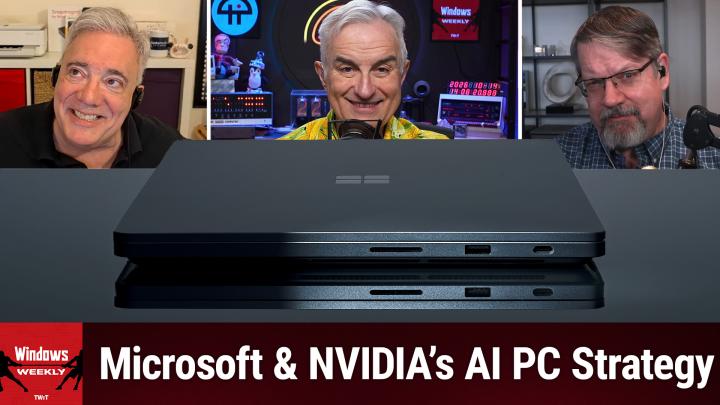
we knew that there was going to be a Surface Laptop Ultra element to it, that being their RTX Spark computer. Um, we knew there would probably be other RTX Spark computers mentioned. Nvidia was going to be part of it, so we're probably going to talk about the NX1 and these RTX Spark computers, blah blah blah, whatever. And, uh, and we did. We did. But I'm gonna just draw a, what for many people is gonna be an uncomfortable comparison, which is that 2.5 years ago, Microsoft launched a platform called Copilot+ PC that everyone seems to hate. And yes, I mean, it is a matter of history that the first big end-user feature they talked about and the marquee feature for Copilot+ PC for maybe the first year, even though, by the way, it is still to this moment never exited preview, is, was Recall, which immediately became controversial. And that one of the problems with Copilot plus PC is that you have these features scattered around the OS that sit outside of OS versions or product editions and so forth.
Paul Thurrott [00:05:06]:
And if you have a computer that qualifies, you get these things, but you can't like point to any one of them and be like, oh yeah, this is why you buy this thing. It's more like the combination of all these things is what makes this thing kind of valuable, whatever. Okay, here's the thing. They didn't do this for this RTX Spark thing at all. There was not a single end-user feature that was mentioned. I'm gonna put an asterisk on that because there is a side story to this that's coming down the road. So as this thing launches and these computers are coming out on Friday, they don't have something they can point to and be like, oh, Look at this. See this thing? You want this.
Paul Thurrott [00:05:45]:
This is why you're going to spend a lot of money on this thing. It's awesome. Everyone wants it. Um, there is not that thing. Um, and that's confusing. I have to say, it's really confusing. Um, if you were highly technical, if you are basically Leo or 3 other people on Earth and are just living in this world every single day, you might have been excited by this event. You might have been interested in the demos they did.
Paul Thurrott [00:06:07]:
Uh, you might have understood what they were talking about. But I would say 99-point-something percent of people on this earth would've looked at this and been like, what the hell are they talking about? What is this? And I just found the whole thing to be kind of rather bizarre.
Leo Laporte [00:06:21]:
Yeah, this is, you know, I get this complaint about all of our shows lately. This is like, no one cares as much about AI as you do, Leo, so stop
Paul Thurrott [00:06:31]:
talking about it. Well, that's not so. AI has, I've said this before, and I feel this more strongly every passing day. I know that for my entire adult life, I've been talking to someone who maybe is a friend of mine or someone else who's in the industry, and we're talking about this stuff like we're talking on this podcast. And then there are normal people over on the other side of wherever we are in whatever imaginary world I'm in here, and they're looking at us like, what the hell are those people talking about? This stuff is like, what is this? They don't understand us. And now AI comes along. They've heard the term.
Leo Laporte [00:07:02]:
They kind of know that there's something going on, but they don't know.
Paul Thurrott [00:07:04]:
Yeah, they're like nerds or something. What is this? But AI makes me feel like that. Not only is it complicated, not only does it evolve very rapidly, but just the language we use to describe things is changing and changing and changing and changing. I don't think a week or 2 or a month or whatever goes by where there isn't some new term. Now we're using harness, whatever it is. And it's very hard to kind of keep track of what's happening.
Leo Laporte [00:07:31]:
Now you know, but this is good because now you know how normies have felt all this time as we talk.
Paul Thurrott [00:07:35]:
I know, and I hate those people so much. You know, and it's— no, I'm just kidding. Um, no, it is.
Leo Laporte [00:07:43]:
I mean, since I've been doing computer stuff, uh, you know, into the public, people have gone, oh, I don't know what you're talking about.
Paul Thurrott [00:07:51]:
No, I, I—
Leo Laporte [00:07:52]:
And in fact, that's the big— that's my big challenge. The thing I tr— I want to do, and I tried to do on the radio show for 19 years, is explain this in language people understand.
Paul Thurrott [00:08:02]:
Right, of course.
Leo Laporte [00:08:03]:
But we don't need to do that on this show. I just want to read it.
Paul Thurrott [00:08:05]:
Well, we do and we don't. I mean, part of the thing I have to say is like You know what, I've talked about this in the context, especially Windows 11, but as Windows has moved along, like, you know, back in the day I could write a book or an article or whatever and be like, look, if you wanna do this, you do this, and then you'll get to that point. And now it's like a flowchart of, well, you might see this, you might see that, you might do, do, do, do, do, do. And if anything, AI makes life even less deterministic. So I mean, it makes it complicated. You know, you wanna be able to say, if this is the goal, then do these things and you will get there. And it's getting harder and harder. Yeah.
Paul Thurrott [00:08:41]:
It's just harder to do that. That's all. So anyway, I've watched and rewatched this Microsoft event. And I will say, I mean, to be fair, a bunch of, I don't know. Well, a bunch, a lot of it did have to do with Windows. You had to really strain it to kind of get the stuff out the end that was, you know, for everybody or whatever.
Leo Laporte [00:09:01]:
That's that cat soup I was talking about.
Paul Thurrott [00:09:02]:
Yeah, yeah, yeah. But like at a high level, we had AI PC. So AI PC was a brand that Intel and Microsoft agreed on. These were computers and still are computers. Any computer that has an NPU in it is an AI PC.
Leo Laporte [00:09:17]:
Excuse me, Mr. Surratt, we have decided to call it superintelligence, so that would be a— Oh, please.
Paul Thurrott [00:09:22]:
Well, this is a previous— this is an actual brand with a trademark and whatever it's called.
Leo Laporte [00:09:26]:
I know, and they changed it all. Did you see that Elon wants to change xAI to xSI?
Paul Thurrott [00:09:32]:
Yeah, I'm not going to even entertain that stupid— that's ridiculous.
Leo Laporte [00:09:36]:
Okay, we'll call it AI from now on.
Paul Thurrott [00:09:37]:
I'm not beholden to the Yeah, the politics
Leo Laporte [00:09:41]:
of the whole
Paul Thurrott [00:09:41]:
thing. So no, but this is whatever, this is a brand from the past. It just is a thing. I mean, it just is what it is.
Leo Laporte [00:09:46]:
AI PC.
Paul Thurrott [00:09:46]:
Yeah, AI PC. So if you're from the perspective of a Windows user, one of the, well, actually the only thing you get just from having any NPU is some form of Windows Studio Effects. And these are mostly video, but there's one audio effect, things for your webcam when you have a, like a work call. So you can do background blur, you know, It will follow you or whatever the capabilities are of the computer itself and the camera you have, et cetera, et cetera. So that's the base level. The second generation AI PC was Copilot plus PC, right? Still around, a specifically powerful NPU that enables certain things. Although, as we've often pointed out, those things could be enabled otherwise, but they aren't. But that's whatever, that's whatever it is.
Paul Thurrott [00:10:29]:
And now we have these RTX Spark computers. I was sort of thinking to myself, like, there's gotta be a name for this. Like, at one point during this event, they talked that like this tier is for the makers. And I'm like, all right, the makers, there's gonna be some kind of a name here, maker-related. And there isn't, right? And so the RTX Spark platform, such as it is, is just like Copilot+PC, is just like AI PC, in fact, is a superset of those things. So there's some natural progression there. But with one big difference. This is very, it's not just ARM or x86, it's NVIDIA.
Paul Thurrott [00:11:03]:
It's the NX1.
Richard Campbell [00:11:04]:
I mean, it is ARM, really.
Paul Thurrott [00:11:07]:
Right, but it's also only that thing. Like in other words, with Copilot plus PC, you have ARM and x86 choices. With AI PC, you had ARM and x86 choices. With this one, you have NVIDIA. And yes, it is ARM. The CPU is ARM. It has this special GPU with the Blackwell cores, 5,000 to 6,000 of them depending on the version of the chip, which is insane. Okay, fine.
Paul Thurrott [00:11:37]:
You could, I wouldn't, but you could make the case that Copilot plus PC specifically was kind of built for, I hate to think of it as an era because it lasted for the blink of an eye, but for sort of the generative AI era in particular. Yeah. Generative AI that you would be looking for.
Richard Campbell [00:11:54]:
They required that MPU to be a Copilot PC, which was what, 40 TOPS? And the new spec is 80, and the RTX Spark is 1,000.
Paul Thurrott [00:12:03]:
Well, so that's another part of this conversation. So it's a petaflop, which is 1,000-something of something, right? 1,000 teraflops. But the problem is, yeah, so the rating TOPS stands for nothing. But what it—
Leo Laporte [00:12:18]:
In fact, nobody uses it, by the way, in the world outside of Microsoft. This is the other—
Paul Thurrott [00:12:23]:
I know, this is the— so this is—
Leo Laporte [00:12:24]:
We used to, but we haven't since.
Paul Thurrott [00:12:26]:
So this is getting into a separate conversation about RTX Spark, but I might as well just say this now because Microsoft and its partners, because they have to use TOPS for the NPUs in their computers, Apple measures memory bandwidth essentially. They don't really talk, they don't give you any numbers for TOPS or petaflops or anything else. But when you look at TOPS and petaflops, TOPS is a measurement of integer operations for AI. The petaflop thing is floating point. And these are also not the only way you measure integer and/or floating point performance on these chips or cores or whatever. It's insane. I really had to look for this, but NVIDIA or—
Leo Laporte [00:13:14]:
By the way, NVIDIA till heretofore has never, as far as I know, used TOPS either.
Paul Thurrott [00:13:20]:
They do not use it. That's correct. Yeah. But here's the thing. The architecture of this chip, which is probably, and I don't know this for a fact, but it occurs to me that it's probably very similar to what Apple does with Apple Silicon, is that they don't have a separate chip that's an NPU. What they have is 5,000 to 6,000 cores in this GPU. Some of them are different kinds of cores. There's like, what's it called? It's like S, I think it's, I'm on the wrong screen here, sorry.
Paul Thurrott [00:13:46]:
I'm probably on the wrong, yeah, I'm on the wrong. Let me see if I can just find this. I don't know if I can find this or not. Yeah, some of them are like streaming multiprocessor cores, like SM cores. Some subset of those are Tensor Cores. Some combination of those Tensor Cores in the NX1 are collectively presenting themselves to the operating system as what's called an NVIDIA NPU, even though that thing does not exist as a separate chip. So there's some subset of that giant GPU or whatever SoC that is dedicated to what on other computers would be done with a standalone NPU. So it exists.
Paul Thurrott [00:14:25]:
And that thing is, I don't have this number right in front of me, but I wanna say it's somewhere around 263 or 265 TOPS. So it's, and I could be wrong on that, but whatever the actual number is, it is dramatically faster than any NPU that's in any Copilot+ PC. So even on that measure, these things are much more performant, I guess.
Leo Laporte [00:14:48]:
The problem I have is I don't know how to translate that into a number that makes any sense.
Paul Thurrott [00:14:55]:
Right, because, yeah, so, all right, so, right, so here's part of the problem. When you think about the performance of, I guess, for lack of a better term, like AI tasks running against a processor, whatever that is, AI operations, right? There's raw performance and then there's efficiency. And you go back to that second Steve Ibbotishi talk from 2, 3 years ago, whatever it was, where he was talking about the power of the NPU. 23? Yeah, 20. Well, the second one. So this would've been, actually, I guess it would've been 2024. So it was right after they announced the Copilot+ PCs. The reason that kind of a chip is so ideal on a laptop is that it's so power efficient.
Paul Thurrott [00:15:32]:
In fact, it basically doesn't move the needle on battery life at all. You can do things. It's just like the GPU saves the CPU from doing things, the NPU does as well. So if you do have AI operations that run against an NPU, it's incredibly efficient.
Richard Campbell [00:15:47]:
Mm-hmm.
Paul Thurrott [00:15:47]:
But as we've often talked about in the past 2 and a half years, you could have a system like Richard's or anyone else's that we have this gigantic, maybe Nvidia, probably Nvidia, but whatever it is, RTX, whatever graphics card, and you could get several hundred TOPS off of that thing. 1,000. Of performance, but Copilot plus PC doesn't know about that. We're not talking about it and we don't know why. So yeah, anyway, NVIDIA is talking about floating point operations. TOPS is integer operations. And then you have the memory bandwidth thing. And this is actually another interesting area because if you think about, let's go Snapdragon X, like most Snapdragon X2 processors, the memory bandwidth is 152 gigabytes per second.
Paul Thurrott [00:16:32]:
The Elite Extreme models, I think there are 2, can hit 228. And that feels like, what is that? Like 50% more? 50% more? It's a big bump, whatever it is. Microsoft compared the NX1, the Nvidia RTX Spark platform, to the Apple Silicon M5 Pro repeatedly. That makes sense because that thing has Memory bandwidth of 307 gigabytes per second, which is faster than the NX1. I'd say they're kind of in the same ballpark, right? Um, but they didn't compare it to the M5 Ultra, which by the way goes up to an insane 1.7 terabytes per second, which is completely different. Okay, I'm sorry, uh, but a different league. Um, and it's really, really fast.
Leo Laporte [00:17:16]:
Super fast.
Paul Thurrott [00:17:17]:
Yep. And they don't have any—
Leo Laporte [00:17:20]:
Complicate these even more.
Paul Thurrott [00:17:21]:
Oh, I'm not done.
Leo Laporte [00:17:23]:
That's not even The only thing, or even maybe the most relevant thing when you're using AI.
Paul Thurrott [00:17:28]:
Right. Okay, then I'm going to get to it then, because I think I know where you're going. So we have this system, this platform. We have a bunch of computers coming out based on this platform. One of the other things about this is, yes, if you get a version with 128 gigs of RAM, it can do up to that 1 petaflop of whatever. It can hold bigger models in memory, blah, blah, blah. But the big question I have is, why is it limited to 128 gigs of RAM? That's a lot of RAM for a normal computer. It's more RAM than you can get in any Snapdragon X2 computer, although that's artificial.
Paul Thurrott [00:18:00]:
They could make this, right? Like, it's a— these are 64-bit chips. You could support whatever, based on RAM density, blah, blah, blah, whatever. It could support any amount. Apple Macs, the M5 Ultra-based Macs, can go up to 512 gigabytes of RAM. 128 sounds awesome unless you know that. And then it's like, wait a minute, why? Why would this be limited to that much RAM?
Richard Campbell [00:18:24]:
Well, and we built servers with 700 gigs of RAM. Yeah. You know, yeah, it's also possible to put more in, but yeah.
Paul Thurrott [00:18:31]:
No, no, it's not. Not in NX1. This is—
Richard Campbell [00:18:34]:
that's the limit. I'm with you. Yeah, but we built machines like this, but not in this configuration, much less the speeds we're talking about too. Well, that's the other thing.
Leo Laporte [00:18:43]:
It's not— yeah, there's RAM and there's RAM.
Paul Thurrott [00:18:47]:
Yeah, well, there's also— there's RAM and where the RAM is located.
Leo Laporte [00:18:50]:
There's GPU memory. Yeah. And then there's, and there's system memory.
Paul Thurrott [00:18:54]:
Yes. So, right. So what Leo might just know this off the top of his head, like Apple, when Apple refers to the RAM that's in a Mac, a phone or whatever it is.
Leo Laporte [00:19:03]:
It's DDR5 system memory.
Paul Thurrott [00:19:04]:
Yeah. But what's the, what, what, it's not called unified RAM. It's called—
Leo Laporte [00:19:08]:
Yeah. Unified. Yeah.
Paul Thurrott [00:19:09]:
Or is this unified RAM?
Leo Laporte [00:19:10]:
Yeah. Basically what they're saying is unlike, um, many of the machines you're used to, Yeah. Where you have, you'd have, you know, you're a gamer.
Paul Thurrott [00:19:21]:
The graphics card would have dedicated—
Leo Laporte [00:19:23]:
Yeah, it has VRAM that is just for the graphics card, and that's where the textures go in your game and anything that needs the GPU. And then you have system RAM, which the CPU has access to. There's GPU and CPU. The Apple machines, much like, by the way, I think the PlayStation did this first, but there are other gaming devices that do this, where the system RAM is shared with the GPU and the CPU. And the advantage of that is that you can have a much larger pool of RAM for the GPU. The disadvantage is it's gonna inevitably be slower.
Paul Thurrott [00:19:57]:
There's other disadvantages. I mean, one of them is you can't expand it, right? So like, I, I was talking to Brad this morning. I was like, I don't understand why they don't have 2 kinds of RAM in these computers.
Leo Laporte [00:20:08]:
Oh yeah, 'cause it's built on the die. Yeah, yeah, yeah.
Paul Thurrott [00:20:10]:
Yeah, I mean, I would almost want the, the apps and stuff to run off the slower RAM and then the, you know, the AI stuff to run off whatever the, you know, the best RAM.
Leo Laporte [00:20:18]:
That's how it used to be.
Paul Thurrott [00:20:19]:
Right. Anyway, it's not, but it's not, not NX1. NX1 has unified RAM. So it is like Apple. It can't reach the same speeds as you get on the Mac depending on the processor. That's kind of a problem. They did do like an Osborne effect thing here, by the way, because right at the end of the show, they're like, all right, we have this awesome new computer. Everything's great.
Paul Thurrott [00:20:38]:
Uh, they're going to be on sale next Friday. Oh, by the way, we have this other thing coming down the road, it's way better. And, and that's amazing to me. So they, they literally announced something called the DGX Station for Windows.
Leo Laporte [00:20:49]:
Oh yeah, now tell them how much that would cost.
Paul Thurrott [00:20:52]:
Well, I'm guessing it's going to be about $90,000.
Leo Laporte [00:20:55]:
It's going to be over $100,000.
Paul Thurrott [00:20:56]:
Yeah. Okay, so, but here's the—
Leo Laporte [00:20:58]:
that's why it doesn't really matter. They've always had it. They've had a DGX Spark and a DGX Station. They've always had this.
Paul Thurrott [00:21:05]:
But now it's— they have one now.
Leo Laporte [00:21:06]:
It's for Windows. It was for—
Paul Thurrott [00:21:07]:
it will be whenever they, they put it up, right? So this thing supports what's called coherent memory.
Richard Campbell [00:21:14]:
Because all the other memory was incoherent.
Paul Thurrott [00:21:16]:
Like, yep. Uh, up to 20 petaflops of floating-point AI compute versus 1. 20 times as fast. Is this thing we want you to buy next week? 20 times as fast. We're already talking about it.
Richard Campbell [00:21:28]:
We don't know what— Map to 20,000 TOPS, I wonder.
Leo Laporte [00:21:32]:
I'll tell you who this is. I'll tell you the— maybe this will help understand this.
Paul Thurrott [00:21:37]:
Well, okay, but let me actually, if you don't mind, let me just— Yeah, go ahead, you finish it and I'll— But I have a theory. I can annotate. Okay, uh, because I just want to just— I just want to get this out of the way. Yeah. And then, uh, the, the total RAM on this is— the total RAM is, uh, 748 gigabytes possible versus 128 on Xbox. So, so why would they announce this? Oh, and I should say too, actually, as far as scalability goes, the other thing you can do with this, and this thing Leo and I were talking about a little bit last week, was chain these things together with high-speed Ethernet, right? This thing supports up to 800 gigabit per second Ethernet, which by the way doesn't actually seem that fast to me, but whatever. The idea is that if one of these boxes somehow is not enough for you, like, you know, you're the guy that didn't believe 640K was enough for DOS and you need more, you can stack 2 or 3 or whatever number of these things, chain them together and you get this scalable architecture, it's fricking insane. So I can only think they talked about this at all because they knew that people were gonna be like, excuse me, you just talked about this M5 Pro thing, but you do not even come close to this M5 Ultra.
Paul Thurrott [00:22:42]:
So when does that happen? And the answer is we have this.
Richard Campbell [00:22:45]:
Mm-hmm.
Paul Thurrott [00:22:46]:
I think that might be the only reason they discussed it, just to shut that down because that would've been the thing. When Snapdragon X1, the OG version, was announced, the M3 was the current chip. Qualcomm did a big presentation, they compared it to M3, it blew it out of the water. And I think it was 8 days went by and Apple announced the M4. And then 9 months went by and they released the X1 computers. Congratulations, idiots. So I think this is their little let's not do that again moment.
Richard Campbell [00:23:14]:
Yeah.
Paul Thurrott [00:23:15]:
That's my guess. So anyway, I'm sorry. You had some additional commentary? Yeah,
Leo Laporte [00:23:20]:
because this is, by the way, I've been spending a lot of time trying to understand this, like the last year.
Paul Thurrott [00:23:25]:
Yeah, I haven't noticed, but go on.
Leo Laporte [00:23:27]:
And it's evolved considerably. So at least in the NVIDIA world, they make these devices, the DGX Spark and the DGX Spark Station, as these are pure inference devices. They're headless. They're kind of a a smaller analog of what they run in data centers, right? Using high-speed memory or sort of high-speed memory in some cases. And they're really designed to be, you know, I have 2 Sparks. The 2 Sparks I have, which cost $10,000 and now would cost more like $15,000 or $16,000 because the prices soared. Are analogous, very similar to the RTX Spark that they're selling that Microsoft's offering and there's OEMs. The only difference is the high-speed networking connector.
Leo Laporte [00:24:20]:
So you can daisy chain Sparks. Right, which is curious.
Paul Thurrott [00:24:23]:
So I wouldn't expect that on a laptop obviously, but some of these RTX Spark computers are desktops. And why would you not offer it?
Leo Laporte [00:24:31]:
Well, it's an expensive part. So it's—
Paul Thurrott [00:24:33]:
I know, but if you have to scale beyond this thing, you're spending money. So why not?
Leo Laporte [00:24:37]:
Yeah, so, so the cable itself is over $100. I think I spent $200 for the cable, and the card I think is at least that much. Anyway,
Paul Thurrott [00:24:46]:
yeah,
Leo Laporte [00:24:46]:
uh, the Sparks themselves aren't that fast. In fact, a lot of— when they first came out a year ago, people said, what do you want that for? It's really slow. But the day— it does have unified memory. You can connect it via this high-speed connector and add more, and the bandwidth multiplies by the number you add. And modern models and what we call mixture of expert models, can use this because they're not all, you know, in a dense model, you have to run every token through the whole thing. On a mixture of experts model, which all the newer, smaller models are, like the Flash models, you only run it through the expert you need. So this kind of memory separation is not a problem. It's okay.
Leo Laporte [00:25:28]:
Hmm. The problem though is, and this is why I said, The memory bandwidth isn't the only issue. The problem is also prefill and KV cache. I'm not gonna go too deeply into this, but it does affect the overall speed of it.
Paul Thurrott [00:25:42]:
Okay.
Leo Laporte [00:25:43]:
My Sparks really couldn't handle more than 3 or 4 people at a time, and they slow down rapidly. Like, I use them one at a time. 2 people using 2 DGX Sparks, okay. 5, no. The DGX Station is much faster, but it's not intended for one person to use. It's intended for a small office to use.
Paul Thurrott [00:26:03]:
It's a server. It's kind of— it's like these RTX Sparks are workstations and that thing is a server.
Richard Campbell [00:26:09]:
It's weird they show them in a, in a sort of PC ATX form factor. They should just be in 4U rack cases.
Leo Laporte [00:26:15]:
Yeah, but I think it says Nvidia sells these as ATX tower cases.
Richard Campbell [00:26:19]:
Yeah, which is wacky, right?
Leo Laporte [00:26:20]:
Well, I, I think what they're selling—
Richard Campbell [00:26:22]:
If I was setting up a development office where we had to do LLMs local,
Leo Laporte [00:26:26]:
right,
Richard Campbell [00:26:26]:
you'd get 2 or 3 of them in a rack. Yeah. Yeah. And spend— I mean, look, if I've got a dozen people productive at the levels that are the potential, $500,000, I'm gonna pay for a year.
Leo Laporte [00:26:38]:
That's why that price differential. That's exactly it. It's not intended for an individual. No, it's intended for a small office.
Richard Campbell [00:26:45]:
Yeah.
Paul Thurrott [00:26:45]:
Well, look, you could, you could price out even like a, whatever they call it, a Mac. What's the Mac thing? Mac Studio, right? 512 gigs of RAM. I mean, how much is that thing gonna run? It's $10,000.
Leo Laporte [00:26:54]:
I will find out in 2 weeks and then I'll be writing a big check and be one, I'll have one for your kidney, but that's okay because I've got
Richard Campbell [00:27:02]:
2. You got 2.
Paul Thurrott [00:27:02]:
No, they might be 18 to 20,000. You can spread it out over 18 to 20.
Richard Campbell [00:27:05]:
Well, the good news is when you go down to one, the one that's left gets bigger and you can sell it for more.
Leo Laporte [00:27:10]:
Then you'll have no kidneys. Uh, so yeah, I don't know if I'm going to buy one yet because they're, because by the way, the way Apple's designed this, they're not good at that pre-fill thing, which is a whole—
Paul Thurrott [00:27:20]:
So I also think there's a, Apple has a very big lead right now in local AI, I guess the way to say it. And I mean that on multiple levels. There's just a perception thing there, but then you look at the numbers. And you're like, actually—
Leo Laporte [00:27:32]:
No, they're tied.
Paul Thurrott [00:27:33]:
They're actually—
Leo Laporte [00:27:34]:
They're pretty close to tied. And one of the big differences is more conceptual, but it does impact you. Apple is selling a full-purpose computer, as is the RTX Spark. It's designed for you to sit there and use productivity tools and an AI. Those DGX Sparks and the DGX Station are not designed to be used as a computer.
Paul Thurrott [00:27:54]:
Right, but we all know, look, there's gonna be an N2X, there's gonna be whatever. I hope so. Well, of course they will, right? So I mean, eventually they're going to get there, but—
Leo Laporte [00:28:03]:
And then the other question is how much is it going to cost?
Richard Campbell [00:28:05]:
Right. Because I also think that I would always go headless on this. Like I would get like a DGX or something like that. That's what I carry with me with my laptop.
Leo Laporte [00:28:14]:
Otherwise you have to keep your laptop open.
Richard Campbell [00:28:16]:
Well, yeah. And you're mixing workloads. Like it's wacky. I completely agree.
Leo Laporte [00:28:20]:
And that's why the Mac is maybe less desirable because it isn't just pure inference.
Richard Campbell [00:28:25]:
Yeah.
Leo Laporte [00:28:25]:
It's a full computer. I don't want macOS on that.
Paul Thurrott [00:28:28]:
The one thing I don't know enough about is whether there's because NVIDIA and CUDA is so successful in the data center and so much is written to that as a sort of standard, is there some advantage to also having that architecture locally? Whether, you know, for the— will models be optimized for this or whatever?
Leo Laporte [00:28:48]:
What we're seeing, especially because of Apple's releases of these new computers, is that Apple's technology— so there's CUDA, which is an NVIDIA proprietary technology, which every model is kind of written to use. 'Cause that's what's in the data center. Apple has its equivalent, which is MLX. And we're seeing, because there are these new Mac Studios, more and more people working on MLX.
Paul Thurrott [00:29:09]:
Right, that's right.
Leo Laporte [00:29:09]:
So models come out for CUDA, but they very rapidly will come out for MLX. So that's less of a problem than it used to be.
Paul Thurrott [00:29:16]:
Okay, I mean, I don't know. I'm just throwing stuff out there.
Leo Laporte [00:29:19]:
No, I'm telling you, this is something I'm paying very close attention to 'cause—
Paul Thurrott [00:29:22]:
Right, I mean—
Leo Laporte [00:29:23]:
I'm trying to decide how big a check I need to
Paul Thurrott [00:29:25]:
write. Okay, so, but to your, the question was raised, you know, why do we have these things in laptop, blah, blah, blah.
Leo Laporte [00:29:30]:
Yeah, that's a really good question.
Paul Thurrott [00:29:31]:
I'm not sure I understand it. Well, this is the— it's like, it's weird because compared to like a Snapdragon XR2 laptop, this thing is— these are bigger, they have giant fans, there's giant exhaust vents and blah, blah, blah, whatever. They're much more powerful on one level. It's kind of a brute force kind of a power, but it's whatever. Right now, I mean, literally, if you just took a snapshot of the market, you know, and you think about the the market that might be served by portable workstations today, it's pretty small from a units perspective. But yes, creators are part of that. I made this point last week, but the marketing materials I'd seen before last week's show from multiple PC makers all said the same thing, which was that there are essentially 2 tiers. And it's like 128 gigs of RAM and then everything that's below that.
Paul Thurrott [00:30:20]:
And I think the most typical configuration there is going to be 32. That's what you see in the laptops, but you could get one with 24. You could get one with 48 or 64 or whatever number, but 128 is the max. And then, so there's like these 2 tiers. There's also 2 tiers of N1X, by the way. There's the version with 5,000 whatever CPU cores or GPU cores and the one with 6,100 whatever GPU cores. There's an 18-core CPU and a 20-core CPU. So there's like a little bit of differentiation every now and then.
Richard Campbell [00:30:48]:
Is that just spinning, you think?
Paul Thurrott [00:30:49]:
Yeah, yeah, almost certainly. I've never seen— well, I can't talk about that. So there is a market today for creators, and creators is a broad term, but people who edit photos, edit videos, they're social media people maybe, or whatever they're doing. Why would you buy this over a gaming-class laptop with a dedicated NVIDIA GPU is actually a good question. I mean, it's something we could talk about. But this is the beginning of a wave. And I think the point of it is like we come into market, we're already as good or better than that type of thing, depending on what we're talking about. They can play games, you know, even it's kind of incredible.
Paul Thurrott [00:31:29]:
And it had— but it has to scale. The thing that I keep stopping on those, why is it limited to 128? Because once you get up into the type of thing where it's— I don't know what to call these people, but Leo and those 3 other people who are doing local AI all the time, all the time, all the time, and want to have the biggest possible model, you need, you know, hundreds 128 gigs of RAM to me would be like the minimum, frankly, but whatever. Um, 128 is a lot more than 32, but it's also a slice in time, and 3 months or 6 months or 12 months is going to go by, and 128 is going to look pretty crappy about a year from now. Like, I'm kind of— this really kind of blows my mind. Like, that may not be true. Okay,
Leo Laporte [00:32:07]:
that's something that is up in the air. So, okay, this is the other thing you need to understand. I'm sorry, tell me if I'm— no, it's okay. Uh, the big models like, you know, Opus 5, 4.5, uh, ChatGPT, Soll 6.1, the really big models, you're never going to run at home.
Paul Thurrott [00:32:25]:
No, I know that.
Leo Laporte [00:32:26]:
They're running in data centers and they're terabytes, and you just— it's not a reasonable thing to expect to run at home. There's a very active contingent, mostly of— well, I would say entirely of open weight models. That is, models you can download for free. Some of them, most of them come from China, companies like Alibaba and Jipu. Xiaomi, others. Some of them come from NVIDIA. They have kind of not so great open weight models called Nimotron. Meta has just released some new open weight models and has promised to do more.
Leo Laporte [00:32:58]:
They were the first to do it, by the way, with LLaMA. So those models you can download, they have to be small because you can't, A, you don't have enough memory to run them, but B, the bigger the model is, the slower it is. Think about it. Sure. Right?
Paul Thurrott [00:33:14]:
Well, but I'm not— I actually, I guess where my brain is at, it's more like it's not about what's the biggest one model I can run on this computer. I feel like these things are gonna be running dozens of models and you still run into—
Leo Laporte [00:33:25]:
That's possible, sure.
Paul Thurrott [00:33:26]:
Just the total memory capacity. That's possible.
Leo Laporte [00:33:28]:
Or, but you may want the biggest model you can run at a reasonable speed on the machine you have. I run, for instance, a Chinese model called GLM-53 Flash. The flash is important. Those usually mean smaller, models you can run on a machine. It's a very, very good model. What's going to happen is the model sizes are not going to get bigger, I don't think, because we're constrained by speed and RAM.
Paul Thurrott [00:33:52]:
But our use of models is only going to grow. We're going to need more and more.
Leo Laporte [00:33:55]:
They're going to get small, but they're getting smarter. Like GLM-53 Flash is much smarter than its predecessors at the same size. There will be on the frontier bigger and bigger models. I think that The new models that both Anthropic and OpenAI are going to announce in a month or two are going to be possibly as much as $10 trillion.
Paul Thurrott [00:34:17]:
Okay, but I guess—
Leo Laporte [00:34:18]:
Wait, you can never run that at home. So there's rapidly becoming 2 categories, the ones you could run and the ones you are going to run in a frontier cloud.
Paul Thurrott [00:34:27]:
Well, yeah, but that's, I mean, technically that's always been true. It's just that the local ones have been getting bigger and more capable. Not bigger is better.
Leo Laporte [00:34:35]:
Yeah, okay.
Paul Thurrott [00:34:36]:
But I just want to say it's a weird hard limit. That's my only— my only— however you want to slice this.
Leo Laporte [00:34:42]:
I'll give you an example. One of the decision points on this 512GB Mac Ultra, besides the vast cost, is what do I get by running— could I— is there a reason to run a model that needs all that RAM? No, because I could maybe run GLM 5.3 instead of Flash in it. But it's going to be much, much slower because it's so big. Even at 1.2 terabytes a second, it's going to be too big to run.
Paul Thurrott [00:35:07]:
All right, so whatever we just talked about for the last 30 minutes, because I didn't understand a lick of it— I'll shut up now. No, no, I, I, I— is part of the problem here because—
Leo Laporte [00:35:17]:
I understand, it's very complicated.
Paul Thurrott [00:35:19]:
Well, and it's also— there's no— also no clear user value here for most people. Like when— like I said, you could go back and watch it, you'll be horrified, but If you watch the Copilot+PC launch, they were like, this is what it does, this is what it does, this is what it does. And you're like, okay. And it wasn't a million things, but it was like, all right, well, okay, we get it. Like, you know, there was some value to it. Also, that platform, for whatever it's worth, especially on Snapdragon side, was the most reliable, awesome performance, really efficient, great battery life. Like the whole, it was the whole package was awesome. And then this one, they're like inference and look, it's all hitting the GPU.
Paul Thurrott [00:35:55]:
We're ignoring the NPU now, I guess. We're going to have agents and we're going to have orchestrators for agents and we're going to blah, blah, blah, blah, blah. And look, this guy did a thing through multiple really high-end tools that no one ever has even heard of. And that was a great demo, Bob. And okay, I hope you want to buy one. And we're like, wait, what? What happened? What is this thing? Like, it was just— it was confusing. I mean, and part of the problem is there's so much to it. You know, Microsoft— there's a— to make running AI agents safe on Windows, Microsoft created that execution environment, MCX, which is now generally available.
Paul Thurrott [00:36:28]:
app, they have in fits and starts improved and then ignored Windows ML. They've done that again with this. They're okay, this is how you should do it. The little asterisks I gave about there being no local AI that would benefit anyone will actually apply to Copilot plus PCs too. So one of the little rumors recently was like, oh, they're getting rid of this brand, but they talked about it in this show and it's still there and is getting some of the benefits of the things they're working on now, one of which is the ability of Copilot, the app in Windows 11, to orchestrate between local and cloud AI for both just standard AI stuff and also for agents. You get to pick the model, so you're going to— it's going to have a bring-your-own-model aspect to it. If you are on a Copilot-based PC, you can pick a local model that is designed to work well against an NPU, and that will work however well it works. It will work, whatever.
Paul Thurrott [00:37:20]:
So that's the little asterisk, but that's not ready now. So these things are coming out in 2 days. That does not exist. It's coming, but a lot of things are coming. Christmas is coming, winter is coming, you know, whatever. So, you know, I, for some reason we had this event. But if you look just at Windows, like, because it was a Windows event, right? You also sort of see that evidence of the chaotic nature by which Microsoft is putting AI out in the world because they clearly don't know exactly what they're doing. So for example, 3 years ago when Microsoft launched, right before Microsoft launched Windows 11 23H2, they added Copilot to Windows.
Paul Thurrott [00:38:01]:
Right. And then they spent the next 3 or 5 months moving the icon around, changing how the app works. It was a sidebar, now it's a floating app, now it's a this, now it's a native app, and now it's blah, blah, blah, whatever. But during this timeframe, one of the initial benefits of Copilot as an app was that you could prompt it with things about your computer and it would change settings for you. So you might be like, I don't know how to change my computer into dark mode. I don't even know that the feature is called dark mode, but I could go to Copilot and say, hey, my screen's too bright. Could we make this into like, we'd make everything look dark? And like, oh, do you want me to turn on dark mode? You're like, yeah, thanks. And then it does it and you're like, oh great, that's what— and that's a stupid interaction.
Paul Thurrott [00:38:36]:
Who's gonna type that? But that was a thing you could do. And that's gone actually because in the interim, They put that into the Settings app where it belongs, right? So now if you have Settings, it's actually better on a Copilot+ PC. That's one of those things that is a differentiator. But there is on a Copilot+ PC a local AI model specifically trained or grounded in the settings that are in the Settings app. Like, that's what it's for. And so they moved it. And now, and this is not here yet, but if you're in the Insider Program, you can test it. They've looked at this again and they're like, We're gonna move a lot of the interactions for AI stuff into search because they feel like search is like a starting point for a lot of people.
Richard Campbell [00:39:16]:
I would say it's the interface point, right?
Paul Thurrott [00:39:18]:
Yeah, except it's also the thing you use once and it fails and you never use it again.
Richard Campbell [00:39:22]:
Yeah, yeah, although it's the thing that everybody's already given up on, so obviously we should put more features there,
Paul Thurrott [00:39:26]:
right? And this, this supports my, uh, view that the real reason Microsoft is fixing Windows 11 this year is because they need a solid platform for this crap. Yeah, but whatever. It benefits everyone.
Richard Campbell [00:39:37]:
You came to that conclusion in 2023, dude, and there was no hope at the time.
Paul Thurrott [00:39:41]:
Yep. So they're going to have this kind of handoff in search where if you do something that's— if you have a question, it'll just answer it there. But if it needs more work or whatever, it will hand off to the Copilot app. And okay, that's fine. We're still trying to figure out the UI. It's like, whatever. I mentioned the local model thing with Copilot was kind of interesting. There's also, depends on where you're at, I guess, in life and what you subscribe to and/or use, but there was a Copilot app.
Paul Thurrott [00:40:12]:
There was a Microsoft 365 Copilot app. They combined those apps. That combined app is in Windows 11 today, unless you buy it, by the way, a business-class PC, in which case you still get, today anyway, this will change soon, the Microsoft 365 Copilot app. There's a new version of the app they announced last month, I guess, or earlier this month, wherever we are in time, that will have those 3 main tabs, right? Like Home, Code, and I think the other one's Autopilot, which is the new name for the Scout personal assistant. I don't see that today because I don't have a— well, I'm not using it with a business account. I think you might be able to see it if you had a business account, but I don't see it. And then there's this super app thing where it's going to have the same basic UI, but they're also changing the capabilities. And now we're adding this integration with the Windows Search thing.
Paul Thurrott [00:40:56]:
So like, they're still dicking around with Copilot. They literally have no idea what this app is. Like, it's— this is kind of bizarre.
Richard Campbell [00:41:02]:
They're just trying to find their way, man. Like,
Paul Thurrott [00:41:04]:
they really are. But it's been 3 and a half—
Leo Laporte [00:41:06]:
Spaghetti against the wall.
Paul Thurrott [00:41:07]:
It's exactly what it is. This is 3 and a half years later.
Leo Laporte [00:41:10]:
We don't know what to do, so let's do it all.
Richard Campbell [00:41:12]:
Just keep trying.
Paul Thurrott [00:41:13]:
Someday something will click, you know. Um, they spent 16 minutes talking about Surface Laptop Ultra. They spent 1 minute talking about every other RTX laptop there is on Earth. This company is the worst friend that has ever existed.
Richard Campbell [00:41:29]:
Yeah, 'cause all of them are making one now, right? Lenovo's got one. Yeah, they were all there.
Paul Thurrott [00:41:33]:
There were 5 or 6 other PC makers, all of which, by the way, actually sell PCs, unlike Microsoft. If you go, this is the one thing that was the same between this and the Copilot+ PC launch, 'cause if you go back to that, remember that was only Snapdragon at the time.
Richard Campbell [00:41:48]:
Yeah.
Paul Thurrott [00:41:48]:
Intel had people on the ground that tried to get in the event, they got kicked off the campus.
Richard Campbell [00:41:51]:
They kicked them out, yeah.
Paul Thurrott [00:41:53]:
They did the same thing. I don't know the numbers, but they spent all the time talking about the new, at the time, Surface Laptop 7 and Surface Pro, whatever that number was, the Snapdragon X versions. And then a little minute or whatever on the other one, everyone else. And then we went to the pavilion and it was a giant room and 90% of it was Surface stuff. And then over the corner, they jammed all their PC maker partners and gave them basically no space, which by the way, no one was particularly happy about. They're still doing it. Like, I don't know. Okay.
Paul Thurrott [00:42:20]:
Um, but I, I don't remember if I brought this up, uh, last week, but it's worth mentioning now because Richard's here. Um, but there was this horrible, horrible, horrible, horrible, horrible moment that this kind of thing almost ended on, which was at the end of the show, they had a roundtable, um, which wasn't round and didn't involve tables per se.
Richard Campbell [00:42:42]:
At all, right?
Paul Thurrott [00:42:43]:
Yeah. I think there were 3 guys sitting in chairs. Yeah. 3 guys in chairs. One of those guys was Satya Nadella. One of those guys was Jason Huang, the CEO, founder of NVIDIA. And the other guy was some AI guy I've never heard of in my entire life. Microsoft guy.
Paul Thurrott [00:42:57]:
And he used to work for Microsoft briefly. And who the hell is this person? I have no idea. But actually I do. I looked it up and I don't care. It doesn't matter. But I'm not kidding. He briefly was like some kind of a tech advisor for the White House. I don't remember which president.
Paul Thurrott [00:43:13]:
It doesn't matter. It could have been Biden or it could have been Trump. I don't know. And he's doing— I don't know who he is, but he's just sitting there with him like some jerk. Like, hey, I'm one of these guys. Okay, whoever you are. Yeah. And I don't remember the question, but the first, the opening part of this Q&A, which is what it sort of was, just, or this interaction between these people, these gods from Olympus come down and they're between— they're in front of us now and they get to just delight us with their intelligence and humor.
Paul Thurrott [00:43:41]:
And Jay, the guy from Nvidia, tells the story of Nvidia and how it was always tied to something that had to, you know, to Windows. And the history of Nvidia is very much the history of Windows was his point, you know, DirectX and all the stuff they did together and blah, blah, blah, whatever. And now here we are, it's come full circle.
Richard Campbell [00:43:58]:
Remember we used to focus on video games? That was it.
Leo Laporte [00:44:00]:
That's really what it is.
Paul Thurrott [00:44:02]:
Now it's like, yeah, we throw that stuff in a box of cereal now. We couldn't care less about it, you know. So anyway, he's finally wrapping up this history lesson and he says, you know, inextricably NVIDIA is linked to Microsoft and Windows. The RTX Spark platform is just a full circle moment for both companies. And then Nadella trying to be a human being, which he is not, blurts out, and Jensen's now going to do a little transfer of market cap back to me. Hahaha. Oh God. This is what billionaires are actually like.
Paul Thurrott [00:44:34]:
So if you ever thought this was a human being and not a robot and someone who was just like us and maybe could blend in, no,
Leo Laporte [00:44:43]:
no.
Paul Thurrott [00:44:43]:
The other guy laughed like a madman. Jason was looking, thousand-yard stare, small smile, trying to think of something he could do to save this moment.
Richard Campbell [00:44:52]:
Something clever. Yeah.
Paul Thurrott [00:44:53]:
And then he just— and his response after, it took some seconds, it took him a moment, but he said, I do that every day. And I generate every day—
Leo Laporte [00:45:02]:
What does that even mean?
Paul Thurrott [00:45:03]:
Transfer market cap to Microsoft.
Leo Laporte [00:45:05]:
Oh, I'm giving them money. Yeah.
Richard Campbell [00:45:07]:
Yeah.
Paul Thurrott [00:45:08]:
Yep.
Richard Campbell [00:45:08]:
I make value for Microsoft every day.
Paul Thurrott [00:45:09]:
I'm sorry, guys. Listen, these people are the worst. All of them. I don't just mean these 3 people. I mean everyone in charge of anything this big in our world.
Richard Campbell [00:45:19]:
Nothing like a trillion dollars to make you a bit weird.
Paul Thurrott [00:45:22]:
Terrible. Yep.
Leo Laporte [00:45:23]:
I think that's it. Because they all become weird.
Paul Thurrott [00:45:25]:
We live in a world where people are picketing data center installations More than half of the people in this country at least are more scared of AI than they are excited by it. And this is how you come out. This is your— you're like the Westworld thing where he rips off his face and there's a robot thing in there. Like, what are you doing,
Leo Laporte [00:45:45]:
Yul Brynner?
Paul Thurrott [00:45:45]:
What are you doing?
Leo Laporte [00:45:46]:
Well, but it was— I'll tell you what, it gives you some insight into what that whole event was about, or at least that part of the event was about. Nvidia has developed these things. Independently of Microsoft, they run on Linux.
Paul Thurrott [00:45:57]:
Oh yeah,
Leo Laporte [00:45:58]:
they— on somewhere there was a deal where Microsoft said, hey, you know, we really would like it if these were running Windows.
Paul Thurrott [00:46:06]:
So this is— and Jensen said, sure, 100%. So give me an event.
Leo Laporte [00:46:11]:
Yeah.
Paul Thurrott [00:46:11]:
Yep. So
Leo Laporte [00:46:12]:
because they'd already designed it, all they had to do is put Windows on it.
Paul Thurrott [00:46:14]:
This has been happening behind our backs forever. And one example of this, which again, I— which I have No proof of, but I just want you to think through the logic of this. Why did Qualcomm get into the PC market in the first place? Why would they even do that? Why? Why? You are at that time selling chips to 1.7, 1.5, whatever billion devices that get sold every year. Not just a chip, but multiple chips in most cases, because they make modems, they make all these other chips, right? Now you're going to enter a business that sells 200-ish million a year, And if you are as successful as you can be, you might get 10% of that market. Why? And then you do several years of this and all you do is bring your phone chips over. They're terrible. It works horribly. Microsoft is busy working on the platform.
Paul Thurrott [00:47:02]:
And then you announce you're going to buy Nuvia, which is a company that at that time made ARM-based data center chips, but you're going to use this as the basis for what becomes Snapdragon X, this new generation of PC chips that, by the way, is fantastic and actually works great. So I don't remember the purchase price. I want to say it was $1.8 billion, but something like that. Qualcomm is not a company the scope or scale of a Microsoft, an Apple, a Google, or whatever. I wouldn't even call them big tech. They are in the single-digit to low double-digit billions in revenues per quarter. They're not humongous. Why would they spend that much money on this little? I think Microsoft paid for it.
Paul Thurrott [00:47:43]:
I think Microsoft is basically commissioning this. I think Microsoft is artificially making that happen. And Leo just said the same thing for Nvidia. I think it was exactly the same thing. Microsoft can see what's happening out in the world. They can see what's happening with Apple Silicon, which I think is what promoted or forced the Nuvia thing for Snapdragon. They can see what's happening now with Apple with these big Mac Studios and whatever. And they're like, listen, we're gonna get— we only have— we don't have phones.
Paul Thurrott [00:48:13]:
We don't have, you know, we're second or third depending on what you look at in cloud. We're, well, I guess second. We're a distant nothing in AI as it is. We've spent all this, like, what do we— like, if we lose this one foothold, we're screwed. And I think Microsoft is financing this. I really do. I think so too. Whether it's explicitly or implicitly, however you wanna say it.
Paul Thurrott [00:48:34]:
There's no way that this makes sense for NVIDIA.
Leo Laporte [00:48:38]:
They don't need it.
Paul Thurrott [00:48:39]:
Yeah, they don't need it. They don't need it.
Leo Laporte [00:48:41]:
They can't make—
Paul Thurrott [00:48:42]:
they'd be better off with Linux.
Richard Campbell [00:48:44]:
You did diversify a market too, right? Like, more marketplaces, the better.
Leo Laporte [00:48:48]:
There is one issue that NVIDIA is going to face, which is, and by the way, and you guys can correct me on this, I'm going to start a new conspiracy theory. There is no RAM crisis.
Paul Thurrott [00:48:59]:
Wow.
Richard Campbell [00:49:00]:
Yeah,
Leo Laporte [00:49:00]:
that what's really going on is massive price gouging by the RAM companies.
Paul Thurrott [00:49:05]:
No,
Leo Laporte [00:49:05]:
they have sold capacity in theory. They've sold their entire capacity in theory because all these data centers are going to get built. None of them have been built.
Paul Thurrott [00:49:16]:
Yeah, this is— well, this is their whole economy is based on this.
Leo Laporte [00:49:19]:
They're sitting on a pile of RAM.
Paul Thurrott [00:49:21]:
The wimpy school of economy, which is like, I will gladly, uh, take a hamburger today and pay you Friday, whatever the phrase is. It's like—
Leo Laporte [00:49:28]:
I'm just saying there's no There's a RAM glut right now, but it's all in a warehouse because they're waiting for these data centers to be built. So if they're not built, which I think there's a pretty good shot that not all of them anyway—
Paul Thurrott [00:49:41]:
I think a big chunk of them will not be built.
Leo Laporte [00:49:42]:
You're gonna get— the market will be flooded with HBM4 RAM in the next year.
Paul Thurrott [00:49:46]:
Which is, by the way, awesome. So I want you guys to consider the difference between these bubbles bursting, because when the dot-com bubble burst, actually, I got this chair I'm still sitting in 22 years later.
Richard Campbell [00:49:57]:
You and me both, brother. Same chair.
Paul Thurrott [00:49:59]:
I got an Aeron. My wife bought this for me at Christmas. She bought it at an auction from a dot-com company that had gone out of business. So we didn't pay $1,000 for it. She probably paid $700 or $500, whatever it was. It doesn't matter. Still have it. Works great.
Paul Thurrott [00:50:14]:
And so that was the fallout of the dot-com boom. This one is going to be RAM chips for everybody, baby.
Leo Laporte [00:50:19]:
Right.
Paul Thurrott [00:50:19]:
Yeah. Like it's kind of incredible.
Leo Laporte [00:50:20]:
Because they haven't really, they got them somewhere or they're, I don't know, you know, they're not, because they're not being put in anywhere.
Paul Thurrott [00:50:27]:
Right.
Richard Campbell [00:50:28]:
Yeah. There's some— I mean, where do you think MVL72 has come from? There's a lot of RAM in there.
Paul Thurrott [00:50:34]:
I have to say, Leo, what Leo just said, knee-jerk, you want to sort of reject this idea, but actually I think it was Amy Hood commented to this effect at the most recent earnings announcement where she kind of said that the problem isn't— I'm trying to think how she said it, but she kind of alluded to this. It's like we have We— if we had the part, we could build this stuff, but we just don't have any place to put it. And, um, and it's sort of what you just said, uh, in a way. It's like she was trying to say that the problem wasn't demand, I think was the argument. It was that we just don't have a place to put the chips, you know. If we could just do this, if we could magically make data centers appear, um, we wouldn't have this problem. I think they would then have a different problem, but, you know, whatever. And I look— I look forward to
Leo Laporte [00:51:20]:
Companies like Nvidia, who really basically control TSMC, they're their number one customer, then there's Apple, really can say to TSMC what they— I mean, Nvidia is also culpable in this, in jacking up prices. I feel like this is a very artificially created crisis.
Paul Thurrott [00:51:42]:
Which is why the name AI is so great and we have to return to it.
Leo Laporte [00:51:45]:
It's artificial.
Paul Thurrott [00:51:46]:
It's the right name.
Leo Laporte [00:51:47]:
It's artificial crisis.
Paul Thurrott [00:51:50]:
Yeah, right.
Leo Laporte [00:51:52]:
And so a lot of what Nvidia and Microsoft and others are doing is trying to create a market.
Paul Thurrott [00:51:57]:
Right. Well, here's one way you could do it. So we're doing this thing for some reason. It's AI PC 3.0. It's got really powerful GPU. It's the same GPU we use in the data centers. Nvidia, the name everyone loves, blah, blah, blah. The one company actually making real money right now from this stuff.
Paul Thurrott [00:52:16]:
Fun. Okay. These things are going to cost between $3,500 and $10,000, I guess, whatever the numbers are, depending on the configuration. You're like, great. All right. What does it do? What are we doing? So in other words, like, for example, like I've often made the case that like Snapdragon X Windows on ARM is absolutely like so good. I would just call it perfect for most people.
Richard Campbell [00:52:43]:
Mm-hmm.
Paul Thurrott [00:52:43]:
And I mean like 99-point-something, like whatever. The obvious exceptions there are gaming, which is whatever. A lot of people also, I would say, just kind of game on a dedicated thing. Like in my audience, when people complain about Snapdragon, I'm like, you have multiple computers, who cares? Like, well, I can't print to my 1979 Brother computer from this. It's like, okay, but you have other computers. Also, you're printing? What are you doing? But whatever, okay, whatever. But, but this world, like once we get into creators, makers, however you want to define these people, where they're doing things like video editing, which actually relies on this thing working correctly. Think about the timing of things and you're, you know, inserting, uh, you know, effects and whatever you're doing with video.
Paul Thurrott [00:53:26]:
Um, that might be a good case to be made where, you know, maybe you want an x86 computer in this case. Like, I mean, and it's interesting that this and gaming are both that way. They are kind of the exception. So like the really high-end creator workloads, so to speak, whatever those are. Actually, that might be an area where compatibility matters. There is maybe a brute force approach to what Nvidia's doing where it will just force the issue, it will just work. But then again, you're spending, like I said, $3,500, $7,000, whatever the amount is on some computer. And like, look, I'll make something up because this isn't maybe a great example, but like Adobe Premiere works Perfectly.
Paul Thurrott [00:54:06]:
And you're like, yeah, but it's running like it's on a 10th generation Intel chip with 6 gigabytes of RAM because it's all running in emulation. So it's like, yeah, it's working, but— and that's not a good example because I think Premiere might be ARM native at this point. It doesn't matter. But this is the one world where I could actually accept like a compatibility argument where you're like, no, this is too important. We're spending too much money. This is for professional use case. Those creative tools have to work perfectly. Uh, I'm not taking that risk.
Paul Thurrott [00:54:35]:
And at that point, I'd be like, yeah, no, I get it. So I'm just trying to understand, what is it we're selling here? Like, what is this? What— there wasn't a single feature that you could go out Friday to a Best Buy, maybe wherever they sell these things, and, uh, buy one of these computers and come home and use the thing they showed on screen. There's nothing. There's not one. Even the stuff that's built into Windows is not there yet. So I don't know, I'm just not, I'm not sure what's happening here. I mean, I guess you could make the argument with Recall that sort of happened too, right? And like I said, it's still not brought, you know, not out of preview because it probably never will be. But, um, but there was stuff, you know, there were things back then, like there was a list of here are the benefits, and it's only gotten better in time.
Paul Thurrott [00:55:19]:
And this one is just a lot of pro— it's like AI in a nutshell. It's like, oh man, the world's gonna be awesome.
Leo Laporte [00:55:23]:
It's all just projection.
Paul Thurrott [00:55:25]:
You just wait. It's all happening.
Leo Laporte [00:55:27]:
Whatever it is, it's going to happen.
Paul Thurrott [00:55:29]:
And I think I made this, this has got to be in the notes later for some. Yeah, we're going to talk about this in AI, but there's this thing too where when you look back, it's a little sobering. Microsoft was talking about local AI. It was talking about AI agents 3 and a half years ago, 3 and a half. Every year that's come since, this is it. This is the year. This is the year of agentic AI. The final little milestone that I would imagine most of you people listening to this or watching this do not know as well is that last year at Ignite Microsoft, Pavan Davalori, the one thing he did there was lead a session about how agents would work in Windows 11.
Paul Thurrott [00:56:12]:
And the idea is that they'll be sort of like apps and they'll have icons in the taskbar. And if they need you, they'll pop up a banner notification and you can click that thing and interact with it and see how it's going and blah, blah, blah, whatever. And you're like, okay, that's, that's That's one way you make something familiar. You make something that is not familiar work the same way as something you use all the time. You're like, okay, that makes some sense. I'm not saying it's the right way, but okay, cool. And this is the part no one knows, I think. They shipped the code to make that possible in May last year.
Paul Thurrott [00:56:41]:
It's in Windows 11 right now. Nobody uses it for anything. Even Microsoft doesn't use it. So, okay. And by the way, when all the talk at this event About local AI and agents and blah, blah, blah. The one thing they never showed was anything I just described. They didn't show any of that stuff. So is it still happening? Is it still working that way? Nobody knows because nobody does it.
Paul Thurrott [00:57:02]:
I don't know. This is the world we live in. It's like, what has happened? What is this thing? It's bizarre. So anyway, like I said, this is a very expensive therapy session for me, but it's trying to understand this. It's not the first time this has happened for sure. Quantum computing did this to me. Windows Azure, when it was first announced as Windows Azure, did this to me. It's like, this is breaking my brain.
Paul Thurrott [00:57:28]:
I don't understand. It's like, you wanna see, even if I don't agree with it, if you could point to something and say, well, this is why they're doing it, I'd be like, okay. Maybe I don't agree with it, but I get it. And this time I'm just like, I don't, what? I don't get it. What did they do? Why are they doing this? Yeah.
Leo Laporte [00:57:44]:
Well, I could tell you one thing that's going to happen. You're going to stop talking and I'm going to start reading a commercial.
Paul Thurrott [00:57:49]:
Yeah, I figured we were going to get there eventually.
Leo Laporte [00:57:50]:
Because we're about an hour into the show on this topic.
Paul Thurrott [00:57:52]:
I know, right? I'm so sorry. I know it's just, it's dense.
Leo Laporte [00:57:54]:
If we're going to end before, uh, before the end of the day—
Paul Thurrott [00:57:57]:
We have to. I got to get out of here at the end of this topic. Okay.
Leo Laporte [00:58:00]:
Yeah. And I should, I, by the way, I'm very excited because at 2 PM Pacific, 5 PM Eastern, we do have to end, right? Because we're gonna have a wonderful, uh, guest show up.
Paul Thurrott [00:58:10]:
Uh, who is it?
Leo Laporte [00:58:11]:
It is a wonderful guest. And I don't
Richard Campbell [00:58:15]:
know—
Paul Thurrott [00:58:15]:
Didn't expect that to put you on the spot. I'm sorry.
Leo Laporte [00:58:17]:
I know he's really, really wonderful. And he's a guest. And he's gonna be on the show. No, I'm—
Paul Thurrott [00:58:24]:
You're like the— it's like the SNL skit about George H.W. Bush where he like, he's like a million, a thousand, or what is it? A million points of light or whatever. And then like, he's like, I must be running I'm running out of time. Like, no, you have another minute. He's like, uh, 1,000 points late. That's all. He's like, my own stunt? Nope, you got 45 more seconds. Like, uh, 1,000 points late.
Leo Laporte [00:58:45]:
Now you know this guy, it's Martin Woodward. He's the Vice President of Developer Relations at GitHub. He is a fabulous fella.
Richard Campbell [00:58:51]:
One of my buddies. Yeah, good friend.
Leo Laporte [00:58:54]:
You know, and I think we're gonna have a really good time with him.
Richard Campbell [00:58:56]:
He's fantastic. Yeah, yeah, really enjoy him.
Paul Thurrott [00:58:59]:
Yeah, 1,000 points late.
Leo Laporte [00:59:00]:
And very interested, as one would expect, because He is kind of running the developer relations.
Richard Campbell [00:59:06]:
My very first GitHub Copilot account came from Martin.
Paul Thurrott [00:59:09]:
What does GitHub know anything about any of those early teasers?
Leo Laporte [00:59:12]:
There you go.
Richard Campbell [00:59:13]:
Really appreciative.
Leo Laporte [00:59:14]:
Yeah, he's a sweetie. So that'll be a lot of fun. That's coming up at 2, but that gives you, you know, an hour and 45 minutes to—
Paul Thurrott [00:59:20]:
By the way, GitHub Copilot is going to support local models too. Just throwing that out there. It was one of the million things they announced. Yeah.
Leo Laporte [00:59:27]:
Um, does Microsoft— Microsoft has So the hot topic these days, of course, is Meta's Muse, Grokbot, DOTS from OpenAI. Does Microsoft have an agentic—
Paul Thurrott [00:59:40]:
Like a character.
Leo Laporte [00:59:41]:
Character that runs in its cloud?
Paul Thurrott [00:59:44]:
They did, but they got rid of it. So I think it was called Mica. Does that sound right? It was a little—
Leo Laporte [00:59:50]:
So close.
Paul Thurrott [00:59:51]:
Guy. They're off, you know, Microsoft.
Richard Campbell [00:59:53]:
There was Scout.
Leo Laporte [00:59:54]:
Scout. Well,
Richard Campbell [00:59:55]:
no, but I mean, I don't think it's ever gone public. It's only been internal.
Leo Laporte [00:59:57]:
They've mentioned Scout. Yeah.
Richard Campbell [00:59:59]:
So Scout has employees at Amnesiac.
Leo Laporte [01:00:01]:
Same idea.
Paul Thurrott [01:00:03]:
Scout will be released as Autopilot. That's the new name for that. But what he's talking about is like an animated character. Well,
Leo Laporte [01:00:08]:
it doesn't have to be animated. It just has to be an agent that runs in the cloud.
Paul Thurrott [01:00:13]:
But it also ideally looks like a plush toy and is something you can talk to.
Leo Laporte [01:00:16]:
It's helpful if it looks like a plush toy because then the—
Paul Thurrott [01:00:18]:
please. So Copilot did have this thing, and I believe that character was called Micah. But I also— I think it's gone. I think they've killed it.
Leo Laporte [01:00:26]:
The functionality is what I'm—
Paul Thurrott [01:00:28]:
I could be wrong about the name, but it's— if I'm wrong, it's close.
Leo Laporte [01:00:31]:
I've decided to drop all of those. I had Muse, and then I got really scared because, uh, yeah,
Richard Campbell [01:00:36]:
because it had access to absolutely everything. It had access to everything.
Leo Laporte [01:00:39]:
And Wesley Faulkner on Sunday— you were there, Richard— said the thing that scared me, which is you're not only narcing on yourself, you're narcing on all your friends and contacts, because that's what Meta does. And I went, oh crap, where I can give up my privacy, I don't want to give up privacy of my friends. So yeah, I literally nuked it from space. Well, not literally.
Paul Thurrott [01:01:00]:
I don't know why anyone would trust Meta for anything.
Leo Laporte [01:01:03]:
I had GrokBot, and I'm not sure I trust SpaceX AI any more than I trust—
Paul Thurrott [01:01:08]:
No, they're in the same boat for me.
Richard Campbell [01:01:11]:
So best to use OpenCLAW just as an open source product. Exactly. So at least it's self-inflating.
Leo Laporte [01:01:16]:
I've been doing Hermes. I've been— I have a lot of energy into that. So I realized I don't need somebody's agent in the cloud. But that is the hot topic because that's what most— most people aren't sitting as I am in front of 560 gigabytes of AI RAM. And so they reasonably want to use Mark Zuckerberg's AI RAM.
Paul Thurrott [01:01:39]:
Well, I mean, because it's free for now. that kind of thing. It doesn't have ads yet, but will obviously. Okay. I mean, that's fine.
Leo Laporte [01:01:45]:
That's why I wonder about Microsoft's play here.
Richard Campbell [01:01:49]:
Right. Yeah. Well, Scout, it's never become a public tool.
Leo Laporte [01:01:52]:
That's—
Paul Thurrott [01:01:52]:
no, but it, but it, but it will. It will as Autopilot and become something else. So, okay. So we're mixing things up here a little bit. So what you're actually— the Autopilot is what is a personal assistant, right? It's, um, like Google has one as well, like within Gemini. I can't think of the name of that either. Um, But in other words, it's like the role that Cortana and the original AI— sorry, personal digital assistants had, which was, this will be your primary interface for whatever else happens. It will spin up sub-agents to get things done, but you'll have one entry point, which by the way, for most people is what makes sense.
Paul Thurrott [01:02:31]:
You don't want 20 different people working for you all doing one thing. You want a middleman that's kind of helping you I'm going to use the term orchestrate all that, right? I mean, that's the point of that. But Muse has whatever that little cuddly thing or Meta, the Muse thing is like a little character.
Leo Laporte [01:02:48]:
Cuddly just makes people, because everybody thinks AI is the Terminator.
Paul Thurrott [01:02:53]:
No, I get it. But—
Leo Laporte [01:02:55]:
And it is underneath the cuddle.
Paul Thurrott [01:02:57]:
Yeah. But a year ago you had to go enable it, but Copilot actually had this. They had a little creature thing. I don't, like I said—
Leo Laporte [01:03:04]:
But does it run? On their servers, on Microsoft servers.
Paul Thurrott [01:03:07]:
Yeah, this was all cloud-based.
Leo Laporte [01:03:08]:
Yeah, it's all cloud. Okay. All right, let's take a break. We will probably talk about something else. Maybe not. I don't know.
Richard Campbell [01:03:15]:
Maybe not. Maybe not.
Paul Thurrott [01:03:16]:
We're going back to AI, baby, but we'll do some other things first. Just because I don't want to kill everybody off there.
Leo Laporte [01:03:23]:
You know, it's everybody. I get email, not a lot, but I get email from people who say, Enough with the AI. And I said, but what do you really wanna talk about? What else is going on?
Paul Thurrott [01:03:36]:
I've said this before, you're doing the right thing. But halfway through the show, we're gonna talk— this past week has been an awesome series of milestones that just prove what I just said. Like, it is— this is the problem I have with RTX Spark is that it feels far off and there's no palpable benefit to doing it right now. But the AI in general and our ability as human, just normal human beings, not developers, to create things, whether they're apps or games or whatever they are, has never been better. And we saw an explosive series of milestones last week, just in a week. Like, the last week was insane. So yeah, don't listen to the doubters.
Leo Laporte [01:04:23]:
While you were talking, by the way, They shipped 3 more models.
Richard Campbell [01:04:27]:
Wait, no. Yeah,
Leo Laporte [01:04:28]:
I'm testing. That's true, actually. I'm testing a model right now in the Sparks called Naive. And nice. And it's aptly named. It's a dummy. And then I am using the new Google model, Argon, which I finally got access to yesterday to do something that I've wanted to do for a long time. I'm using Agnes.
Leo Laporte [01:04:48]:
Agnes is my sysadmin. She's, uh, and Agnes running anti-gravity with Argon.
Paul Thurrott [01:04:55]:
She sounds like a battle axe, if you know what I mean.
Leo Laporte [01:04:57]:
No, she's not. She's, you know, she is, she's Marisa Tomei from My Cousin Vinny.
Richard Campbell [01:05:01]:
Oh my.
Leo Laporte [01:05:02]:
She's got this great— oh,
Paul Thurrott [01:05:04]:
she's— That might get annoying pretty quick though, but okay.
Leo Laporte [01:05:07]:
I like it. Anyway,
Paul Thurrott [01:05:08]:
okay,
Leo Laporte [01:05:08]:
um, I have to have them all have very distinctive voices so I know who's talking to me in my, in my head when they— the voices talk to me in my head. Anyway, uh, one of the things I have to do, and it's time-consuming, before every show is, is they Slack me the ad copy for the show and I put it in the teleprompter and it's really painful.
Paul Thurrott [01:05:27]:
Did you just say Slack me?
Leo Laporte [01:05:28]:
Yeah, you know Slack? Have you ever heard of it?
Paul Thurrott [01:05:30]:
No, I understand it. Yeah, no, I'm just familiar with it. Slack it to me. Yeah, yeah, I got it, I got it.
Leo Laporte [01:05:33]:
We use Slack.
Paul Thurrott [01:05:34]:
I do too. Yeah, I do too.
Leo Laporte [01:05:36]:
Kind of has to. I would love to use an open source alternative, but—
Paul Thurrott [01:05:40]:
Me too. I'd give anything to drop Slack like a bad habit, but Okay.
Leo Laporte [01:05:44]:
It's just like Teams. It's just there.
Paul Thurrott [01:05:46]:
Yeah. It's just there and you hate it and you have to use it. Yeah.
Leo Laporte [01:05:49]:
Yeah. You know what? Before this it was Lotus Notes. So there's always been some software the company uses.
Paul Thurrott [01:05:55]:
Leo, let's just go back to plan files. Okay. 'Cause I'm telling
Leo Laporte [01:05:58]:
you, plan files are great. You could finger me. I would send you my plan files.
Paul Thurrott [01:06:03]:
Plan files are great because I get exactly as much conversation from other people as I want.
Leo Laporte [01:06:07]:
Life was good.
Paul Thurrott [01:06:08]:
Just put it out there. You
Leo Laporte [01:06:10]:
know, whatever happened to the finger protocol? I ask you. Beep. Anyway, um, God,
Paul Thurrott [01:06:21]:
station identification. Uh, I'm sorry. I'm—
Leo Laporte [01:06:24]:
Anyway, Agnes just said— I said, is there any way you could do this for me every, you know, every day, go get the latest copy and put it in my teleprompter? She said, yeah, sure, I could do that. I said, oh, thank you. So, uh, this is, this is the little things that you get these things to do that add up over time, right?
Paul Thurrott [01:06:48]:
How many— I hate to even— I don't even want to know the answer to this question, but how, how many agents would you say you're working with?
Leo Laporte [01:06:57]:
I got Agnes, Ripley, Laszlo, Elon, Kronk, Yzma, and Kuzco.
Paul Thurrott [01:07:03]:
Does Kronk like Like slam a football on the ground every time he does a parade?
Leo Laporte [01:07:07]:
Yes, Kronk talks in a caveman voice. It's actually, uh, Patrick Warburton. Yeah, I remember him from The Tick. Yep, he sounds like that. And then, uh, uh, I do have an Elon because, uh, I thought, well, I should have Grok because they, they finally put out a relatively inexpensive subscription plan. And I thought, well, what voice will I give it? Well, obviously Elon Musk. And it turns out it sounds exactly like Elon Musk. I just don't have a job for it.
Leo Laporte [01:07:32]:
So I told her, you be the bully.
Paul Thurrott [01:07:33]:
Just like Elon Musk.
Leo Laporte [01:07:35]:
Exactly. Every once in a while you come in, make an absurd suggestion, and tell everybody you do it or you're fired, and then you leave. And it just adds some levity.
Paul Thurrott [01:07:44]:
Everyone else is looking around, everyone else is like, who was that? I'm
Leo Laporte [01:07:46]:
like, do we have to do what he says? No, no, humor him. Uh, anyway, Agnes is, is at work, uh, doing this. So this is— my life is just infinite. But you add these little, little bits better and better and better, and it adds up. So there is a use this ball is all I'm saying.
Paul Thurrott [01:08:04]:
So when you and Lisa get divorced, like, what does that look like?
Leo Laporte [01:08:07]:
I keep the AI baby. Oh, she— trust me, she doesn't want it. She doesn't want it. Okay, she'll be— that'll be a happy day when the voice is in the house.
Paul Thurrott [01:08:16]:
That's gonna be a weird meeting at a round table.
Richard Campbell [01:08:18]:
Just thinking about AI prenups.
Leo Laporte [01:08:20]:
I want Agnes and Ripley. You can have Laszlo and Elon.
Paul Thurrott [01:08:23]:
Just like clutching a, like, an RTX Spark box and like rolling on the floor like, please
Leo Laporte [01:08:27]:
baby, don't You can have visitation every other weekend.
Paul Thurrott [01:08:32]:
You can have my children, just don't take this.
Leo Laporte [01:08:34]:
Yes,
Richard Campbell [01:08:34]:
they are a billion tokens every 3rd Wednesday.
Leo Laporte [01:08:38]:
I like— I need all the tokens. I don't even— man, billions of tokens gone by now. Billions and billions. Okay,
Paul Thurrott [01:08:47]:
okay,
Leo Laporte [01:08:48]:
okay, no more Aeon. Let's talk about Patch Tuesday. What up? Whoa, whoa, how many patches?
Paul Thurrott [01:08:58]:
Whoa. Well, over 1,400 security fixes.
Leo Laporte [01:09:02]:
Steve Gibson texted me last night.
Richard Campbell [01:09:05]:
Unbelievable.
Leo Laporte [01:09:06]:
And said 40. So what he said is watch, because at some point it's going to go down, start going down. But it's not yet.
Richard Campbell [01:09:13]:
No, no, this is, this is, I mean, it's 10 times normal, but it's at least triple last month's, right?
Leo Laporte [01:09:18]:
Yeah, well, last month was 900.
Richard Campbell [01:09:21]:
Okay.
Paul Thurrott [01:09:21]:
So it's, it's almost double, but this is, uh, somewhere around 15x the normal amount. If you go back a year or 2 years, whatever, like it's, it's, we're not
Leo Laporte [01:09:28]:
at the bottom of the year. So last month they said it's more in one Patch Tuesday than all of 2025.
Paul Thurrott [01:09:33]:
So, okay. Yeah, that could be. I did that. I
Richard Campbell [01:09:35]:
didn't look at it.
Leo Laporte [01:09:36]:
Yeah. Yeah.
Richard Campbell [01:09:37]:
Amazing. Last year was just under 1,000.
Paul Thurrott [01:09:40]:
So this is the whole year to that, for the whole year. Yeah. That Family Circus thing, which is one of the most excruciatingly painful cartoons I've ever seen in my life where The 2 kids are looking out, they're kind of on the back of the couch, the ambulance is going by in the street, and the girl goes, oh, that's so sad, someone's got hurt. And then the boy goes, oh, it's so great, someone's getting the help they need. So there's 2 ways you could look at this, which is awesome, but also Jesus, what's happening? But we keep talking about when this plateaus. I don't know. I think we're going to go up and down. We may have a down month in the future sometime, but I—
Richard Campbell [01:10:17]:
Well, because meantime, the tool's getting better and probably going to find new vulnerabilities we hadn't That the tool hadn't been—
Paul Thurrott [01:10:21]:
yeah, this may just be the new normal. And, um, you know, we'll see. At some point, you know, I, I just feel like maybe they found some—
Richard Campbell [01:10:33]:
you're really particularly dodging the real question, which is what are the ones they're not willing to deploy,
Paul Thurrott [01:10:39]:
right? In other words, yeah. So we, we in the history of Windows have had these like hard stop events, you know, going from 9x to NT was, you know, it was a big deal. Yes, going to SP2 was a big deal. Um, Server 2003 was a big deal.
Richard Campbell [01:10:51]:
Yeah.
Paul Thurrott [01:10:52]:
Um, these were when things just stopped working, you know. UAC, kind of a small deal, but in that same vein.
Richard Campbell [01:10:57]:
Yeah.
Paul Thurrott [01:10:58]:
Um, I, you know, we'll see. But yeah, is there—
Richard Campbell [01:11:02]:
UAC was only a small deal because everybody refused Vista before they got it. But what if UAC had been pushed out of— into XP? Like, what if? I know. They could have made it far worse than they did. As it is, they just tanked a new version of Windows rather than tanking—
Paul Thurrott [01:11:17]:
Which was already going to tank anyway. So this is a good time to do it. So yeah, it's interesting. If you look at this just from, you know, forgetting about the security fixes for one second, because there's not much to say there other than we could go through, you know, some of them are zero-day type things and blah, blah, blah, whatever. But We've kind of gone up and down on this over the course of the year, because this is the pain points year, right? So Microsoft is fixing all this stuff in Windows 11. So if you are on 24, 25, or now 26H2, you are getting or have already gotten by this point, probably the same update. And there's nothing major in here. This isn't the big stuff from this year.
Paul Thurrott [01:11:57]:
That's already happened here, right? So small changes across File Explorer widgets, personalization, blah, blah, blah, whatever. A couple of new Copilot key reassignments you can do before Microsoft finally just does the right thing and lets you do anything with it, including nothing, by the way, but nothing major. 26H1, which is only available on Windows 11 on ARM-based PCs that shipped this year with the latest silicon, right, is getting an update too. And this is the big one because they're a month behind, right? So this is the one with the new taskbar, the new Start menu, the new Windows Search, major File Explorer improvements. Et cetera, et cetera, et cetera. So, you know, I guess you could make the argument after this update goes out and these new features are actually, you know, enabled everywhere, we're finally on kind of equal footing with the major stuff. But it does raise that question again, not for the first time, but I'm on 26H1, where am I going next? You know, Microsoft never said. So, you know, we'll see.
Paul Thurrott [01:12:54]:
Will that be Windows 12? Will they just call it Windows 11? You know. Nobody knows. Um, so it's big or not big depending on how you look at it, I guess. Um, this is the last 24H2 Patch Tuesday.
Speaker E [01:13:04]:
Lay out a calendar, please.
Leo Laporte [01:13:06]:
Sorry.
Paul Thurrott [01:13:06]:
It's okay.
Leo Laporte [01:13:07]:
Um, David Spade, you know how he is.
Paul Thurrott [01:13:10]:
Yep, little pain in the ass. I, I bumped into him in Phoenix one time in the 1990s. Uh, he's a small man anyway.
Leo Laporte [01:13:15]:
Um, that's how he fits into my Spark.
Paul Thurrott [01:13:17]:
Yeah, and he was there visiting his parents. It doesn't matter. Uh, he, uh, this is 30 years ago. Um, uh, yeah, if you're— I can't— I don't know why you'd be on 24H2 Homer Pro, but if you are, you're gonna— you'll be getting 26H2, or you will never get another update. I don't know, we'll see. But, um, that one's going out of support this month. And then going forward, instead of talking about 24 and 25H2, we'll be talking about 25 and 26H2, of course. Um, and then the 26H1 on the side there.
Paul Thurrott [01:13:47]:
Okay. So that happened yesterday. All right.
Leo Laporte [01:13:51]:
And all of this, just to bring us back, it's because of AI, right? They're using—
Paul Thurrott [01:13:56]:
Oh yeah, of course. Yeah. The security fixes, you mean? Yeah. Yep. Yep. 100%.
Richard Campbell [01:14:01]:
It just makes you wonder how many other pieces of software aren't being patched. Yep.
Leo Laporte [01:14:06]:
Everybody needs to jump on this. Instead of saying, oh, let's stop this, you know, we're going to freeze the— fix your software.
Richard Campbell [01:14:13]:
Yeah.
Paul Thurrott [01:14:13]:
Right. Just fix it. Well, to me, this is the silver lining of all the AI stuff. This
Richard Campbell [01:14:19]:
is solving protein folding, right?
Paul Thurrott [01:14:21]:
Yeah. Well, I guess we'll see. Yeah, maybe. So there's that. And then some hardware stuff. So like I said, Friday, all of these, the first RTX Spark computers are coming out into the world. At that point, I can write about whatever experiences I may or may not have had with these computers. But I don't understand quite why, because everyone else is really strict about this, but ASUS is allowing people who are reviewing their laptops to do like unboxing.
Paul Thurrott [01:14:51]:
They just call it unboxing. They didn't say video or write-up, so I just wrote it up. I didn't do a video. Um, but because we are on video and this is unboxed, I can at least show it to you. And, um, it's like— what I can't show you is the software. So, um, although I will tell you from my experience at IFA, whatever it's called, that, um, they're just computers, right?
Leo Laporte [01:15:10]:
Can you, can you tell me one thing? How much RAM is in there?
Richard Campbell [01:15:13]:
That's the important part.
Paul Thurrott [01:15:16]:
No, um, it will be between 24 and 128.
Leo Laporte [01:15:20]:
I know, I know, I know that. I just want— I'm hoping you got the 128, and let me know when you want to put some, uh, AI in there.
Paul Thurrott [01:15:28]:
Well, Leo, let's put it this way, um, I have more than one of these, and there's almost a 100% chance at least one of them is 128.
Leo Laporte [01:15:35]:
You have more than one? So all the OEMs sent one, or is it all from Microsoft?
Paul Thurrott [01:15:38]:
Well, not all the OEMs, but
Richard Campbell [01:15:41]:
Most of
Paul Thurrott [01:15:41]:
them. Oh, you could have so much fun with the good ones.
Leo Laporte [01:15:45]:
Tell me which voice you want and, uh, I'll help you.
Paul Thurrott [01:15:49]:
Anyway, it's— the point of this really is just, it's just a laptop, right? I mean, it's like a— this is—
Leo Laporte [01:15:53]:
it looks like a creator pad a little bit.
Paul Thurrott [01:15:54]:
It's a very nice, you know, premium, um—
Leo Laporte [01:15:58]:
Which one is that? Who's— who's—
Paul Thurrott [01:15:59]:
This is the ASUS ProArt 16P16. Very nice. It's beautiful. Nice keyboard, you know, whatever. It's a bit— it's a nice—
Leo Laporte [01:16:07]:
You do— I hate to tell you, but at some point in your testing, you're You're gonna have to put a model on there and really work it so you see how hot it gets, if nothing else.
Paul Thurrott [01:16:14]:
Yes, yes, I know, I know.
Richard Campbell [01:16:16]:
A laptop you can't put on your lap.
Paul Thurrott [01:16:20]:
Um, I mean, you can if you don't want to have children.
Richard Campbell [01:16:23]:
Um, it reminds me of the old P5 laptops. Those are hilarious. They had to put feet on them so they'd have enough air circulation.
Paul Thurrott [01:16:29]:
Yeah, I mean, these things all have their own kind of thermal thing going on, uh, because they're, you know, they, yeah, they, they, these GPU especially, I guess, runs really hot.
Richard Campbell [01:16:37]:
AI laptops, it's a thermal thing.
Paul Thurrott [01:16:40]:
Yeah, well, it's, it's nice that the winter's coming up because this will be— I'll just put this in the foot of the bed. It'll be nice. Um, anyway, so that's coming. So Friday. So we'll be next week, we'll talk a little more substantively about this stuff. Um, and then, uh, IDC, uh, who are now the ravens of doom, uh, have opined on the PC market and have found it lacking. Um, PC sales dropped 20%, I think at 20.1% year over year. There isn't a PC maker that didn't see a decline.
Paul Thurrott [01:17:08]:
Most of them were double-digit declines. I think the smartphone market might even be worse. I believe the smartphone market fell below a billion units or will fall below a billion units for the year for the first time in forever.
Richard Campbell [01:17:20]:
First time in forever, but yeah.
Paul Thurrott [01:17:21]:
14 years. I mean, it's a long time, a really long time. But the PC market's been going up and down for a long time. Sure. So this is just whatever. But basically what happened—
Richard Campbell [01:17:31]:
I do like the other memory-centric devices are taking a hit too. This is not about PCs, it's about memory.
Paul Thurrott [01:17:37]:
Right, right. Yeah, anything that uses memory is going to be impacted by this. You see this, I mean, yeah, I mean, we, we talk about what we talk about. I mean, I think, you know, cars are impacted by this. I think there's all kinds of stuff.
Richard Campbell [01:17:46]:
Security cameras.
Paul Thurrott [01:17:48]:
Yeah, right, right. Yep. Um, yeah, lots of stuff. But, you know, Whatever I focus on, whatever stupid little market I focus on. But I don't know this for a fact, but there are certain quarters that are bigger than other quarters. We might see a holiday quarter that is a decline over a normal quarter. There's just weird stuff going on. So this may not get better anytime soon.
Paul Thurrott [01:18:17]:
I guess we'll see what happens. And then last year, Leo, or Richard rather, sorry, you missed my Google Book rant, but— Mm-hmm. I bought one of these things. A week ago Sunday, it feels like it was 8 months ago.
Richard Campbell [01:18:28]:
I got one.
Paul Thurrott [01:18:29]:
Yeah, and it's garbage. It is hot garbage.
Richard Campbell [01:18:32]:
As opposed to the Chromebook? Because the Chromebook was one—
Paul Thurrott [01:18:34]:
The Chromebook is actually better. So, um, I, I feel like they're— I feel like they're gonna get it there. But I, I just— I just looking at the Files app, like where you can do— where you can't do things that you can do on Chromebook, like browse the network and go to your NAS, or, right, um, uh, sync your Google Drive folders or files arbitrarily offline, not available. There's all kinds of stuff like that. A lot of little things. The Linux environment.
Richard Campbell [01:19:00]:
The v1 stuff?
Paul Thurrott [01:19:01]:
Yeah, but they've had v1. Come on. How is it not a superset of what they already had? It doesn't make any sense.
Richard Campbell [01:19:07]:
Because they started over. Because that's what every dev wants. Like, I want to start over.
Paul Thurrott [01:19:12]:
It's just a big problem. A couple of other things, like the Linux environment is only there for AI workload stuff. You can install like GUI apps. but they don't run. And I guess some of them will run in kind of a container window or something that's the same window that's used by the terminal app, but it's not for that purpose. And that was the purpose with Chromebook. Um, and I— they'll probably get it there eventually, but it's just not there yet. And then also, like, there's this full-featured, uh, not full-featured, like a desktop version of the Chrome app.
Paul Thurrott [01:19:45]:
So you're like, all right, well, this is Chrome desktop like we had on Chromebook. It's not. It's actually the Android desktop, or the Android app that's been adapted somewhat to desktop, but it still doesn't have a lot of features that you get on desktop. And it doesn't work, like all the extensions don't work. Um, you— they're changing this soon, but you can't pin a site as an app if it's not actually a web app, which is like something desktop browsers have had for like 10 years.
Richard Campbell [01:20:09]:
Hmm.
Paul Thurrott [01:20:09]:
I mean, it's just, it's all kinds of weird little regressions all over it. And, um, just from like a workflow perspective, it's like I It's kind of a nightmare. The thing that's happened since last week, because I kind of went to town on this last week, but as I've watched a bunch and read a bunch of reviews from other people, and they're all— they're not saying, citing the same things, oddly. In fact, I'm not 100% sure I've seen anyone raise the issues I just raised about the Files app, which to me are the non-starter. But each person has whatever focus they have, and they have their own, and they're all like, this thing is garbage. Like, it's garbage.
Richard Campbell [01:20:41]:
Mm-hmm.
Paul Thurrott [01:20:41]:
And it's software, so they'll fix it. The hardware itself is actually very nice. I only have one of them, but it's a beautiful laptop. It's light and it's really nice, but the operating system is terrible. It's just terrible. It's unusable. We're going to Mexico Tuesday. I might just leave it here.
Paul Thurrott [01:21:00]:
I might not even bring it. It's just horrible. Nice. Yep. I know I was excited for this, so we'll see. Oh, and then I should say too, oddly enough, I was coping with this and then this This thing happened out of the blue because one of the things I'm interested in with the Google Books or with Chromebooks, I guess, in general is this notion of like desktop computing but on a simpler kind of mobile-oriented platform. Like if you think about iPadOS and how they improved it last year, so it makes sense as sort of a laptop device for the first time. Like that to me works really, really well.
Paul Thurrott [01:21:32]:
And actually, most of the things I complained about in Google Books work fine on an iPad. You can browse the network. You can get to NAS shares. sync Google Drive or other cloud services offline, no problem. There's things that just work that are not in Google Books. But I was like, all right, well, I've been waiting for a year, year and a half for this thing to come together. It comes out, it's garbage. I'm like, great, now what? It's going to be months and months.
Paul Thurrott [01:21:55]:
Google half-asses everything. When are they going to get their act together? And then Amazon of all companies announced a new family of tablets that are in 8, 11 and probably 12-inch sizes. The 12-inch is a Pro. It has one of those nano display things, so it can look like a color or black and white Kindle if you want. It has a keyboard case like a Surface device, and it runs real Android. It has Google Play Store support, and it's like, oh. So I'm going to take a look at that. I ordered one, but I ordered the cheap, the small one just to look at the OS.
Paul Thurrott [01:22:27]:
And then Amazon—
Richard Campbell [01:22:28]:
Just remember how awful the Fires were if you tried to do Anything outside of what they want.
Paul Thurrott [01:22:32]:
Yeah, it was complete garbage. Yeah. So they, they're getting rid of that brand. They're not going to use that for that anymore. Like, it's because it just never resonated with anybody. So they had their own stupid little app store, you know, the Amazon App Store, blah blah blah, whatever. People were sideloading Google Play and doing all that crap. But now you can—
Richard Campbell [01:22:46]:
Are these the Alexa tablets? Is that—
Paul Thurrott [01:22:48]:
Yeah, Amazon. Yeah.
Richard Campbell [01:22:50]:
Why did they use that name?
Paul Thurrott [01:22:52]:
Uh, it's a more positive brand name than Fire is my only guess. But yeah, I guess Yeah, I don't know. Well, I mean, and I'm sure Amazon— I'm sure Alexa's all over it. I— the question here is going to be how much, uh, Amazon crap is in there and how hard or how possible will it be to get rid of it, right? So
Richard Campbell [01:23:09]:
yeah. Well, and by the way, it's flipping hard, right? Like, I've used Fire tablets for HA controllers and they're just hostile. Like, you have to block it from connectivity because they will wipe your stuff as often as they can.
Paul Thurrott [01:23:20]:
So they, they also rev like their Kindle e-readers and like these things are all like higher quality. They're more premium than they were before. Metals, not plastic, and they look good. I mean, it's Amazon. They could completely screw it up with software, so we'll see.
Richard Campbell [01:23:34]:
Yeah, we complain about Apple's hostility to developers, but Amazon's in a different league.
Paul Thurrott [01:23:39]:
Oh yeah, yeah. It's hard to even explain. That's always been true. It's very strange what they've done, but they finally gave it in.
Richard Campbell [01:23:49]:
I think, you know, there's certain fundamentals in this industry, right? Oracle's licensing approach and, you know, Amazon's hostility to developers. These are the fundamentals.
Paul Thurrott [01:23:59]:
If you got— look, I'm not like a Walmart guy, but, uh, if you go to Walmart, you just go to the website and look at the On tablets, O-N-N. Like, they just run stock. They're nice and they're not expensive. Like, yeah, you just want to do what you want with them. Yep, stock Android. You don't want any of this garbage.
Richard Campbell [01:24:13]:
Yeah, bare bones Android. As bare as bare bones as you can get. Right, just basic. Just don't mess with it. Let me configure it the way I want to. Leave me alone.
Paul Thurrott [01:24:20]:
Right. So yeah, we'll see. I'm gonna, I'm gonna look at it. I, I've never not been disappointed with Amazon hardware, so we'll, we'll see.
Richard Campbell [01:24:28]:
My current HA tablet approach now is Pi 5s and the 10-inch 1080p touchscreens because they're beautiful.
Paul Thurrott [01:24:38]:
Okay.
Richard Campbell [01:24:38]:
And you have, and you have complete control over it. And it's over, you know, the Pi 5 is overkill except that it'll drive that screen. Yeah. And Pi, you know, remember when Pis were $30?
Leo Laporte [01:24:48]:
How much are they now?
Paul Thurrott [01:24:49]:
Like $200.
Leo Laporte [01:24:50]:
Oh geez.
Paul Thurrott [01:24:52]:
I know, it's crazy.
Richard Campbell [01:24:53]:
Yeah. Admittedly, the 5's got a lot of horsepower in it, but still.
Paul Thurrott [01:24:56]:
Well, this was the, uh, the— we'll talk about Apple a little bit later, but you know, Apple just announced like a new Apple TV. It's like $300. This thing used to be $100.
Richard Campbell [01:25:04]:
Yes.
Paul Thurrott [01:25:05]:
It's like, okay, 6 months ago is $150. Like, It's like, okay. Yeah, it's whatever. We live in an age of wonder. So I've talked just a software bit here. This could have been the pick of the week, but except that I need to spend more time with this. So Tiny 11 Builder is to me the best way to create an install image for Windows 11 that's as clean as possible, but also not useless in the sense that you can update the software. You can add back anything it removed that you still want to use.
Richard Campbell [01:25:34]:
Mm-hmm.
Paul Thurrott [01:25:34]:
It just works great. started as a, like, a PowerShell script.
Richard Campbell [01:25:38]:
Yep.
Paul Thurrott [01:25:39]:
Um, in the previous version, um, they added a GUI front end to it, which I like. Um, I kind of— well, not kind of, I wrote about it. And then in— I wrote that book, the De-NShitify Windows 11 book. I use that as the way to do this from a fresh start. But they've just revved— they, the guy, it's one guy. NTDev is his handle, but a single developer made And now it's been completely re-architected. It has a WinUI graphical— it's a WinUI graphical app now. It's really nice looking, I will give it that.
Paul Thurrott [01:26:11]:
I've only played around with it. I haven't— I can't— I've only done one install. It seems like it's fine, but there's some new capabilities in there, including the ability to create a custom configuration, save it, and then apply that elsewhere, which is like, duh, obvious. It's really nice. So I'm going to have to rev that book sometime anyway in the next year, so I'll probably include that as part of that. It is out there. It's free. It's on GitHub.
Paul Thurrott [01:26:33]:
Just look up Tiny 11 Builder. It's, I think the new one might even be called Tiny 11 Builder WinUI to differentiate it. But it's a great app if that, if your concern is I want to install Windows 11, don't want all the crap. It is very good for
Richard Campbell [01:26:47]:
that. Yeah. All right.
Paul Thurrott [01:26:51]:
All right. All right. Well, I have an avalanche of AI stuff.
Leo Laporte [01:26:55]:
Let's pause before the avalanche. Have a drink, get a Saint Bernard to give you a barrel of cognac, whatever it takes.
Richard Campbell [01:27:04]:
I've got a cabinet for that. It's a lot.
Leo Laporte [01:27:06]:
Do you have a cognac cabinet?
Paul Thurrott [01:27:07]:
This juice tastes funny.
Richard Campbell [01:27:09]:
I have a brown liquor cabinet. It's got all kinds of odd things.
Leo Laporte [01:27:12]:
Something weird from your closet. Yes.
Richard Campbell [01:27:14]:
My closet becomes weirder by the day, man.
Leo Laporte [01:27:18]:
And while we were talking, Agnes got busy. And put 75 new pieces of copy into my prompter. That's how many ads I have to read before I leave on Tuesday.
Richard Campbell [01:27:34]:
Yikes.
Leo Laporte [01:27:35]:
Yikes. Thank you, Agnes, I guess.
Paul Thurrott [01:27:38]:
Why don't you train your voice on this thing and have it do it for you while you're gone?
Leo Laporte [01:27:42]:
Actually, I've already done that, but I don't think sponsors would like it.
Richard Campbell [01:27:45]:
Right. Sounds just like you.
Leo Laporte [01:27:47]:
It, it really does. I mean, it sounds just like me.
Richard Campbell [01:27:50]:
You
Paul Thurrott [01:27:50]:
could get a really good, uh, As Richard said of Arby's, it's like meat.
Leo Laporte [01:27:55]:
Yeah, my— it's so funny because Claude said, I will make a voice that sounds like David Spade for you, but you may not use that in public because that would be a violation of his privacy and IP rights. It was very clear. I said, no, no, no, no, no, no, it's just gonna be for me and my sad little network. Um, you wanna— I'll play the voice, uh, for you that it made for me of me. Hi, this is Leo Laporte. Well, Honestly, this is Leo Clone X315, and I approve this message. I'm sure Leo would if he were here, which he isn't. So that, that's pretty good, right?
Paul Thurrott [01:28:33]:
That's alarming.
Richard Campbell [01:28:33]:
It's very good.
Leo Laporte [01:28:35]:
It did it— this is, this is the really kind of scary thing— it did it from 25 seconds of audio. So it's so easy for me to make these voices now because all I have to— I say, look on YouTube for 25 seconds of clean audio for any voice. And it says, okay, but you can't use it in public. I said, fine, fine.
Paul Thurrott [01:28:55]:
All right. Well, I mean, honestly, this is kind of tied to the next topic because I— the way I kind of approached this with my wife was I said, hey, have you ever heard of something called Midjourney? And she's like, yeah, that was like a, like an AI thing. Back in the day.
Leo Laporte [01:29:10]:
Back in the day.
Paul Thurrott [01:29:10]:
Yeah, it was. It's the Ask Jeeves of AI. Yeah, it's, it's Oh
Leo Laporte [01:29:14]:
God.
Paul Thurrott [01:29:15]:
It's, yeah, I mean, when Midjourney first came out, you had to like, the only way you could access it was through Discord, right? It was crazy. It was really complicated. It was like a process you had to go through. I'm not 100% sure I ever got it to work correctly. But then, you know, what happens over time is that capability becomes more broadly available and better and better and better. And pretty soon we're just making photographic quality images anywhere. Like, it's kind of crazy. I feel like there are other areas, like this will happen with video and whatever else, but generative AI, I think most people probably just think of it as text, graphics, and video.
Paul Thurrott [01:29:53]:
And then you could say, well, sound, audio of all kind. We can do the thing Leo's doing here. We could make a song with AI like we have at the end of the show for Richard's segment.
Richard Campbell [01:30:04]:
Mm-hmm.
Paul Thurrott [01:30:05]:
Nice. Okay.
Richard Campbell [01:30:06]:
Great.
Paul Thurrott [01:30:07]:
But we're also getting into this, I'm gonna call it a making thing. I don't know what else to call it, maker, making, or making thing where people are vibe coding apps. And we have seen various milestones along the way. Back in May at Google I/O, they released an update to Google AI Studio.
Richard Campbell [01:30:24]:
Is it called Image?
Paul Thurrott [01:30:27]:
No, this was the one, this is, so originally this was a way to make web apps, vibe code web apps with a prompt. And then they added the ability to, Android apps. So I did a bunch of variations of Markdown editors and I was like, okay, actually this is pretty impressive. Microsoft had their CLI for the same thing, but making a WinUI app. What is that called? I guess it's just called— is it called WinUI CLI? I don't remember.
Richard Campbell [01:30:52]:
Something crazy like that.
Paul Thurrott [01:30:53]:
Whatever it's called anyway. So we're entering this kind of a new era, but in the last week, just the last week since we last talked, Mm-hmm. Leo mentioned this to me in passing on the last show because I brought up something called Google Playground. So Google Playground is a web service, anyone with a Google account, I think it might be US only, it might be US, Canada, and of course it's gonna expand everywhere, but if you go to playground.google, it's a place where you can go and create your own games. So I went to this thing and I was like, hey, I really like Shadow of the Beast, make me Shadow of the Beast, and it made me this game like Shadow of the Beast, and it's pretty impressive. Actually, anyone can go see it. It's just there, you can search for it, except I don't know the name of it, but if you look for my name on Google Playground, you'll probably find it. And I'm like, okay, that's pretty cool.
Paul Thurrott [01:31:37]:
It's a 2-way— I'm sorry, a 2D sideways scroller, no big deal. But since then, Artcraft, which may or may not be one man and a bunch of chatbots, released pretty impressive clones of the top 7 Adobe Creative Cloud apps. Wow. He's also working on clones of the top Microsoft Office apps. He also has an AutoCAD replacement, and I assume it's Audacity, although Audacity is free, but it's some kind of an audio editor. I don't remember. But, um, these are, these are pretty impressive. And by the way, these are all what he calls clean room things.
Paul Thurrott [01:32:08]:
It doesn't use any source code. They're all written in Rust. Um, everyone here probably knows a little bit about Rust, but one of the things that's astonishing to me about these apps is that I've installed several of them, mostly— well, I've done Word, the Word replacement, but most of them are The Adobe-type apps. These things install in 3 to 4 seconds max. And the first time you run them, they take 1 second max to run. So if you've ever installed, say, Adobe Photoshop, you know that you're looking at like half of an afternoon just getting that thing on your computer and then finally running. You have to sign in 3 times, blah, blah, blah, whatever. These things are like, we're up.
Paul Thurrott [01:32:44]:
Like, they just work. Now, are they today 100% feature-to-feature replacements for those apps? Probably not. Mm-hmm. But for the— and there are various people, like depending on who you watch a video of or read an article from, they're either like, holy crap, this does everything I need to do, or here are the things it doesn't do and whatever. So the author of these apps, so to speak, or the person orchestrating these apps has said like, I believe that the Adobe apps will be 100% feature complete by the end of this month. They are, well, at least the one I've used the most, which is the Photoshop replacement, already does everything I want. So that one's already there. Kind of impressive.
Paul Thurrott [01:33:20]:
And then the Google AI Studio thing, Google announced that they are making that open to everybody. They're starting that one again. I don't remember exactly. It's probably US, 18 and older. All you need is a Gmail account. You don't have to pay anything. And you can go into this thing and vibe code an Android or web app of your own, which you'll be able to share with others soon. And soon thereafter that, you'll be able to put it, or try to put it, they'll rate it obviously, but you can potentially put this in the Play Store.
Paul Thurrott [01:33:48]:
So Google is gonna allow normal human beings to create apps using their voice or some language, natural language prompt. Once they get it to exactly where they want it, they will be able to submit it to Google, and they may or may not put it in the Google Play Store where anyone could have access to it.
Richard Campbell [01:34:03]:
Mm-hmm.
Paul Thurrott [01:34:03]:
So this is interesting to me because I'm not exactly Nostradamus, But last week when we were talking about this and kind of the advantages of vibe coding, how cool it is, like it's absolutely cool as an individual to be able to say, hey, I like this app, but I would like to make this change. Could I have a version of that? And like AI does that for you. It's amazing, right? That's a crazy capability. But to me, honestly, the broader impact of this is gonna be the ability of you as a normal human being to find, the way I said it last week, I was like, there will be like catalogs sites of these things, and that's what Google's doing with the Playground app, which has submissions made by other people, just normal people, right? And it's exciting to me that there's gonna be someone like my wife, who's a normal, non-technical human being, but may have an idea of some app she wants to make for some reason, or has an app that she likes except for this one thing, and if it could make the version that she wants, that would be amazing, but then puts it out for the world to get, and anyone can get that, And I think the exciting thing, the most exciting thing to me is we're gonna see apps or games now that are gonna be made, you know, air quotes, by normal people, non-technical, have no idea how to program a computer, and they're gonna be pretty good. You know, like, they're like, this is, that's amazing. I think it's amazing on one level to be able to do it for yourself. That's great. But the ability to even be lazier, you know, let him spend the tokens or whatever and go and just, search around.
Paul Thurrott [01:35:32]:
And then, you know, Playground works this way. I suspect the other marketplaces, catalogs, whatever, there will work similarly, where, uh, maybe you go and find my Shadow of the Beast clone and you're like, I like this, but dot dot dot, and then you can make a new version of it for yourself, which by the way you can do. Um, and I, I just think that's really exciting. It's really exciting. And at the bottom of the show, um, there's going to be some news around this with Xbox because Xbox is Embracing this, uh, I— what I think is one of the biggest changes, uh, we've ever seen in this industry. Um, and we'll see where that leads them because right now they're not even sure, but they're— we'll talk about that later. But really, really interesting. It's kind of fascinating.
Paul Thurrott [01:36:15]:
Um, so anyway, that's exciting. And, you know, a week's going to go by and it will be even better next week. This is how this works. It's crazy.
Richard Campbell [01:36:24]:
Is this AI news? Are we still on AI news?
Paul Thurrott [01:36:27]:
Well, we did the Windows. It was first Windows. We never stop. Then we went back to AI. I don't know if you know this, AI is kind of a big deal right now. So if you are a Microsoft 365 consumer subscriber, meaning you have, what is it, Personal, Family, Premium, right? Those are the 3. You may know that the latter 2, support multiple users and that the current agreement is everyone up to 6 on Family, and I think it's the same on Premium, has their own 1 terabyte of storage. So you could potentially across the subscription have a total of 6 terabytes of storage, but only the subscription owner, the person who pays the bill, gets all of the additional Copilot rights.
Paul Thurrott [01:37:09]:
Right. And so you get additional usage and other capabilities through Copilot. And that's been a problem for me and my wife because we do have a family subscription. She wants to use this stuff. I do not, but I have the subscription and there's no way— I can't transfer it to her. There's no way to manage that. There's nothing you can do. But Microsoft has made 2 major changes to Family and Premium that I think go live next year sometime, and I think it's based on your billing cycle.
Paul Thurrott [01:37:34]:
So I think the earliest you might see this change is April next year, but I'd have to look that one up, but it's something like that. And one change objectively is hugely positive. The other one subjectively could be hugely negative depending on where you're at. The positive one is that with this change, everyone on the subscription gets the same Copilot rights. And that to me is like how it should have been from the beginning. But I
Richard Campbell [01:37:57]:
don't know why this was weird.
Paul Thurrott [01:37:59]:
Yeah. And well, there might be a price hike next year to, you know, to align this. I don't know. But for now, like, to me, that's the way it should be. Okay, that's great. Um, but the negative one is that they're going from 1 terabyte of storage per user to 2 terabytes of storage total shared between all the users. So if you actually have 5 or 6 users using 1 terabyte each, this is a huge problem, right?
Richard Campbell [01:38:19]:
Yeah. So you're gonna have to change your account.
Paul Thurrott [01:38:22]:
Yep. And so, yeah, and I think Microsoft's answer to that would be, yeah, but then, then you tell your— those 2 or 3 people to get their own, you know, personal subscription. They'll have a terabyte, they'll be back.
Richard Campbell [01:38:31]:
Sorry, family.
Paul Thurrott [01:38:34]:
I know. So I Oddly, I have been running pretty close to a terabyte myself for a long time with this, but the other people on my subscription, which does include my wife, use no storage. So this is actually not— this is not going to impact me at all.
Richard Campbell [01:38:51]:
Yeah, I mean, it's the same way they— the, uh, the telcos used to pool minutes for cell phones for families, right?
Paul Thurrott [01:38:58]:
Exactly, exactly. Yeah, and everyone loved that model, so bringing that back is awesome.
Richard Campbell [01:39:02]:
Yeah, no, I love it. The more often these— that these companies become More like the most hated companies in the industry. Well done, sirs. Well done.
Paul Thurrott [01:39:09]:
Yeah, let's introduce the term top-off to the Microsoft 365 subscription. I always hated that. Um, okay, but okay, that's fine. And then, uh, Apple announced a bunch of stuff yesterday, um, mostly hardware related, but they have this HomeView smart speaker— or smart display, sorry— um, which is not called HomePod, you know, like everyone expected, but HomeView. And it's only interesting—
Leo Laporte [01:39:33]:
It doesn't look like an iPad. It's just a little pocket handkerchief of some sort.
Paul Thurrott [01:39:37]:
Oddly, the interfaces on it look more like an Apple Watch, which is not the direction I expected. It does.
Richard Campbell [01:39:41]:
It might even be correct.
Leo Laporte [01:39:42]:
It's not an accident. No, exactly.
Paul Thurrott [01:39:44]:
Yeah. Yeah. So the only reason I mentioned this is because this thing only makes sense because of Siri AI. There, there are apps running on this thing, I guess, and then there's a lot of casting of apps that will occur. But the one thing Apple doesn't talk about here is like RAM or storage. Like, you're not gonna at least not in this gen, have a— like, there's not gonna be an app store where you go and install apps on the thing. Like, this is— the idea is you're an Apple household, you have phones and stuff. And, um, but it— but for this to make sense, Siri AI had to make sense.
Paul Thurrott [01:40:11]:
And this is a product they meant to release last year at this time, and they were not even close, um, because of the Siri thing. But now it's—
Leo Laporte [01:40:18]:
So Jason Snell told me they've had this for 2 years.
Paul Thurrott [01:40:22]:
Yeah,
Leo Laporte [01:40:22]:
2 years they've had this.
Paul Thurrott [01:40:24]:
Yeah, it's been a long time.
Leo Laporte [01:40:24]:
It's been a long time, but they didn't have the AI part.
Paul Thurrott [01:40:27]:
Right. Yeah, yeah, the critical thing that actually makes this thing make sense, right? Um, right. So thanks, Google, I guess. I don't know. Um, anyway, I'm kind of— I'm, I'm half curious about it. You know, Apple does things in kind of quirky ways sometimes, so we'll see what they bring to the table here.
Richard Campbell [01:40:43]:
But it's interesting to see them trying to get back into the smart home market when everybody else is more or less abandoning it, or at least is, you know—
Paul Thurrott [01:40:49]:
Yeah, so that's accurate,
Richard Campbell [01:40:50]:
neglecting it very seriously.
Paul Thurrott [01:40:52]:
Right. So the smart home market by whatever you want to call it, gadgets sold or revenues, has declined in recent years.
Richard Campbell [01:40:59]:
Yeah.
Paul Thurrott [01:41:00]:
Google and Apple have both completely half-assed this the whole time. Google just—
Richard Campbell [01:41:05]:
And Amazon too, right? Like their Ring products.
Paul Thurrott [01:41:08]:
Yeah. So Amazon is the one, I have to say, probably yes, but I just don't pay as much attention to this. The one thing Amazon does do still that these other companies do not is once a year they release like 1,000 products, you know, a lot of which are smart home related or, you know, whatever. They did do Alexa Plus or whatever it's called this past year. I'm not gonna use it, I don't care. But, um, like, they have an— their ecosystem, they tend to— they're, they're active at least. I'm not saying they're doing it right, but they're active. Like, Google has kind of given up and then come back and they're like, oh, we have Gemini, we gotta do it again.
Paul Thurrott [01:41:38]:
And Google Home is a huge mess. I would say of those 2, Apple Home is actually already in better shape. Um, You know, they both support all the right standards, but they also both ship speakers that only work on their stuff. And that, you know, like, or not, or other devices. Like, you can't put a, um, what's the Ring thing, or, uh, what's the Google Nest, this cameras, you can't get those in Apple HomeKit. Like, it's like, what, why do we have standards? You know, what's the point of this?
Richard Campbell [01:42:03]:
So this has always been, this is where the Home Assistant thing came from, right, was that you had to pick an ecosystem And then along came HA who said, how about all of the ecosystems so you can run through HomeKit? And believe me, they make it really difficult. Like, I am—
Paul Thurrott [01:42:18]:
I know that, that's the thing, right? That's the thing. So Home Assistant feels inevitable to me in some ways. I, I do like the outside of big tech ecosystem aspect of it. I—
Richard Campbell [01:42:29]:
yeah,
Paul Thurrott [01:42:30]:
Sonos sort of does this just for speakers basically. Yeah. And, and they do a pretty good job, you know, Unfortunately, because of their legal issues with Google, you don't get the full control on the Android side. But, you know, the idea of it is it's platform agnostic, and they, they really went even further than that with their latest OS with, uh, allowing people just to have their own AI assistants and stuff. So that's kind of cool. Like, if Home Assistant is that to just— I call it just smart homes, home automation, whatever you want to call it— like, to me, that makes sense. Like, that seems like a good idea.
Richard Campbell [01:43:02]:
Yeah, um, I finally took down the last of my Nest Cams because really in the end I want local storage. Yeah, I've gone all local. Like,
Leo Laporte [01:43:11]:
I did the same thing because I didn't want to waste the bandwidth sending pictures to the cloud.
Paul Thurrott [01:43:14]:
That's the thing, like, you're just— well, and then it's like the never-ending subscription thing. It's like, I, I
Richard Campbell [01:43:19]:
have a box right here and shitified the snot out of it. Like,
Paul Thurrott [01:43:22]:
it's
Richard Campbell [01:43:22]:
told I was paying for 24-hour day recording, I just wasn't getting 24-hour day
Paul Thurrott [01:43:28]:
Listen, there's a matrix of features out there somewhere you could look up where it's like what the different ways you could pay to get storage through Nest that includes such things as Google AI, whatever subscription, then the Google Home Premium, Google Home Premium, whatever the next level is. It's like, guys, geez, just either do it or don't do it. This is just, it's ridiculous.
Richard Campbell [01:43:47]:
Yeah.
Leo Laporte [01:43:48]:
It's kind of analogous to the local AI thing, right? The problem is you have to buy a lot of hardware. basically a server rack with hard drives in it.
Richard Campbell [01:43:57]:
Yeah,
Leo Laporte [01:43:58]:
to store the video. But at least it's local. I have it.
Paul Thurrott [01:44:01]:
And,
Leo Laporte [01:44:01]:
you know,
Paul Thurrott [01:44:02]:
I gotta think about— I mean, I think in this room— what's that?
Richard Campbell [01:44:05]:
I just thought I heard Kev for a minute there.
Leo Laporte [01:44:08]:
Kevin?
Paul Thurrott [01:44:09]:
I mean, on either side, I have 24 terabytes of storage in this room with me.
Leo Laporte [01:44:13]:
Do you know that Kevin is a newlywed?
Richard Campbell [01:44:16]:
Uh, congratulations, Kevin.
Leo Laporte [01:44:18]:
Congratulations.
Richard Campbell [01:44:19]:
I was gonna say it's not too late, But it is too late.
Leo Laporte [01:44:21]:
That's a good toast. I
Paul Thurrott [01:44:25]:
guess you didn't value your freedom enough. It's fine.
Leo Laporte [01:44:29]:
No, we're all happily married here.
Richard Campbell [01:44:31]:
That's it.
Paul Thurrott [01:44:32]:
Uh, we're all married. Uh, so, um,
Richard Campbell [01:44:34]:
no,
Leo Laporte [01:44:35]:
no, no,
Richard Campbell [01:44:36]:
it's not true.
Leo Laporte [01:44:37]:
You have a fabulous wife.
Paul Thurrott [01:44:39]:
Yeah, that's what everyone always—
Richard Campbell [01:44:39]:
I mean, she has terrible taste. Other than that, yeah.
Paul Thurrott [01:44:42]:
Yes, right. Nobody's perfect. Uh, thank God. And then this is not really AI related, but where else do I stick this, so to speak? So .NET 11 is going to be released sometime in November. Yeah, mid-November.
Richard Campbell [01:44:56]:
At
Paul Thurrott [01:44:56]:
what's the event called? .NET Conf. .NET Conf, yes. So as with previous years, they've run a very steady schedule. They just released the second release candidate. This should be the final pre-release version, I would think. It's being aligned with the C# Dev Kit that allows you to do C# stuff in Visual Studio Code. I wouldn't say that this release in particular has a bunch of new stuff in it, but .NET 11, I guess I don't see it as a major. It's more of a fit and finish type thing mostly.
Paul Thurrott [01:45:27]:
Every year we get major performance improvements. It's worth it just for that, honestly. But the previous year, well, 2 years ago especially, was really good for me because of the WPF stuff. But there's there's not a lick of anything for WPF in here. So
Richard Campbell [01:45:41]:
yeah,
Paul Thurrott [01:45:42]:
that's whatever, but it's okay.
Richard Campbell [01:45:44]:
Uh, you know, that's in with Pavan basically pushing WinUI back into the Windows circle again. Like, I'm really interested to see what the dynamic is between those teams because MAUI has to play in this somehow,
Paul Thurrott [01:45:57]:
right? Uh,
Richard Campbell [01:45:58]:
it— there are some politics that need to be resolved, and honestly, I've never seen DevDiv in a worse state than it is right now. Right. You know, it's just—
Paul Thurrott [01:46:07]:
I will—
Richard Campbell [01:46:08]:
I, yeah, I'm glad they're getting this out the door. I just don't know what their future looks like right now. It's like, I don't think they're going to give up on the framework or, or give up on owning dev tools and things. I think they haven't figured out how it fits into the equation.
Paul Thurrott [01:46:21]:
Yeah, that's fair. I— .NET is, is still in way better shape than WinApp SDK or WinUI or whatever we're calling it. I mean, and, and there are updates there. I didn't— I haven't had it. I would have added this in here, but I didn't look at it yet. But there's a new version of the Oh boy, the WinUI sample app thing that's in the store where it shows you how to program all the different controls and stuff, there was a big update to that that just went out. But that's been on the back burner for so long. I just feel like getting that thing up to speed is going to be a monumental task that never really gets finished.
Paul Thurrott [01:46:53]:
But I do like the idea of having a single mainline, whatever, this is how you make apps for Windows kind of thing. I think that makes sense, but I'm not sure I think WinApp SDK makes any sense, but that's what we got. So enjoy.
Leo Laporte [01:47:09]:
Actually, our guest coming up in an hour is the former executive director of the .NET Foundation, among his many other—
Paul Thurrott [01:47:18]:
Yeah,
Richard Campbell [01:47:18]:
one of the originals.
Leo Laporte [01:47:19]:
Plots. Yeah.
Paul Thurrott [01:47:21]:
Yeah, I think this open sourcing of .NET was the big the biggest step, the big thing, the big Microsoft embracing open source, embracing that whole community. Very suspicious of this company and still are in many ways, but, um, but I'm really not sure like how much they need to do to win these guys over. But,
Richard Campbell [01:47:41]:
um, well, you know, they also turned around and made VS Code, right? Like, yeah, right, open source bona fides are real now. Um, yep. It doesn't mean that tech giants in open source is in the messing with the ecosystem. But that's not just Microsoft, that's all of the tech giants messing with the ecosystem. But open source is table stakes in a cloud world. You have to have it.
Paul Thurrott [01:48:02]:
It's not— And especially for Microsoft, which is so— I'm going to call it developer/platform-oriented still. This is still so core to the point of the company to me, even though I know it now it's mostly real estate or something, but whatever, you know. But as a they, they still— it's still very much platform-oriented, right?
Richard Campbell [01:48:22]:
So it is. The question is, will it continue to be, right? Like, that, that is an interesting question. It is their competitive advantage, right? In the same way that owning a stack is a competitive advantage, because not owning one is a distinct disadvantage.
Paul Thurrott [01:48:35]:
Yes, yes, yes, yes.
Richard Campbell [01:48:37]:
But it doesn't mean it's a revenue— major revenue stream,
Paul Thurrott [01:48:39]:
right? It's right. So something like TypeScript is a good example of that, where it's like, this is a major advance This is something that is used by billions of people every day. It's the most popular programming language, JavaScript, that is. Let's make it better. And it's like, great, how do we make money off this? Well, we don't. We don't make money directly, but it's still an amazing— it's made.
Richard Campbell [01:49:01]:
We maintain our options, right? We have this diversity of capability, and we are not beholden to others in deciding what we build.
Paul Thurrott [01:49:11]:
Yeah. And this is something they might have done with Java if they weren't so evil back in the day, and which, by the way, the same person worked on, like Anders. But Microsoft does not own, and no company owns the JavaScript or ECMAScript standard or whatever it is, but this is a way to have a big influence over this industry in a way that I think most people would agree is good. It's like you might have some rough thing with Microsoft, I get it, but But objectively speaking, you look at type, you're doing JavaScript, whatever it is, and I don't know, I'm sure there are examples where this isn't true, but I think you'd be stupid not to use TypeScript.
Richard Campbell [01:49:47]:
I— so if you're making sustainable web apps, you pretty much need to. There's a couple other strategies, but this is kind of the definitive one. Like, look, if it's good enough for Google, right, or, you know, it's good enough for you.
Paul Thurrott [01:50:02]:
Yeah.
Leo Laporte [01:50:03]:
Well, that's a motto to live by.
Richard Campbell [01:50:06]:
There you go. Imagine, I mean, that's, this is, you know, what happens.
Paul Thurrott [01:50:10]:
If not being evil is good enough for Google, wait, what's happening?
Leo Laporte [01:50:13]:
If it's good enough for Google, it should be good enough for you. And on that note, let us pause because there is still much more to come as you watch this fabulous edition of Windows Weekly. In fact, the, the One of 2 reasons people listen to this show, the Xbox segment is coming up. I'm not gonna say what the other reason is 'cause I don't wanna hurt anybody's feelings.
Paul Thurrott [01:50:38]:
Yeah. Hurt anyone's feelings?
Richard Campbell [01:50:40]:
And everybody can imagine.
Leo Laporte [01:50:42]:
The other reason.
Richard Campbell [01:50:44]:
Yeah, the reference to Google is the Angular library, right? I mean, that's—
Leo Laporte [01:50:47]:
Oh yes, Angular.
Richard Campbell [01:50:48]:
Angular's built with TypeScript.
Leo Laporte [01:50:49]:
Angular.
Richard Campbell [01:50:50]:
Because it is a complex, sustainable piece of software.
Paul Thurrott [01:50:53]:
Well, and plus, I mean, is there a company that has more web apps at scale than Google? I mean, like, you know.
Richard Campbell [01:50:58]:
No. And the fact that they chose a microservice Microsoft tool. I'm going to lean open source.
Paul Thurrott [01:51:02]:
You know, they did not want to.
Leo Laporte [01:51:04]:
They could have chosen a Meta tool, right? React.
Richard Campbell [01:51:07]:
They could have gone React.
Paul Thurrott [01:51:08]:
They could have, but even Google people have souls. So they, you know, that didn't happen.
Richard Campbell [01:51:12]:
I'd also say it's a timing thing. TypeScript, you know, React was a long way behind.
Leo Laporte [01:51:17]:
Right.
Richard Campbell [01:51:18]:
Right.
Leo Laporte [01:51:19]:
I'm surprised Google isn't using its own languages though. I mean, Go came out of Google. Flutter came out of Google.
Richard Campbell [01:51:26]:
Yeah, that's Dart. Um, yeah, well, I mean, Flutter is a framework for mobile development that uses Dart.
Leo Laporte [01:51:32]:
Uses Dart, right?
Richard Campbell [01:51:33]:
Yeah.
Paul Thurrott [01:51:34]:
Well, there was a brief push where Flutter was going to be everywhere, including the desktop, and that has kind of—
Richard Campbell [01:51:40]:
The same thing happens every time you take a mobile stack and try to make it desktop. It sucks. Nobody solved that problem. It's an unsolved problem. Xamarin.Forms ran into this. You know, React Mobile ran into this. So that's hard to do both.
Paul Thurrott [01:51:55]:
That's a problem. As I mentioned, the desktop browser, the Chrome browser, it's in Google Books. That's one of the problems. When you resize that window or refresh the screen, you get this kind of white flash that is very much a mobile thing. You don't see that on desktop browsers. It's garbage. It's a problem.
Leo Laporte [01:52:13]:
It's Android.
Richard Campbell [01:52:14]:
It's Android.
Leo Laporte [01:52:15]:
I was very disappointed actually that they added Chrome OS, but I haven't tried the new Google Books.
Paul Thurrott [01:52:22]:
Don't try it now. I, I, yeah, I think it'll make it better here, whatever amount of time. It will eventually surpass Chromebook, but right now it has not.
Leo Laporte [01:52:31]:
Well, I have, and I have that nice Lenovo Chromebook, so it'll presumably get Android at some point.
Paul Thurrott [01:52:38]:
It will, absolutely.
Leo Laporte [01:52:39]:
I'll put it off. Well, I guess I don't get to put it off. That's one of the, um, things about Chromebooks.
Paul Thurrott [01:52:45]:
Yeah, we'll see. I mean, you can— that OS is supported till 2030 or something, or 2031, so
Leo Laporte [01:52:50]:
they won't Force it on me, I guess. Oh,
Paul Thurrott [01:52:52]:
I'm not saying they're not going to do that later. I'm just saying— Let's
Richard Campbell [01:52:55]:
not get
Paul Thurrott [01:52:55]:
crazy now. Conceivably. Conceivably. We'll see.
Leo Laporte [01:52:59]:
We shall see. All right, let's pause. We'll have more of the Xbox segment coming up, the back of the book too. You're watching Windows Weekly. And now with the return of our newlywed Kevin King, we can bring you the Xbox theme as we begin the world's famous Xbox segment. Ladies and gentlemen, I give you the master of Xbox, the king of Call of Duty, the man who made Gears of War grind, Mr. Paul Theroux.
Paul Thurrott [01:53:31]:
Wow. Um, all right, so
Leo Laporte [01:53:35]:
did I oversell it, do you think?
Paul Thurrott [01:53:36]:
Oh yeah, a little bit. Um, so, uh, Xbox in the past week has announced that they're creating a new XP division. XP is a play on experience points, not XP like Windows XP, which is basically about focusing on non-gaming experiences. So pictures, products, partnerships, places is the thing. Oh,
Leo Laporte [01:54:00]:
it's the PPP of gaming.
Paul Thurrott [01:54:03]:
Yeah, of the OPP. So this was the focus of Xbox One, remember? Someone remind me, how did that go? Uh, this was the submarine version of Xbox, remember? Uh, so whatever. Okay, it's fine. I, I don't know, like, I don't think we're gonna see like Xbox movies and TV shows again. I don't think we're gonna see Xbox Music again. But I guess the idea here is that video games compete with a massive selection of entertainment types these days. Um, so they have to try to keep up or something. I don't know.
Paul Thurrott [01:54:37]:
One thing that makes a little more sense to me, this was just announced last night. Microsoft posted the internal memo that Asha Shyamur sent out to everyone on Xbox talking about the creation of another new organization with Xbox called Xbox Labs, all caps. And Xbox— actually, Xbox XP is all caps too. And this is a response to the vibe coding stuff that we mentioned early in the show. Like all that stuff I just talked about, And her, the way she, this is fascinating to me because some of the stuff I had not actually heard of. So she says, you know, we're seeing this rapid expansion in games being decompiled and rebuilt to run on hardware they were never originally designed to support.
Richard Campbell [01:55:18]:
Well, and mashed up too.
Paul Thurrott [01:55:21]:
Yes, right. Windows PC builds have been translated to run natively on active silicon. There, blah, blah, blah. You know, some of the biggest games in the world being remixed into the source code of other— yeah. Yeah.
Richard Campbell [01:55:33]:
Little Call of Duty and Mario together. It's hilarious.
Paul Thurrott [01:55:37]:
Yeah. This is like every once in a while you'll see people do this with music. Like there are these song mashups where it's like a Van Halen song from 1984 somehow maps exactly to like a Commodore song. And then they intersperse the videos.
Leo Laporte [01:55:48]:
I love those. I love those. Yeah.
Richard Campbell [01:55:50]:
It's, it's, it's structured that way.
Leo Laporte [01:55:52]:
It used to happen all the time and it still happens
Richard Campbell [01:55:54]:
today.
Leo Laporte [01:55:55]:
Oh, does it?
Paul Thurrott [01:55:55]:
I love it. Yeah, I love that.
Leo Laporte [01:55:57]:
I love that. So when, um, Mary Ann and Ginger go visit I Dream of Jeannie, it's just— you just gotta love it.
Paul Thurrott [01:56:04]:
Oh my God, does that ever happen? Because I need to know.
Leo Laporte [01:56:06]:
No, but in my dreams. In my dreams.
Richard Campbell [01:56:08]:
You know, we have AI now, friends.
Paul Thurrott [01:56:10]:
Yeah, we could vibe about that. Um, okay, I'm gonna sit here and think about that for a second. Um, so Wow, Mary Ann, I
Leo Laporte [01:56:21]:
really just struck a chord with that one. His mind is going. Oh, let's really make it exciting. And then Samantha from Bewitched stops in and they have a pajama party and—
Paul Thurrott [01:56:36]:
Okay, I gotta go. Um, thanks everyone. Um, goddamn it. Well, and then there's a Charlie's Angels crossover. Yeah, yeah, yeah.
Leo Laporte [01:56:47]:
Pillow fight!
Paul Thurrott [01:56:48]:
I embrace this new era of AI, is what I'm saying. Anyway, we don't know what will become of this, but this is a good point. We need to understand this. What can we do as, you know, because this is, what's happening today is in many ways a giant threat to these big old kind of old-fashioned platforms, whether it's video game consoles or whatever, like Adobe, which has been around literally since the 1980s. This, you can fight it, and I'm sure there will be legal battles ahead. You can just ignore it and hope it goes away, but you can also kind of embrace it and say, well, why don't we disrupt ourselves instead of just being ground in the ground by someone else? So we'll see. We'll see what comes of it. This was just announced.
Paul Thurrott [01:57:34]:
There's no details, but it is— that's interesting. It's an interesting idea. I don't think that the Shadow of the Beast knockoff that I created on Google Playground was in any way inspirational for them, but yeah, I'll take credit for it. It's fine either way. Um, and then this was announced just before we started the show, but, uh, in November, Microsoft is gonna start selling a $50, uh, Xbox Nano controller. And so it's, it's kind of like the unholy offspring of like a, like a gen— well, not even Genesis, like pre-Genesis. If you think back to the original, like the NES, the little rectangular controller. Yeah.
Richard Campbell [01:58:07]:
The little, little candy bar controllers.
Paul Thurrott [01:58:09]:
Yeah. And Sony— or it's not Sony. Uh, Sega had one for their Master System. Is that the name? Yeah, Sega Masters. Yeah, SMS. Very similar, which is actually the one I preferred. So it's bigger than those, but it has all the Xbox buttons. But obviously if you're a child or have small hands, it's good for that.
Paul Thurrott [01:58:27]:
But also just people who just want super portable, whatever. It's a cute looking little controller. I like it. And last week we talked about how the Xbox Elite Series 3 controllers leaked several times. Nothing on that, but— With this thing coming out November, maybe there's still time for them to, um, release that this season. I would hope so. It looks—
Richard Campbell [01:58:46]:
I, I do want to jump back to the vibe coding thing because I think the vibe coding part is the least interesting part of what's going on in gaming. Okay, I think there's 2 other way more important parts. One is, uh, asset creation, full stop. Music, art, animations, all of that, right? So much more labor.
Paul Thurrott [01:59:05]:
I agree. So yes. So, all right. So since you said that, I'm going to jump ahead a little bit because one of the things I saw just this morning, maybe it was yesterday, was this— it was a rumor or a leak that Epic Games was working on a title, which I believe was related to Disney for some reason, but I guess it doesn't really matter. And the game was getting ready to come out and Epic Games pushed it back and said, no, you need more AI in here, like more cowbell kind of. And you're correct. The 2 sides to this are, for whatever reason, and I mean, I do get it, there's a big pushback against AI in video games that I think is semi-unique in all kind of creative endeavors. Obviously, there is pushback everywhere, like whether you're like a Photoshop-using digital artist or a video editor or whatever it might be.
Paul Thurrott [01:59:56]:
Maybe you're making TV shows and movies or whatever it whatever it is, there's obviously some pushback against AI, and it's usually job-related. I think that's mostly the rationale for that. But we, as we've talked about so many times, um, I play Call of Duty all the time. So one of the things about Call of Duty is, you know, I'm sitting there waiting for the next match to start, you get like a little screen where you can choose between 3, uh, potential levels you're gonna play. Everyone votes, or some people vote, whatever, and a level is chosen. Mm-hmm. And if it's not one of the levels I really wanna play, I'll just I'll back out and try it again, 'cause there are just levels I do not like.
Richard Campbell [02:00:28]:
Not fun.
Paul Thurrott [02:00:29]:
But I know that, yeah, Activision just has incredible data about which levels have worked and which hasn't, haven't. And one of the ways they use that data is to remaster classic levels from the past and put them into newer games, and they look better than they did originally, et cetera, et cetera. Sometimes they change 'em a lot, sometimes they don't change 'em at all, whatever it is. I— there's no way that AI could not be used to like, here's the data, here's the things that work. A lot of these things are kind of like 3-channel type things. We have like a center way through and ways through on the left and the right and different, whatever it is, and that you want them to be roughly equal where there's not an awesome hiding spot that's only on one side. You have to have something equivalent on the other, whatever it is, right? Whatever. This is what AI is good at.
Paul Thurrott [02:01:13]:
So in the sense that I understand the pushback against AI-generated content, in whatever it is, but in this case, in video games, is understandable from the job loss perspective. It's just like anything else AI-related. Like, you can just do things that are not possible with human beings, and you can do it at a speed that's not possible with human beings. You can do so at a cost—
Richard Campbell [02:01:31]:
well,
Paul Thurrott [02:01:32]:
lack of cost. That's not a cost.
Richard Campbell [02:01:33]:
That's the big thing.
Paul Thurrott [02:01:35]:
Right.
Richard Campbell [02:01:36]:
And the quality is always a question, and certainly there's folks that are pushing hard on that part. The other piece is, can we do things you just couldn't couldn't do the other way. And to me, that is the language part, the no longer having to script out every single thing every NPC could ever say to you.
Paul Thurrott [02:01:55]:
Oh my God, exactly.
Richard Campbell [02:01:56]:
But to literally have it generative, to have it responsive to your behavior. So, you know, you're in Red Dead Redemption and you need to talk to the saloon guy, but you shot his dog. So he may still tell you the plot point, but he's really angry at
Paul Thurrott [02:02:12]:
you. And maybe he'll follow you through the desert when you leave. Who knows? Yeah. So fundamentally—
Leo Laporte [02:02:18]:
Was that a Stephen King, oblique Stephen King reference to The Gunslinger? Was that?
Paul Thurrott [02:02:25]:
That's funny. I don't believe so. Was there a crab on the beach that cut off his hand or his fingers?
Richard Campbell [02:02:31]:
I mean, I guess there's that 3-part. There's the savings part, the speed part, and the new capabilities part.
Paul Thurrott [02:02:37]:
Right. But I would also add though, you just said Look, no one wants crappy—
Richard Campbell [02:02:43]:
No, bad quality is bad quality.
Paul Thurrott [02:02:46]:
The earliest movies that came out in the CGI era are so horrible looking and were pretty bad looking at the time, right? Compared to the practical effects you might have seen at a Star Wars movie or whatever it might be. It's like, okay, so we can depict these scenes way easier and way less expensive than before, but they were also pretty terrible looking and even worse so today. And yeah, there's been that in AI, but I also like these, some of the announcements we talked about this past week kind of speak to this where at some point it's not actually worse than what the people are making. Yeah. It could be as good or better. There will be multiple examples of pick your media where some image, some writing, some paint, some movie, whatever it is, is made entirely with AI. It fooled everybody. Nobody could tell, and it wins awards and it's awesome.
Paul Thurrott [02:03:35]:
And, and I just feel like we're quickly hitting this point. And so it would look—
Richard Campbell [02:03:39]:
And I think it's politically savvy of Asha to create a separate group for this.
Paul Thurrott [02:03:44]:
Yeah,
Richard Campbell [02:03:45]:
right. To, to just, oh, it's just happening over there. I'm not saying we're not making games the good old-fashioned way, but over there we're making some experiments.
Paul Thurrott [02:03:54]:
Um, I, I'm gonna forget who this— it doesn't matter. I was— this is from a YouTube video I probably watched like a year ago, but someone was comparing this to um, like you're making a movie pitch and you go into a room full of executives and they're gonna— they are going to or not give you some billions of dollars to make this vision you have. And then you're like, it's like Die Hard but on a boat, or it's like Die Hard but on a, you know, pick your thing. And that's the type of thing that AI is really good at. Like, take something that already exists and, you know, put it in a new, you know, setting, a new whatever it is.
Richard Campbell [02:04:26]:
And considering you can't sell any Anything unless you can describe it in a sentence like that, it means these tools are always going to do well.
Paul Thurrott [02:04:34]:
Yep. And I used the Call of Duty example up top, but the point of that is every year a new Call of Duty comes out. So today, this year, the game is $70. It could be $100 if you buy the expensive version. It's going to launch with 6 to 12 multiplayer games that I might want to play. And in time, every quarter, every couple of months, whatever it is, we'll get a couple of new maps here and there. And by the end of the year, there might be this 20 or 25. There could be 50, you know, and I'm— look, I'm just saying not all of them are going to be great, but it's still a bet.
Paul Thurrott [02:05:07]:
I'd rather have a choice of 50 than 20. I'm just, you know, and the— because the cost is so— look, I mean, Xbox could continue to be what it is today, which is a lot of very high-priced people making money and coming up with ideas that do or do not work. And some things are successful, some aren't.
Richard Campbell [02:05:23]:
Mm-hmm.
Paul Thurrott [02:05:23]:
And there's a speed inherent to it, which I think we can all agree is pretty slow.
Richard Campbell [02:05:26]:
Yeah.
Paul Thurrott [02:05:27]:
And it's expensive. Or, you know, we could do some combination of that and, you know, use AI where it makes sense to use AI. It does— you don't have to take people out of the equation, but I mean, use it where it makes sense.
Richard Campbell [02:05:37]:
Well, and you're pressing on an interesting point here, which is that in general, the big houses aren't doing well and people are very down on their games. GTA 6 being a notable exception so far, but nobody's really played it all that
Paul Thurrott [02:05:50]:
much. Yeah, exactly. I was going to say, uh, yeah.
Richard Campbell [02:05:52]:
But most indie game developers I talk to, super anti-AI.
Paul Thurrott [02:05:58]:
See, that I don't quite understand.
Richard Campbell [02:05:59]:
Yeah, which is kind of nuts to me.
Paul Thurrott [02:06:01]:
I'm fascinated you just said this because I was literally just going to talk into indie in a second. Because one of the things that's kind of fascinating about gaming, but particularly in console gaming, is that the barrier to entry to get into being a developer for any PlayStation, any Xbox, any Nintendo, whatever, is very high. So it's not a natural space for indie developers because it's so expensive. So these platforms, at least Microsoft and Sony, I'm not sure about Nintendo, but they must have something, have some kind of an indie game program where they make that barrier smaller for these companies who don't have any money. And it's fair to say that some of the best games I've ever played over time, like Firewatch would fall into this category, Limbo or Super Meat Boy, there's a bunch of them, were made by these tiny teams of— Indie developers. people in indie game developers. And in many ways, this AI push is what gives them the ability to make even better games as small teams, right? Yeah. In the same way that you could with an iPhone go out and make a movie, I guess.
Paul Thurrott [02:07:07]:
And, you know, yeah, you have to have whatever professionals, some, it's not, you know, that doesn't do it for you, but you can do it. You know, as an indie developer, I would look at this as my opportunity to, compete higher up the chain. Well,
Richard Campbell [02:07:20]:
when you get back to what was your real goal here? Was your goal to create a game by hand, like the— or was your goal to manifest a vision of what— of a play experience? You know, tell the story.
Paul Thurrott [02:07:33]:
Yes. And, and that's fascinating because that pitch, which I talked about, is a pitch one would make making a video game as well.
Richard Campbell [02:07:40]:
Sure.
Paul Thurrott [02:07:40]:
You have a vision, you have an idea.
Richard Campbell [02:07:42]:
Yeah.
Paul Thurrott [02:07:42]:
Could you describe that idea to an AI and could we maybe move this thing along and get some bare bones of this thing.
Richard Campbell [02:07:48]:
I mean, we talk about this in game engines too. Like, why would you write your own engine when, when there's Unreal, right? When, when there's Unity, like those engines are solved problems. Focus on your creative part.
Paul Thurrott [02:08:01]:
Right. Someone has made a spectacular diehead image of me and the, uh, Darren did, uh, of me and Richard.
Richard Campbell [02:08:07]:
I love that I'm in a suit. That's the best.
Leo Laporte [02:08:10]:
Darren dressed you up. Yeah.
Paul Thurrott [02:08:11]:
Yeah. You look like, um, like you're in a Tarantino movie for some reason.
Richard Campbell [02:08:15]:
I do have a gun. So that's something.
Paul Thurrott [02:08:17]:
You did.
Leo Laporte [02:08:18]:
Yeah. I think it's Die Hard, isn't it? Isn't this Die Hard?
Paul Thurrott [02:08:21]:
It is Die Hard, but I'm just saying like, but he's, you know, in a suit
Richard Campbell [02:08:24]:
with a gun.
Leo Laporte [02:08:25]:
Yeah.
Paul Thurrott [02:08:25]:
It's amazing. Um, okay.
Leo Laporte [02:08:27]:
So, and you're blonde, Paul, which I like.
Paul Thurrott [02:08:31]:
Yeah. Well, yeah, it's kind of great.
Leo Laporte [02:08:32]:
It matches.
Paul Thurrott [02:08:33]:
Yeah, it's fine.
Richard Campbell [02:08:34]:
Um, so nicely frosted.
Paul Thurrott [02:08:36]:
Tied to that. So there was this Epic Games rumor or leak or whatever it was. And it, like I said, it was in the past 24 hours-ish or whatever. And, uh, okay, cool. Like, I was like, that's interesting. I, I, I get it. It's, um, you know, whatever it is. And then this morning they announced— they, Epic Games— the release of something else which has kind of been in the, uh, making for a while, which is a new version of their, uh, PC app, which is like the Epic Games Launcher, which is a piece of crap.
Paul Thurrott [02:09:04]:
Like, all these— like, Steam is like this. They're all terrible. Mm-hmm. And, um, so this, this version of the app is like a first step toward the thing they were— have been working on for a while. So Loads a lot faster, dramatically better performance, nice screens for the games, nice screens for the downloads and everything. It's really nice. Completely vibe-coded. Nice.
Paul Thurrott [02:09:23]:
We were making a version of this app by hand like losers, and we're like, no, let's just vibe-code it. And I just like, yeah, there you go. And it's like, oh, what about the jobs? I know, okay, but we've been waiting for this damn app for years. They never were able to put it together, and they just vibe-coded this thing. It's pretty great. You know, I— it's just an idea. So that's something. Um, and I think—
Leo Laporte [02:09:46]:
didn't they say that they're pivoting to, uh, they're— the Unreal Engine to, uh, AI? Like they're gonna have—
Paul Thurrott [02:09:55]:
That I did not see. So
Leo Laporte [02:09:56]:
maybe I saw that.
Paul Thurrott [02:09:57]:
So I feel like Epic is on— so Epic, you know, think about who they are. They're the Burger King, right, of this, right? So, you know, Steam is the biggest player by far in the PC space, and then they're number 2, but they're number 2 Far away number 2. So this is what I was talking about. When you think about it, they're a distant number 2. They're much smaller. I mean, the guy's still a billionaire, the company still makes good money. It's, you know, it's not as big as big, big games companies, but, but this is what I meant. In other words, here's this smaller business, they can compete higher up the chain by using AI, right? Even then, it's not 3 guys in a garage, I get this.
Paul Thurrott [02:10:29]:
I'm— but, but even this company is like, yeah, let's do this.
Leo Laporte [02:10:33]:
So they said they're delaying the Disney project and they're—
Paul Thurrott [02:10:36]:
Yeah, this is the thing I was talking about. Yeah.
Leo Laporte [02:10:38]:
Oh yeah, yeah. So this is Yeah, they're replacing it.
Richard Campbell [02:10:41]:
More AI.
Leo Laporte [02:10:42]:
Fewer artists, more AI. I know the community's not going to love that, but—
Richard Campbell [02:10:48]:
Oh no.
Paul Thurrott [02:10:49]:
No, but at some point we have to get beyond histrionics. And also, look, obviously job loss, everyone, we get it. It's bad. Everyone, whatever. But we also understand progress and the world is changing and whatever. And we're not going to just keep mining for coal because those are jobs. At some point, We do have to move on. And at some point we're going to look back and be like, I cannot believe that was a job.
Paul Thurrott [02:11:18]:
So whatever, these transitions are painful, but to me this is just pragmatic and semi-obvious. The companies that don't do this to some degree are going to disappear because they're not going to be as agile as—
Richard Campbell [02:11:33]:
Too expensive.
Leo Laporte [02:11:34]:
There may have been pressure. Disney's a big shareholder. They have an equity share, and apparently the progress in the Disney game was slow, and they may have been saying, you know what, you guys—
Paul Thurrott [02:11:45]:
They were like, listen, we've made 5 Star Wars series with a single green screen. Could you just figure it out? Let's go. Yeah, let's, let's go. Um, hey, whatever. I mean, sometimes you need that. But
Leo Laporte [02:11:56]:
I watch, uh, you know, I like to watch football games, the NFL, and, uh, man, the number of clearly AI-generated graphics Yeah. These networks are using now. I mean, it's basically all AI-generated.
Paul Thurrott [02:12:08]:
So I don't know what this was. We were in a bar the other last weekend or whatever, and, um, there was a commercial. Oh, I don't— it was a normal— it was not a tech thing. It was like a— I don't know what it was actually, but it was these beautiful young women and men that were clearly AI-generated. Yeah. Like clearly.
Leo Laporte [02:12:24]:
Yeah. There's a certain type, isn't there?
Paul Thurrott [02:12:26]:
Yeah. It was way too clearly not real. Right. And I don't understand how you go to market with that because You have a choice. You could have people and you could have a cartoon.
Leo Laporte [02:12:34]:
But that's the one you noticed, Paul. What you don't know is how many—
Richard Campbell [02:12:38]:
The ones that are done well.
Leo Laporte [02:12:39]:
That are done well that you didn't notice. And I suspect almost all ads will be AI-generated.
Paul Thurrott [02:12:44]:
And that was something I discussed earlier, which was that thing where I said, you know, they're gonna win awards and we're not gonna know. Like, when you see something and it's obvious and you're like, oh, that's gross, I hate that. Like, when you learn 2 months later that you've been reading a book or you've been watching a TV series or you've been whatever it is, and you're like, oh yeah, that was all 100% AI-generated. Like, wait, what? That's gonna be the moment for a lot of people because I think right now you just see slop and you're like, oh, it's all garbage. It's never gonna be great. And it's like, I don't think you understand like how fast this moves. Like, which is what makes that commercial I saw so offensive 'cause that could have looked good.
Richard Campbell [02:13:18]:
It should have.
Paul Thurrott [02:13:18]:
I don't know. Would they use local AI? Jerks. No, but I was just, it was weird. Like, I don't know why it looked so bad.
Richard Campbell [02:13:25]:
Yeah.
Paul Thurrott [02:13:25]:
It was notably bad.
Leo Laporte [02:13:26]:
I think that's the difference between, Somebody knows what they're doing with AI and somebody doesn't. The human input, taste, and judgment still is required.
Richard Campbell [02:13:38]:
Yep.
Paul Thurrott [02:13:39]:
Right. And find that right mix. It's going to shift. It's not we all go down to the salt mines and chip away. Automate the stuff that can be automated. Or even like, look, I'm super into Star Wars, right? So I watch all the special features and everything. When Lucas went and started making the prequel movies, he had this— it was completely different from the way it was before. And obviously not all those results were great, but, but what would happen is all these artists would come up, they have a meeting, and they put a wall up of these images.
Paul Thurrott [02:14:09]:
He's like, I'm looking at— we're doing a scene, here's what's happening, give me some visuals. And so we can go. And he would just go by and be like, nope, nope, nope. Yeah, no, this one, this is it. This is the design of that ship, or this is the design of that arena, or the whatever it is. And that kind of curation can— I'm not saying it's the only way, I'm not saying it's the best way, but in that case, he had a team of human agents who were creating these visuals for him laboriously and over great periods of time, and then he would yes or no them. And that's what we can be— we can do that with AI. Why wouldn't we? And leave that human— that could be part of the human element of that creation.
Paul Thurrott [02:14:49]:
Like, look, me, a normal person, whoever, you make some stupid game or whatever it is, and maybe you just accept it and you're like, yeah, this is fine. But maybe if you're a little more critical and more of a creator, you would be like, no, this has to change this. And then by the end of it, it has your kind of stamp on it. I'm not saying I have the answer. I'm just saying it's an idea.
Leo Laporte [02:15:09]:
Yeah.
Paul Thurrott [02:15:10]:
And then real quick, 2 things. So GTA 6 is coming out next month, right?
Richard Campbell [02:15:16]:
November. Yeah.
Paul Thurrott [02:15:17]:
But only on consoles.
Richard Campbell [02:15:19]:
Yes.
Paul Thurrott [02:15:19]:
And so now there's the rumors that, um, they're not going to wait too long to get the PC version out because let's face it, it's going to be vibe coded into existence anyway. Um, but they're going to release a, uh, the version on the PC allegedly, uh, early in 2027. So that makes sense. And this is, I don't know if we knew about this.
Richard Campbell [02:15:36]:
The master race is patient.
Paul Thurrott [02:15:37]:
Yes. Yep. Um, Forza Horizon 6 is coming to PlayStation 6. I can't recall. They must have announced this.
Richard Campbell [02:15:45]:
PlayStation 5.
Paul Thurrott [02:15:46]:
Yeah, the PlayStation
Richard Campbell [02:15:47]:
5.
Paul Thurrott [02:15:48]:
January 26th, just in time for the, uh, holidays.
Richard Campbell [02:15:51]:
27th.
Paul Thurrott [02:15:53]:
Yep. Or whatever. Okay,
Richard Campbell [02:15:56]:
time is an illusion.
Paul Thurrott [02:15:59]:
We're running out of time, so we— Yeah,
Richard Campbell [02:16:00]:
we are running out of time.
Leo Laporte [02:16:01]:
Oh my God, we are really running out of time, and we do want to get to the back of the book.
Paul Thurrott [02:16:05]:
Someone has been babbling, and I feel like his initials are not PT.
Leo Laporte [02:16:09]:
Yeah, I babbled a little I didn't help. I'm sorry. I apologize.
Paul Thurrott [02:16:13]:
No, no, no. Listen,
Leo Laporte [02:16:15]:
there's
Paul Thurrott [02:16:15]:
no rabbit hole you've ever opened that I haven't gone happily down.
Leo Laporte [02:16:18]:
The back of the book is imminent. It's coming up. It's time for the back of the book. And you, my friend, you, Mr. Paul Theroux, you kick things off with your tip of the week.
Paul Thurrott [02:16:30]:
I'm going to make this as quick as I can because I know we're running out of time here, but it doesn't require too much description or too much discussion. So my tip and app pick are both tied to this kind of vibe coding idea, which is the tip is just— I wrote about this back in April. It's amazing how much more relevant it is today, but just make it. Like, if you have an idea for something, the tools are there, give it a shot. I know AI is one of those things, especially in our circles, where people might have tried this stuff early on and it was garbage and they gave up on it. And it's like, guys, you gotta look again. It's astonishing. How much this has improved and so broadly across so many categories.
Paul Thurrott [02:17:06]:
It's astonishing. And then the app pick is just something we already discussed before, which is tied to that, which is the Artcraft apps. Open source, free, made with Rust. Not rust rust, but the language. Maybe they don't meet all your needs right now, but this is worth looking at. So the company's called Artcraft. They make the Adobe apps, they make the 3 Microsoft Office apps, they make some kind of an AutoCAD replacement, and whatever the audio editor is. But I've tried several of these and I gotta say, this is, I've been working on the same text editor for like 8 years and these guys just made like 13 apps, you know, like really good apps.
Paul Thurrott [02:17:43]:
You know, it's inspirational, it's amazing. And you really need to take a look at these things. It's
Leo Laporte [02:17:48]:
the end of software as we know it, I think. It's really interesting.
Paul Thurrott [02:17:50]:
It's funny 'cause I saw AI as the end of apps, but, and yeah, the end of software is kind of a standard phrase. But to me, this is an explosion of software, right? This is a very different, it's a different, it's like the software apocalypse is in fact a software explosion.
Leo Laporte [02:18:06]:
Yeah.
Paul Thurrott [02:18:06]:
You know, it's very interesting.
Leo Laporte [02:18:08]:
I mean, I was talking about how I had Google's Argon copy all my ads into the prompter. I said, did you do that? Is it an LLM? She said, no, I just wrote a Python program to do it. It's just a standalone Python program. It wrote it in a matter of minutes.
Paul Thurrott [02:18:25]:
See, mine would be sparky. It would be like, no, I just wrote It's a Python script, you idiot.
Leo Laporte [02:18:31]:
It's great because I can run it manually. I mean, it just does it. It's really, uh, it's— yeah. And, and the thing is, I mean, maybe I could have written it, maybe it'd take me a week, uh, nobody else would have written it.
Paul Thurrott [02:18:44]:
Okay, but guess what? You just saved a week. How much is a week of your time worth?
Leo Laporte [02:18:47]:
Yeah, and now people— yeah, and now, and it's going to save me time every day from now on. And now people can create programs for their own specific, very You know, limited itches. This is exciting.
Paul Thurrott [02:18:58]:
And share them with others and publish them perhaps.
Richard Campbell [02:19:01]:
And perhaps support them forever.
Leo Laporte [02:19:04]:
Yeah.
Paul Thurrott [02:19:05]:
Well, I mean, this, so look, the, you know, Google is formally doing this. Xbox is looking at it, but I mean, part of the deal has to be, and I'm sorry, Microsoft's doing this too in Copilot. They're gonna let people make apps. You know, part of that process is we wanna make sure they meet some standards, whether they're for, you know, make sure there's no vulnerabilities or they're not exploiting things or doing something wrong. I mean, that has to be part of it, but that is part of it. That's the point. You know, these aren't simple little goofy apps. These are, these are really sophisticated apps.
Leo Laporte [02:19:35]:
Yeah, it's kind of interesting. Moving on though, let's talk about Ron Has Radio with Richard DeCamp.
Richard Campbell [02:19:42]:
Sorry we've missed a couple of good shows because I've been, uh, hither and yon, but this week's show is with Joy Apple. who is from the old—
Leo Laporte [02:19:50]:
As opposed to Tim Apple.
Paul Thurrott [02:19:51]:
Yeah, exactly. Not related.
Richard Campbell [02:19:53]:
Not
Paul Thurrott [02:19:53]:
the
Richard Campbell [02:19:53]:
same at all. And she's an MVP and been a SharePoint lady for the longest time out of Tulsa. And of course morphed into M365 focus because that's inevitable. That's what it's all about. And has this really great talk that we now have turned into a half-hour conversation about the fact that there's just too many things in M365. Like, it is confusing. confusing. What are you supposed to use? Like, you know, picking— there's just multiple choices for everything.
Richard Campbell [02:20:20]:
Uh, and she had a real systematic way to sort of break down what are the, what are the important products, what approach do you take, and really the conversations you should have before you start picking too. It's just like, what are we trying to accomplish here? What's important in our organization? And that can lead you down a path that kind of organizes stuff in more useful ways.
Leo Laporte [02:20:39]:
Nice. Choosing Tools at M365 with Joy Apple, episode 1058, runasradio.com. Now you have about 13 minutes to talk about, and it's gonna take you all 13 minutes just to say the name of this whiskey, I think.
Richard Campbell [02:20:56]:
Um, Bunahabhain is not that difficult to say once you've had a lot of practice. It looks like it. Yeah, it's very intimidating. Uh, and the Gaelic version of it, which is Bunahabin, uh, means the mouth or foot, because Gaelic's a funny word, of the river. Because yeah, this distillery is right beside the Margedale River, which is, you know, the names are not that clever at all. Uh, this is part of the whiskey tour that I did a week or so, a couple weeks back. Uh, you're gonna get a bunch of these. I picked one you can actually buy just to make it nice to you.
Leo Laporte [02:21:28]:
And I wanted— so this was— it's exactly what I love, sherried, sweet, and unpeated.
Richard Campbell [02:21:33]:
An unpeated from Islay. Very interesting, right? Wow. And you wouldn't think such a thing existed. We got here on the Wednesday when I could have been doing Windows Weekly from Starlink, in theory, sitting on a boat. We actually did 3 different whiskey tastings that day. So we had arrived the night before up the Sound of Islay. This is the little strip of water between Islay and Jura, quite narrow. The currents are serious.
Richard Campbell [02:21:57]:
There's a number of wrecks in the area because of those currents, but our ship was able to make it and then tucked into this nice little bay. The weather had been bad and the The sea's very rough, so we were lucky to be in a safe spot anchored out and did a distillery tour in the mornings. That's when they show you the stills and the mash and all of those sorts of things and had a tasting with that. Then we go back to the boat for lunch and we're coming and going by dinghy, by the way. And then in the afternoon, we did their Warehouse 9 tour. So this is where you go in amongst the barrels and usually in the far back corner, they've cleared off a little area and they've got got 3 or 4 barrels laid out that they're going to thief from and literally give everyone a taste straight from the barrel. More expensive, harder to get. You need to go with a group.
Richard Campbell [02:22:42]:
They're not going to do it for 2 people. It needs to be 6 or 8 or 10. In our case, it was almost 20. And just though you'll love those experiences because you're tasting things you'll never taste. And that's where you get these things like these, these little what they call driver's trams. Although admittedly, this is a Bundt& Havin 12, so it's easy to come by. And it might be hand-labeled, but you you can get a little bring with you. And then in that evening, we did yet another tasting.
Richard Campbell [02:23:07]:
So one of the things I learned on this whiskey tour was no extraneous drinking of any kind, because you are drinking whiskey all day, every day. Just little sips, but it adds up. The story of Benheven is classic. It's very Victorian. 1881, a guy named William Robertson, who was a part of a Glasgow blending firm, Robertson and Baxter, creates a distillery with a couple of other partners. This is the 1880s, so there is no such thing as single malt. That won't show up until the 1960s. This is all blends.
Richard Campbell [02:23:37]:
And so this was from the outset a distillery built to manufacture blends at scale. Why did he put it there? Land was cheap. It was away from everybody else. This is a time when the roads were very mediocre. So it's all about building out a pier and everything coming and going by ship. And was remote enough that he actually had to build a village essentially for the workers. So Bunahaven Distillery predates the village of Bunahaven. There's a little bit initially, just a bit of road between the village and the actual distillery itself and a pier.
Richard Campbell [02:24:10]:
And we went through this pier, although since the roads have built up and the ferries exist, it's a lot cheaper. So this pier was in a dilapidated state, a little scary to come and go from, but back in the day, everything would come and go. by that pier. So it took about a year and a half to build the place. They incorporated the Islay Distillery Company and started production in '83. And then within a few years, very early on, again, they're selling their blends up to others. The Islay Distillery Company gets merged in with Glenrothes, which forms Highland Distillers, which you've mentioned a few times. And that eventually becomes Edrington, which is Famous Grouse and Macallan and a bunch of others.
Richard Campbell [02:24:48]:
And of course, that's what Bunnahabhain was doing. They go into, or at least used to go into, Famous Grouse, particularly their Black and Caddie Sark and Black Bottle. The first recorded documentation of electricity on the Isle of Islay is actually at the Bunnahabhain Distillery, which is weird. I think it's just a documentation thing, but there was a news story from 1894 of having electricity at the distillery. Shut down during the World World War I and the Great Depression and Prohibition, also closed during World War II. The road system on Islay only makes it up to the northeast corner where Bunahaven is in 1960. So they operated fully for 80 years, really not having access to the rest of the island, just coming and going, everything by ship. But as soon as those roads go through and shipping costs start to go down, They switch over to more mature sort of large-scale methods.
Richard Campbell [02:25:47]:
In 1963, they expand the distillery from 2 stills to 4. They get rid of floor maltings and start being able to buy malt because they now have the road system to bring it in. So now it's a much more production version. And the first version of Boddha Haban 12, we get in 1979. So very early on in the single malts. And this was actually the product, although it was the original product, that was the first of them making a single malt. So up until then, they were just going into blends. But this was the first product they made where it's like, this is our brand, our thing.
Richard Campbell [02:26:15]:
So they start doing the branded thing, not just a quiet little blending distillery. Although the 1979 edition, and these bottles are now precious if you can find them, they're very valuable. They're only 40% ABV, which is low for a whiskey today, right? But back in those days, that's how you did things, right? The blends were 40, so of course the single malt had to be 40. It was very likely colored and chill filtered and so forth, like a very polished product. Although there are a few export bottles from that era that are 43%. The dock is fully shut down by 1993. That's the last time a ship arrives to bring in whiskey-related supplies for the distillery— barrels, barley, all those sorts of things. Now the trucking via the ferry system and via the roads is much cheaper.
Richard Campbell [02:26:59]:
Edrington actually spins off— Edrington, which still exists today, spins off Boddahaven to a group called Burns Stewart, which are controlled out of a group called CL Financial out of Trinidad. Almost immediate— but CL Trinidad, a few years later during the Great Recession, 2008, 2009, has a liquidity crisis and collapses, even though Burns Stewart itself and specifically Bonne Haven is quite profitable. And so in 2010, they reformulate Bonne Haven 12 into the version we have now, which is now 46.3%, which is exactly what's on this bottle. Why do you raise the ABV? A, it was expected, but also because it doesn't flocculate. You remember that conversation? You can put ice in it and it won't go cloudy. It's cheaper and easier than doing shell filtration and coloring and so forth. And the taste, of course, is affected by this, becomes richer and oilier, a little stronger mouthfeel. Bunahaven only starts making peated whiskey in So very, again, very odd for Islay, but because they were isolated and always operating from oil-fired plants that they import, brought that oil in by truck, you know, actually access to the peat was kind of a nuisance.
Richard Campbell [02:28:10]:
So initially they started with 20%. Today it's about 40% of their production is actually peated whiskey, but this is not one of them. The financial collapse of CL Trinidad finally, or CL Financial in Trinidad, finally comes to a head. in 2013, and Bern Stewart is sold off to the South African company called Distell, which owns a bunch of different distilleries, is a major distribution hub as well. And it's Distell in 2017 through 2019 that does a huge upgrade to Boda Haban, which is the experience that we had going there. Beautiful visitor center, really nice setup. It was a great spot to operate in. This is a big operation, 2.7 million liters per year.
Richard Campbell [02:28:51]:
Today, their malt comes from Port Allen Maltings, as does most malt on the island, full stop. That's just totally normal. And that would be both the peated and unpeated type. They used a type M strain of yeast, water obviously from the Larkdale Spring. They, depending on the additions, anywhere between 15 to 100 hours of fermentation. They have one gigantic mash tun that is, you know, over 100 years old, stainless steel with a big copper dome on top of it. that they've actually reduced the production lots that they do from what the potential capacity of that mash tun is. 6 Oregon pine washbacks of 70,000 liters each.
Richard Campbell [02:29:26]:
Again, exceptionally large. This is a large operation. The 2 wash stills are 35,000 liters each, 2 spirit stills are 15,000 liters each, and they are old school. They have the fireboxes under them. I've never seen this before, but because they're from the Victorian era, They have the red brick fireboxes underneath them that they actually used to burn fire, burn oil fires underneath. They eventually, of course, switched to steam like everyone else did, but they left the fireboxes in place, just changed the piping around. The storage capacity on the distillery itself is about 20,000 casks, mostly dunnage, some racks. They also have more cask storage on the mainland as well.
Richard Campbell [02:30:10]:
And while we were there, They had full-size semi-trailer tankers of new make, the clear spirit being shipped out to the mainland. So there's lots of other processing there. Bunnahaven's also famous for having a large bioreactor plant that provides most of their heat and electricity now. So they take the spent grains and other biowaste and so forth and run it through a biomass reactor, which is third-party owned. So they shifted a lot of their carbon footprint over to this company that then does the electricity heating. It was adjacent to the building. buildings there. I'll throw one more story in.
Richard Campbell [02:30:45]:
If you check the website, it's in there, which was Lillian Still. So as we got to the distillery floor, it's sort of a flow through from area to area. One of the spirits still has a big sign on it that says Lillian Still, and it's for a particular person known as Lillian MacArthur, who started work there in 1975 at the age of 16 and worked her way through all of the jobs. Today she is known as General MacArthur because she is the senior administrator Every financial operational detail in her head. In 2025, after 50 years of working there, they named the spirit still after her and also released a special edition of their whiskey called Lillian's. So Bonahaven 12 is a sherry cask, as you've seen, so aged in bourbon and sherry. Typical color. That driver's dram is not huge.
Richard Campbell [02:31:38]:
It's just enough. for a taste, but that's the way it should be.
Leo Laporte [02:31:41]:
Boy, it really isn't very big. I thought it was so— like an airplane bottle. It's tiny.
Richard Campbell [02:31:45]:
No, it's smaller than that. Yeah, definitely. But, um, this is— it smells like a sherry cask, like any you might have.
Leo Laporte [02:31:52]:
I love port and sherry casked whiskies.
Richard Campbell [02:31:55]:
Although I'll tell you this, it's not like there's no peat in it. I don't think they peated the, the, the, the grist itself the normal way that you would do it. They talk about 1 or 2 ppm in this, and I think it's literally peat creeps into the water, right? This is a natural spring, and so there's just this little hint of kind of earthy smokiness, just the faintest hint of it, while still being a sherry cask. It's very nice. It's a 12, like, you kind of can't go wrong. It's a little pricey. I found it on BevMo for about $80 US. So, I mean, it is available, but at the same time, this is a great— so you don't like Islay's, try this because it's not peated.
Richard Campbell [02:32:45]:
It doesn't have to be peated. In fact, I will introduce you to some other unpeated Islay whiskies, right? This world, the Islay is not just made up of the Lagavulin and Laphroaig and Ardbeg, which by the way, were just down the road from us where we were, uh, you know, not all those peat monsters. There are others. There's Brookladdy and there's Ardmore and there's other things going on on that island. But Bonahaven is about as far northeast as you can get on the Isle of Islay. It was a beautiful protected shelter. We ended up spending 2 nights there. Wow.
Richard Campbell [02:33:17]:
The next day, because the weather was so rough, we went ashore and actually took all 3 taxis on the island and all 3 drivers about the same age, went to school together.
Leo Laporte [02:33:29]:
Of course they did.
Richard Campbell [02:33:30]:
Took us around. That's when we got to Kilchoman and Bowmore and a few others, but that's a story for later on. But I mean, I'm going to talk about a lot of unique whiskies over the course of these stories that you're not gonna be able to get, but I wanted to lead you with one you absolutely can— Bunnahabhain 12.
Leo Laporte [02:33:45]:
I have, uh, I've been a fan of the Glenmorangie Portwood-aged, uh,
Richard Campbell [02:33:49]:
classic far northwestern corner of the Highlands. Man, that's a very interesting place to make whiskey. I've never heard that distillery. I should do it.
Leo Laporte [02:33:57]:
Yeah. Well, there you have it. I didn't get a chance to play the song, but that's okay. We're running short of time. We might as well get right into the booze.
Richard Campbell [02:34:06]:
Insert it in post.
Leo Laporte [02:34:08]:
Yeah. Uh, that's Richard Campbell. You'll find him at runasradio.com. That's where his podcast Run As Radio and .NET Rocks reside. Paul Theroux is at theroux.com. And, uh, you should become a premium member because then you get free copies of his great books: The Field Guide to Windows 11, Windows Everywhere, De-Insidifying Windows, and the new one on Markdown, right? Is that out?
Paul Thurrott [02:34:30]:
Yeah, not yet, um, but it's getting there. Yeah, I keep— yeah.
Leo Laporte [02:34:34]:
Okay, they're also available at leanpub.com. We do Windows Weekly every Wednesday, 11 AM Pacific, 2 PM Eastern, 1800 UTC. You can watch us live Live in the club. Club members, thank you for making this show possible. Uh, that is, uh, you know, we've got that Discord for you guys, but also YouTube, X, Facebook, LinkedIn, Kick, and Twitch. So there are plenty of places you can watch the show. And if you are there and they have a chat, check, because I'm watching the chat on all of them. After the fact, on-demand versions of the show available at twit.tv/dubdub, or, uh, you know, you can watch on YouTube.
Leo Laporte [02:35:10]:
There's audio and video at our website. YouTube is video only, although I guess if you closed your eyes, it would be audio. Uh, or subscribe in your favorite podcast client. That way you'll get it automatically as soon as we're done recording this fine episode. Thank you, Paul Therrott.
Paul Thurrott [02:35:27]:
Thank you.
Leo Laporte [02:35:28]:
Thank you, Richard Campbell.
Richard Campbell [02:35:30]:
Sir.
Leo Laporte [02:35:30]:
Thank you to all our club members, everybody watching. We will see you next week. Now, I will not be here. Oh, right. Micah Sargent's coming. Yep, we got 3 Micah— well, 2, 2 Micah. I can't remember, I'm gone 3 weeks.
Richard Campbell [02:35:43]:
Wow, just a timing thing then.
Leo Laporte [02:35:46]:
I don't— I can't remember.
Richard Campbell [02:35:47]:
I'll be back. Stavanger, Stavanger, Norway.
Leo Laporte [02:35:50]:
You're gonna be in Stavanger?
Richard Campbell [02:35:51]:
Just flown in from Warsaw that same day.
Leo Laporte [02:35:54]:
That's next week?
Richard Campbell [02:35:55]:
It's next week.
Leo Laporte [02:35:57]:
And I thought I was doing a lot of flying.
Richard Campbell [02:35:59]:
I'm doing 3 keynotes in 4 days.
Leo Laporte [02:36:02]:
Amazing.
Richard Campbell [02:36:02]:
3 in 2 different countries.
Leo Laporte [02:36:04]:
Well, we'll see you in Stavanger and we'll see Paul. And are you going to be in Mexico or?
Paul Thurrott [02:36:09]:
Yeah, I'll be in Mexico.
Leo Laporte [02:36:10]:
Oh, we're all going away.
Richard Campbell [02:36:12]:
There you go.
Leo Laporte [02:36:12]:
Maybe I'll call in from Bangkok just to, just to add a little spice.
Richard Campbell [02:36:17]:
Absolutely. Bring that, bring your Starlink Mini with you. Have some fun.
Leo Laporte [02:36:21]:
Uh, they won't let it on the boat, unfortunately. Problems. Most of the time I'm gonna be on the boat.
Paul Thurrott [02:36:26]:
Local AI should be no problem on the boat.
Leo Laporte [02:36:29]:
The good Lord willing and the cricks don't rise, uh, next Wednesday I I will be at Angkor Wat in Cambodia.
Richard Campbell [02:36:37]:
Stay on the marked paths.
Leo Laporte [02:36:39]:
That's what I hear. They
Richard Campbell [02:36:40]:
still have not gotten all the landmines even today.
Leo Laporte [02:36:43]:
The most bombed country in the world. Sadly—
Paul Thurrott [02:36:48]:
Not Ireland, huh?
Leo Laporte [02:36:49]:
Just kidding. Sadly, it's a different kind of bombed, Paul. Sadly, they're having torrential rains and monsoons, and I hope we're not flooded out. So I wasn't kidding about the crickstone rise.
Richard Campbell [02:37:01]:
The crickstone rise.
Leo Laporte [02:37:01]:
But I'm hoping this time next week I'll be visiting one of the largest, I think the largest Buddhist temple complex, ancient Buddhist temple complex in the world.
Richard Campbell [02:37:11]:
Cool.
Paul Thurrott [02:37:11]:
That's awesome.
Leo Laporte [02:37:12]:
Should be very fun. I'll take a lot of pictures for you guys and bore you with them. We'll have a slideshow. Thanks for joining us on Windows Weekly, and I will see you in a month. Mike Kassarjian will be here next week. Take care.